

Wildlife Kill Sites: How to Read Feathers, Fur and Feeding Remains
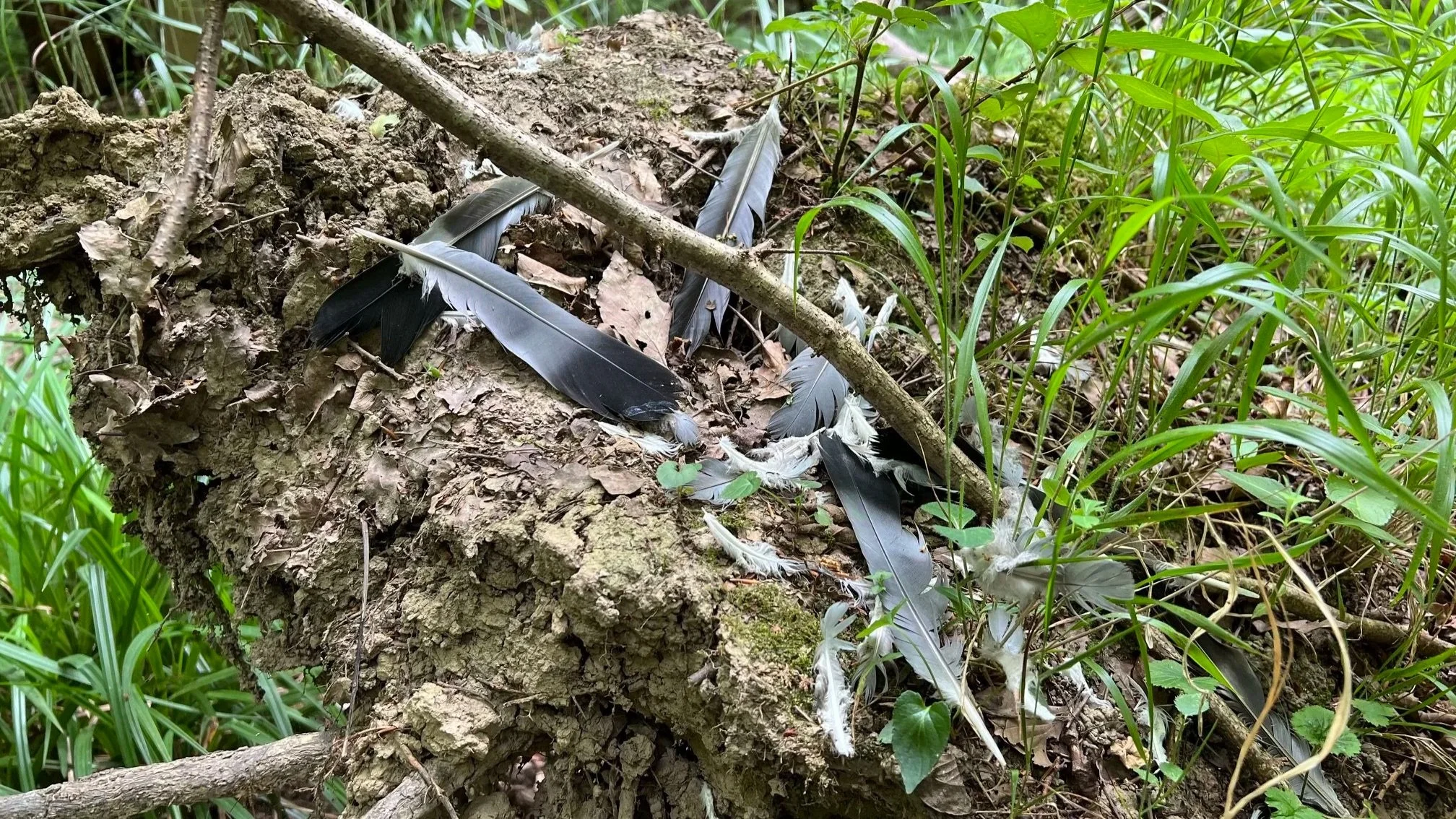
There is a scatter of pigeon feathers on a tree stump. Some of the larger flight feathers lie together, while smaller body feathers and down are caught through the surrounding grass. There is no carcass.
“What killed it? “ That is probably the first question most of us would ask. I know I have. But it isn’t necessarily the best place to begin.
Before deciding whether a fox, sparrowhawk, goshawk, cat or something else was responsible, I want to know what actually happened at this spot. Was the pigeon killed here? Was it carried here after being caught elsewhere? Were its feathers plucked or bitten off? Was it eaten by the animal that killed it, or did another animal arrive later and scavenge the remains? We may not even be looking at evidence created by one animal.
That is what makes wildlife kill sites, feather piles and other prey remains so interesting. They look like puzzles with a neat solution, but the evidence is usually messier.
The aim shouldn’t be to name the predator as quickly as possible…..it should be to reconstruct what most likely happened, while remaining clear about what the evidence cannot tell us.
Is It Actually a Kill Site?
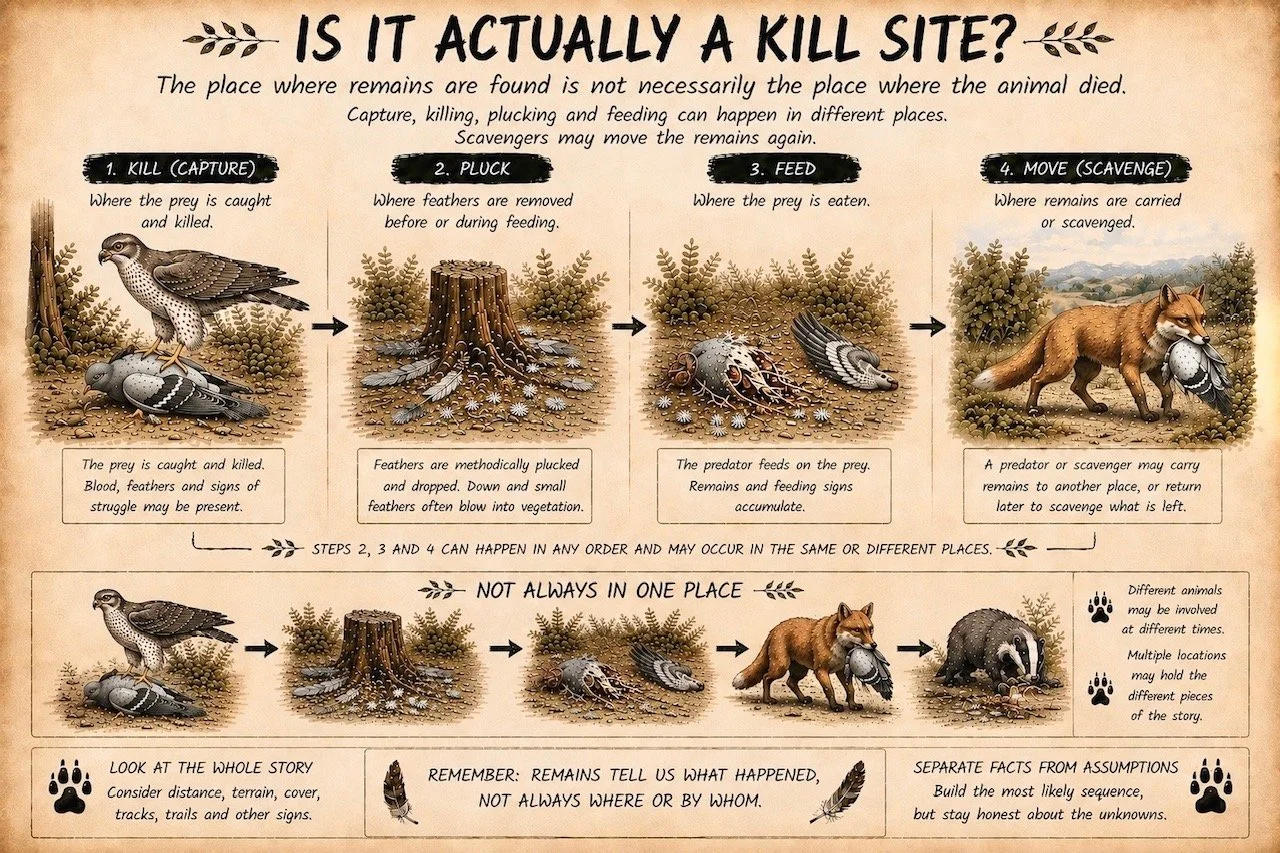
The phrase kill site is useful, but it contains an assumption. Finding feathers, fur or part of a carcass tells us that something happened at that location. It doesn’t necessarily tell us that the prey died there. A predator may kill an animal in one place and carry it somewhere safer to feed. A bird of prey may move prey to a plucking site. A fox may carry a carcass or part of one away. A scavenger can move the remains again. Remains may also accumulate near dens, burrows and resting places, particularly where food is carried away from the original capture site.
It therefore helps to distinguish between a kill site, where there is reasonable evidence that the prey actually died, a feeding site, where an animal consumed prey regardless of where it died, and a plucking site, where feathers were removed. Sometimes all we can safely say is that we have found prey remains of uncertain origin. Feeding evidence can take many forms, and not all remains indicate predation. My guide to wildlife feeding signs looks at the wider clues animals leave when eating.
These categories can overlap. A raptor might catch, kill, pluck and eat a bird within a small area. In another case, those stages could happen in several different places. So begin with one important principle:
The place where you find the remains is not necessarily the place where the animal died.
Stop Before You Walk Into the Evidence
If we were standing a few metres from that pigeon-feather pile, I wouldn’t immediately walk over and pick something up. First, look at the whole scene.
Take a photograph before disturbing anything. Then look at how the remains are distributed. Is there one dense concentration or several? Is a carcass present? Can you see blood, drag marks or disturbed vegetation? Does an obvious animal trail approach the site? Is there mud or another soft substrate nearby that might preserve tracks?
Look above you as well. Are you beneath a substantial branch, stump, fence post or other feature that might have been used while prey was being processed?
Then widen the search. Sometimes the strongest evidence isn’t in the feather pile at all.
Identify the Prey Before the Predator
Establishing what was eaten should come before deciding what ate it.
Sometimes identification is straightforward. Large grey flight feathers may clearly point towards a pigeon. A rabbit foot or distinctive patch of fur can be equally recognisable.
Even a broad identification helps. Knowing that the prey was a small passerine, pigeon-sized bird or rabbit-sized mammal immediately changes the range of plausible predators and scavengers.
If enough remains survive, ask what else can be established. Was the animal adult or juvenile? Which body parts remain? Are we definitely looking at one individual?
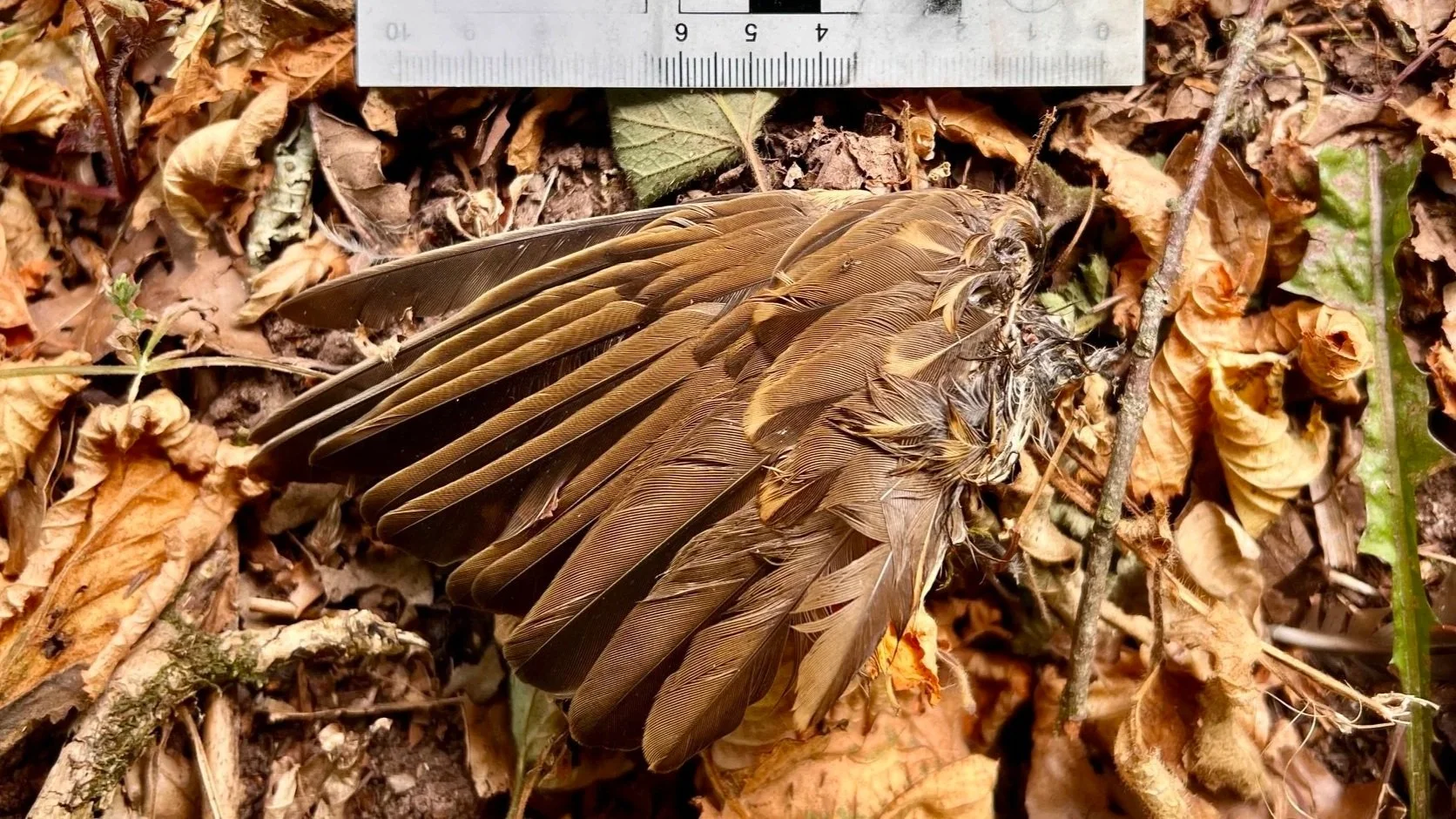
Retained body parts can help identify the prey. Photographing them with a scale also preserves useful size information before anything is disturbed.
That last question matters at repeatedly used feeding or plucking sites. Feathers weather at different rates, wind redistributes them and fresh remains can accumulate among older ones. A pile of feathers does not automatically represent one event.
Plucked, Bitten or Chewed?
Feathers can provide some of the most useful evidence at a bird predation site, particularly when the carcass has disappeared. One distinction worth examining is between feathers that appear to have been pulled or plucked and those showing repeated biting, crushing or chewing damage.
A feather removed comparatively cleanly may retain an intact shaft and quill. Raptors commonly pluck feathers from bird prey while processing and feeding. Mammalian feeding can leave different evidence. Shafts may be bitten through, crushed or badly damaged as the animal grips and tears at the bird.
It would be convenient if the distinction were diagnostic. It isn’t.
A damaged feather does not automatically prove mammalian predation, and an intact feather does not prove a raptor removed it. Feathers can break during capture, transport and feeding, and may be damaged later by scavengers, trampling or weather. Treat the condition as evidence rather than an answer.
Cleanly removed feathers make plucking worth considering. Repeated crushed or chewed shafts make mammalian feeding worth considering. Then look for corroboration.
Look Closely at the Quill
If I could choose one part of a feather to photograph carefully, it would often be the base.
Lay several representative feathers beside a scale and examine the shafts. Are they intact? Have they been cut or crushed? Are the ends frayed or twisted? Is tissue attached?
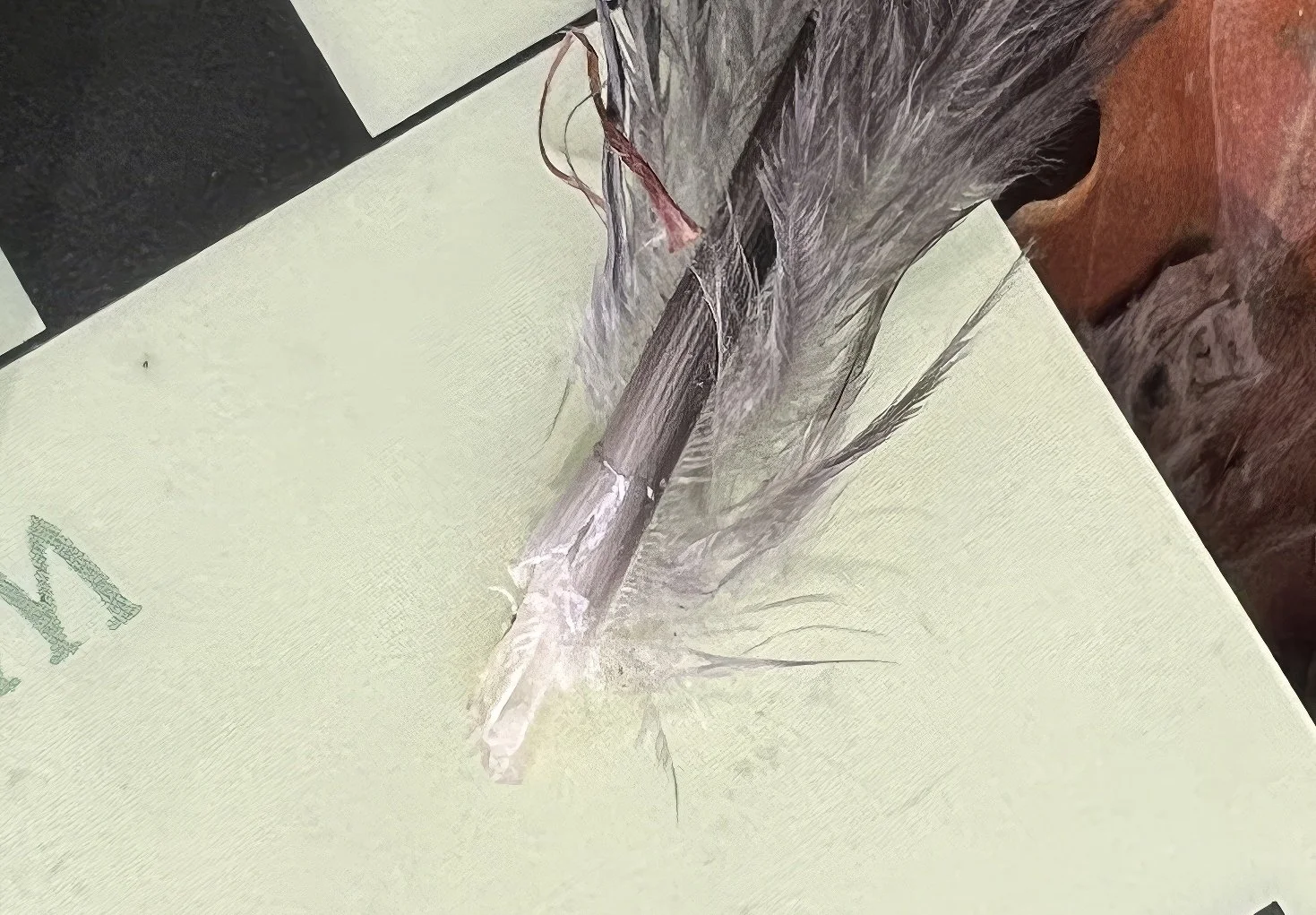
Close-up of a damaged grey bird feather quill with matted down and tissue beside a measuring card.
More importantly, do several feathers show the same kind of damage? One crushed feather among fifty may mean very little. Repeatedly finding similar damage across several feathers is much more interesting.
I recently examined a pigeon-feather site in the Wye Valley where several quills showed obvious crushing and chewing rather than simply appearing to have been pulled free. The down around the remains was also clumped and appeared wet or saliva-matted. Taken together, those observations pushed my interpretation towards mammalian feeding.
Notice that I said feeding, not killing.
The physical evidence supported a mammal having fed on the pigeon. Who originally caught it remained a separate question.
A Second Pigeon Told a Different Story
That distinction was particularly useful because I had examined another pigeon-feather site not long before. The evidence there looked quite different.
Numerous feathers had been removed, including larger flight feathers and smaller body feathers, but the shafts did not show the same repeated crushing and chewing. The overall impression was much more consistent with systematic plucking.
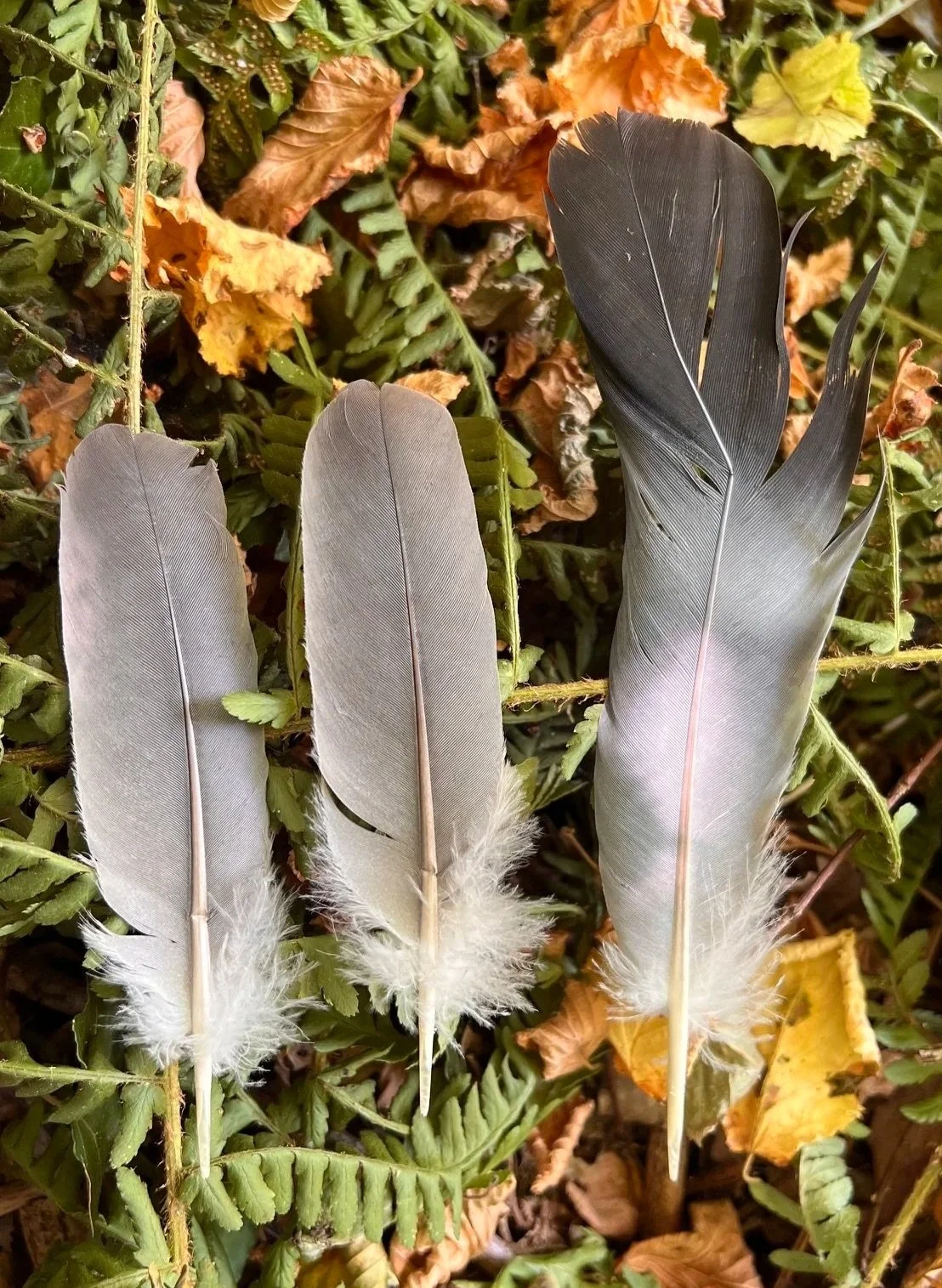
At the second pigeon site, several feathers retained comparatively intact shafts and quills. Repetition across multiple feathers made systematic plucking a stronger interpretation than it would have been from one feather alone. Note, both the feathers on the left show marks on the rachis (the quill) where they have been gripped, likely by a bird of prey’s beak, leaving a distinctive crease.
Raptor involvement therefore became the stronger hypothesis. Given the prey, habitat and nature of the remains, sparrowhawk was my leading possibility, with goshawk another plausible candidate. Even there, though, I would not turn that into:
“A sparrowhawk killed this pigeon here.” The narrower conclusion was much easier to defend:
“The feather evidence is more consistent with raptor plucking than mammalian feeding.”
To make the stronger claim, we would need to establish which predator was involved, that it killed rather than scavenged the pigeon, and that the kill occurred where the feathers were found. The remains alone could not answer all three questions.
That comparison between the two pigeon sites is useful because neither depends on memorising a checklist of predator signs. In both cases, the interpretation comes from asking what physical process best explains the damage we can actually see.
What Can Feather Distribution Tell You?
After examining individual feathers, stand back again.
A concentrated pile may suggest that prey was processed within a relatively small area. A broader scatter could reflect movement during feeding, later disturbance or simply wind. Look for several concentrations, a line of feathers leading away, grouped flight feathers, down caught in vegetation, or an isolated wing or body part some distance from the main scatter.
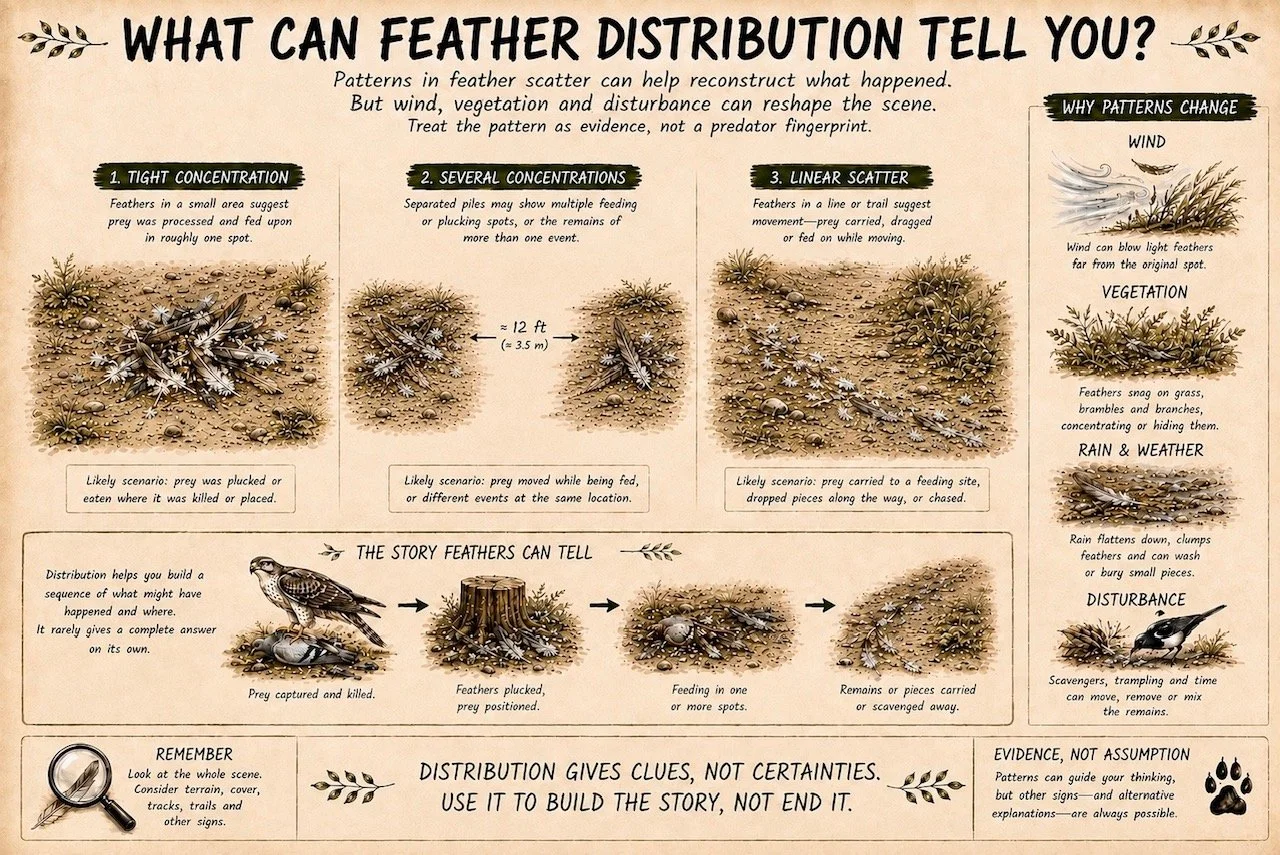
Feather distribution can help reconstruct movement and feeding, but wind, vegetation, weather and later disturbance can reshape the pattern.
But don’t turn those patterns into rigid predator rules. Large feathers and down respond differently to wind. Vegetation catches them. Rain flattens them. Other animals can disturb the site.
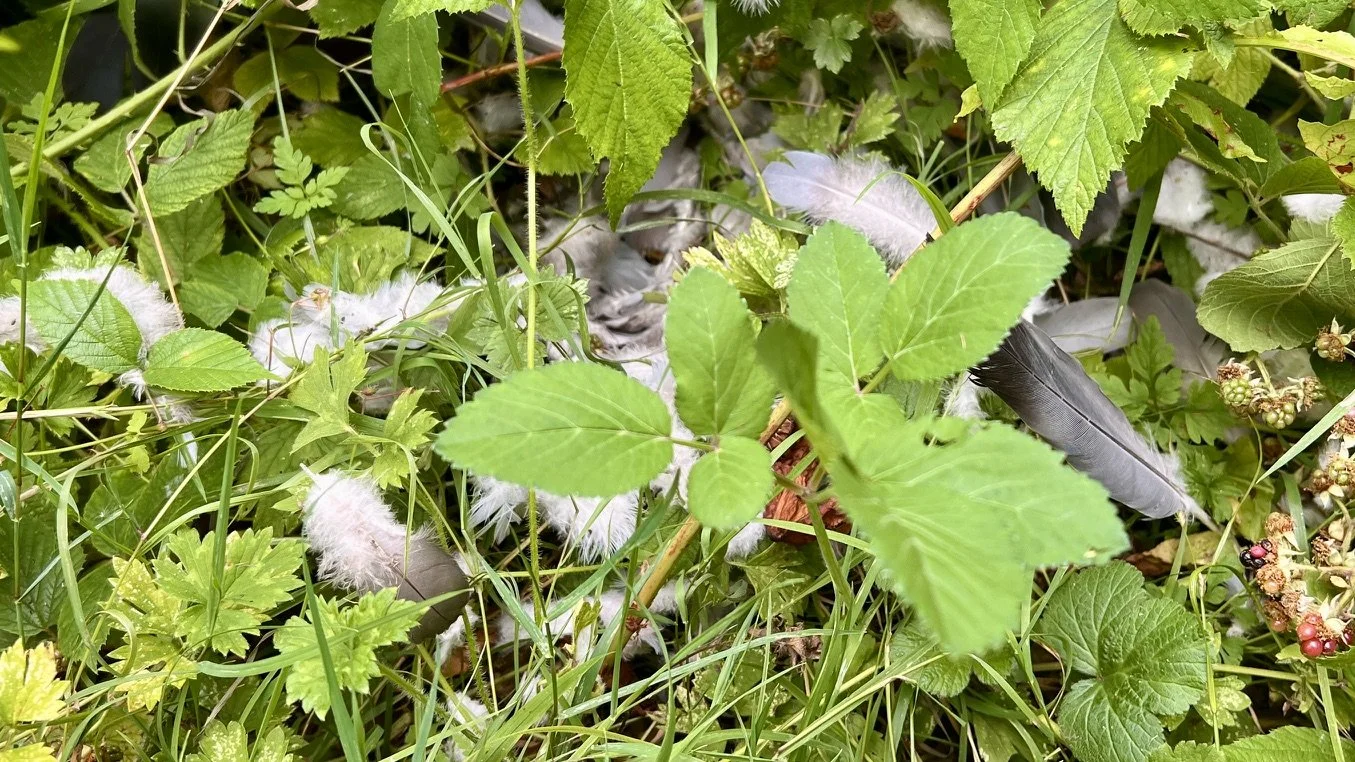
Vegetation can trap light body feathers and down, preserving them away from the main scatter and changing the pattern we see later
Instead ask:
“What sequence of events could have produced this distribution, and how much might have changed since then?”
The fresher the scene, the more confidence we can usually place in its spatial pattern.
What About Fur and Mammal Prey?
The same reasoning works when the prey is a mammal. A patch of rabbit fur tells us that something happened there, but not necessarily what.
Look at how concentrated the fur is and whether skin, feet, bone or other remains are present. Search for drag marks, disturbed vegetation and tracks nearby. If a carcass remains, record which parts have been eaten, whether skin has been removed or torn, whether bones are crushed, and whether the body has been moved, buried or cached.
These observations can support predator identification, but consumption patterns deserve caution. Hunger, prey size, disturbance and the age or experience of the predator can all affect feeding behaviour.
More importantly, scavengers can alter a carcass after the original predator has left.
By the time we discover it, the animal responsible for the most obvious damage may not be the animal that made the kill.
Search Beyond the Remains
It is easy to become hypnotised by the feather pile or carcass because it feels as though the answer should be sitting there. Quite often, I am more interested in the surrounding ground:
Where is the nearest mud?
Does an animal trail enter the site?
Is there a hedge gap nearby?
Are there tracks twenty metres away?
Has hair caught on a fence?
Is there scat?
A clear footprint associated with otherwise ambiguous feeding remains may tell you more than another ten minutes examining feathers. If you want to record them properly, I have a separate guide on how to read and photograph animal tracks.
This is where kill-site investigation joins the rest of wildlife tracking. The feathers are one category of sign. Tracks are another. Scat is another. Trails provide spatial context.
When several independent pieces of evidence point in the same direction, our interpretation becomes stronger.
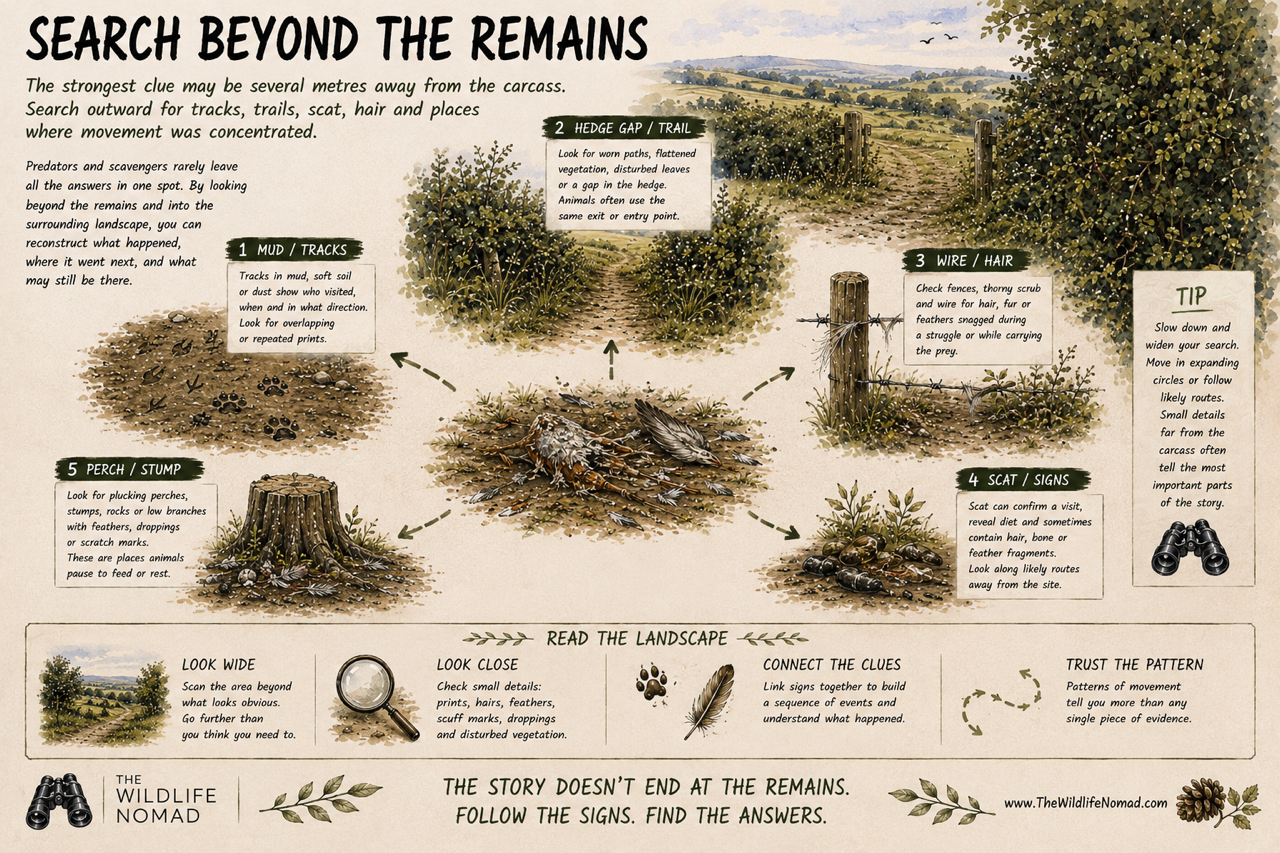
The strongest clue may lie away from the remains. Search outward for tracks, trails, hair, scat and places where animal movement is concentrated.
Scat Beside Prey Remains: Evidence of What?
Imagine finding mammalian scat beside a pile of chewed pigeon feathers. It feels compelling. Surely we have identified the predator?
Not necessarily.
At minimum, the scat establishes that the animal responsible for it visited the location. If it appears fresh and the feeding remains are similarly recent, an association becomes more plausible. But it still does not prove that the animal killed the prey.
Consider this sequence.
A raptor kills a pigeon and feeds on it. Later, a fox discovers the remains, feeds on what is left and deposits scat nearby. We now have evidence created by two predators at the same location. Alternatively, the fox may have killed the pigeon itself. Both sequences can potentially produce mammalian evidence beside bird remains. This possibility of multiple actors is one of the most important things to remember at any feeding site.
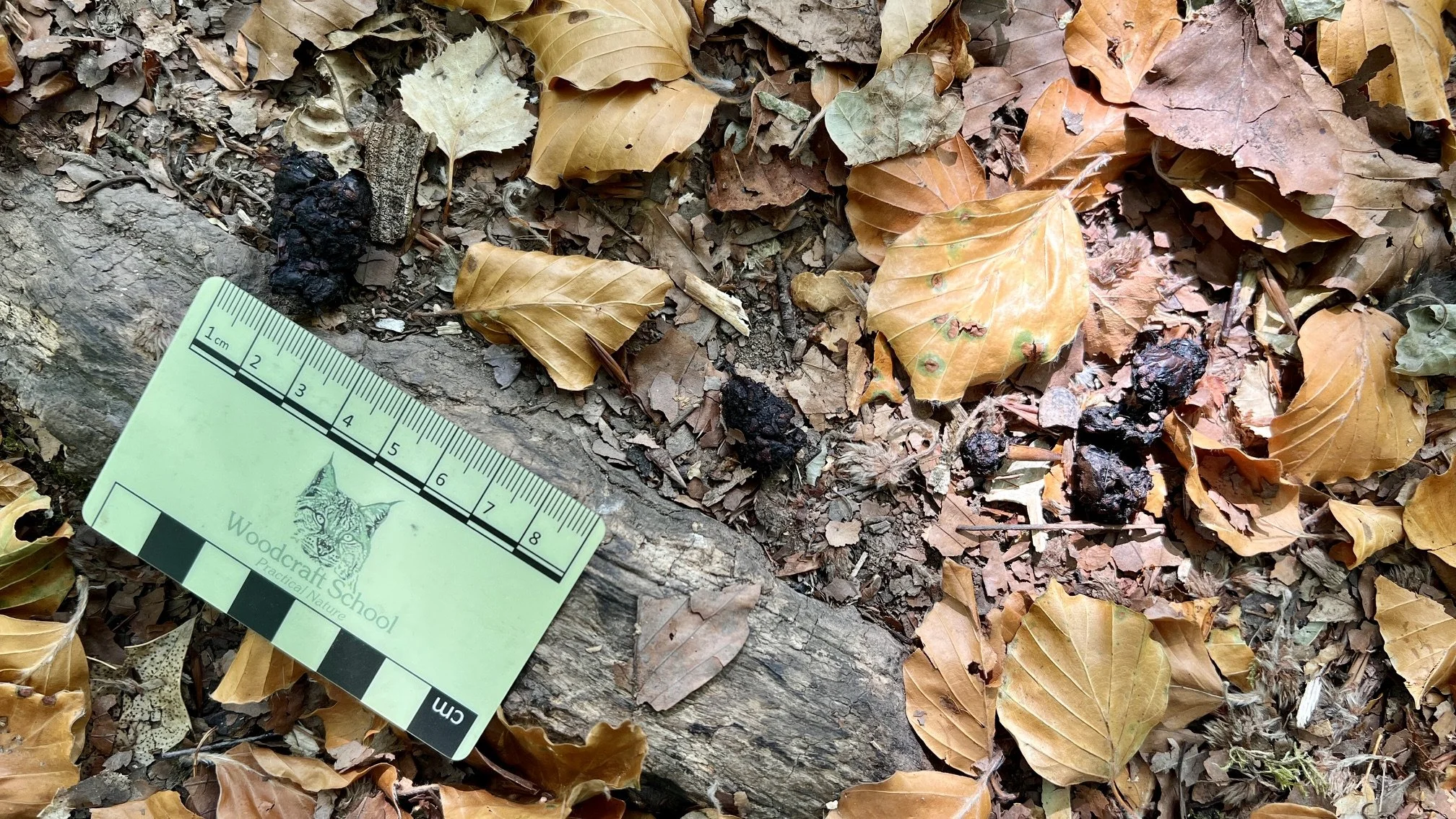
Associated sign can be more informative than the remains themselves. Scat beside feathers establishes that another animal visited the site, but not automatically that it made the kill.
Predator or Scavenger?
Scavenging complicates almost everything. Foxes, badgers, corvids and many other animals exploit carrion. Predators also scavenge prey killed by other predators. That means tracks beside a carcass do not automatically identify the killer. Look beyond the remains for tracks, compressed vegetation and animal trails and pathways that may show how the predator or scavenger approached and left the site.
Even trail-camera footage needs interpretation.
A camera recording a fox carrying away a dead pigeon establishes that the fox possessed the pigeon. Unless we recorded the capture, it does not necessarily establish that the fox killed it. That may sound unnecessarily cautious, but separating what we observed from what we infer is fundamental to good tracking.
Build More Than One Explanation
This is where wildlife detective work becomes particularly useful.
Suppose we have:
Pigeon feathers beneath a hedge
Several crushed quills
Saliva-matted down
Mammalian scat nearby
No complete carcass
No usable tracks
One explanation immediately presents itself: Hypothesis A: a mammalian predator killed and ate the pigeon here.
Now deliberately create alternatives:
Hypothesis B: another predator killed the pigeon and a mammal subsequently scavenged it.
Hypothesis C: the pigeon was killed elsewhere and a mammal carried the carcass or remains here to feed.
Then ask what each hypothesis predicts. Crushed feathers and saliva support mammalian feeding under all three explanations. They do not, by themselves, distinguish between them. That is useful. We have discovered exactly where the evidence stops. The purpose of competing hypotheses isn’t to make identification unnecessarily complicated. It prevents us from mistaking the first plausible explanation for the only plausible explanation.
Use Confidence Levels Rather Than Verdicts
I find four simple categories useful when recording sites like this:
Certain means directly observed or supported by genuinely diagnostic evidence.
Probable means several independent signs agree and competing explanations are less convincing.
Possible means the interpretation fits the evidence but reasonable alternatives remain.
Unknown means the evidence does not support a defensible conclusion.
Our chewed-pigeon example might therefore finish with: Mammalian feeding: probable, Fox involvement: possible, Identity of the original killer: unknown.
That tells us considerably more than simply recording “fox kill”……and there is nothing wrong with unknown.
Ten pigeon feathers beside a woodland path, with no carcass, usable tracks or meaningful shaft damage, may justify nothing more than:
Pigeon prey remains. Predator unknown…….that isn’t failed tracking, it is an accurate description of the evidence.
A Field Method for Investigating Wildlife Kill Sites
When you find feathers, fur or a carcass, working through the scene in the same order helps prevent the most obvious biases.
I use this sequence: Scene → Prey → Damage → Distribution → Associated Sign → Hypotheses
Start with the scene. Photograph everything before disturbing it and record the wider context.
Identify the prey as far as possible.
Examine the damage to feathers, fur, skin, bone or carcass.
Record the distribution of those remains rather than looking only at individual pieces.
Search for associated sign such as tracks, scat, hair, trails and disturbance.
Only then construct your hypotheses.
Before leaving, ask one final question:
“What evidence would change my mind?”
If you believe a raptor plucked the pigeon, would repeatedly crushed quills alter your interpretation? Would footage showing a fox carrying an intact pigeon into the site change it? Would discovering that the feathers actually represent several events undermine your reconstruction? If you cannot imagine evidence that would change your conclusion, you are no longer testing a hypothesis. You are defending a story.
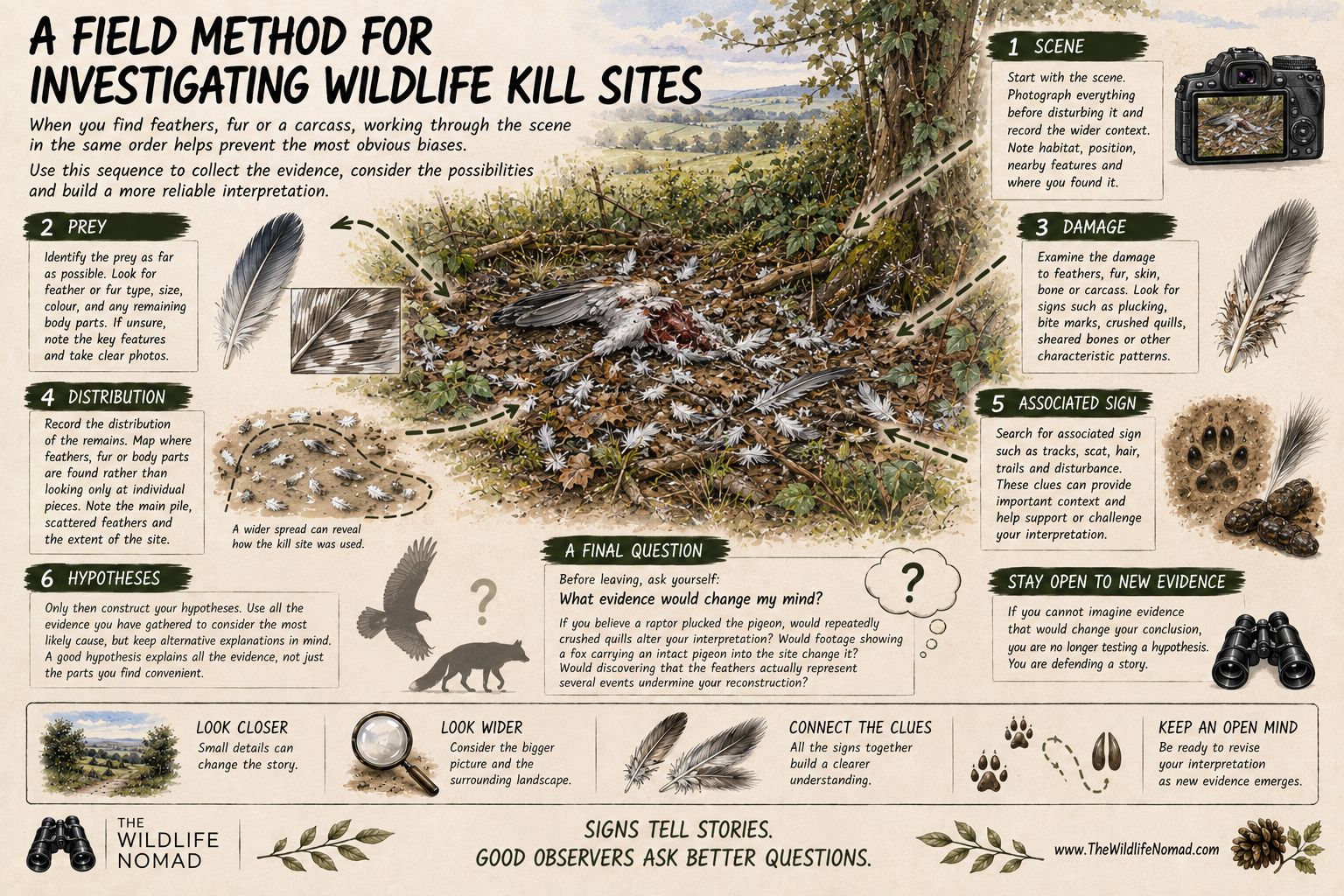
A field method for investigating a wildlife kill site: record the scene, prey, damage, distribution and associated signs before forming a hypothesis, then ask what evidence would change your mind.
When to Leave the Scene Alone
Most prey remains can be examined without interference, and there is often no reason to handle them at all.
Do not disturb a predator that is still feeding or approach an active nest, den, sett or resting place simply because remains occur nearby. Avoid unnecessary handling of dead wildlife, particularly where disease may be involved. If circumstances suggest possible wildlife crime rather than natural predation, the approach changes. Do not rearrange the scene or collect material simply to investigate it yourself. Record what you can without disturbing the site and report your concerns through the appropriate channels.
Knowing when not to investigate further is part of fieldcraft too.
The Real Question at a Wildlife Kill Site
Finding a pile of feathers naturally makes us want a name. Fox. Sparrowhawk. Goshawk. Cat.
Sometimes the evidence will strongly support one of those interpretations. Sometimes it won’t. Start instead with what is physically present:
What prey are we looking at?
How were the feathers, fur or carcass altered?
What happened at this location?
What tracks, scat or other signs occur around it?
Then build explanations that account for those observations.
Cleanly removed pigeon feathers may lead us towards raptor plucking. Crushed quills and saliva-matted down may indicate mammalian feeding. A fox print establishes fox presence. None automatically tells us the entire sequence. That is what makes these sites worth investigating.
The most interesting question is not always:
“What killed this animal?”
Often it is:
“What happened here, what evidence supports that interpretation, and what part of the story is still missing?”
Once you start asking that, a scatter of feathers becomes much more than the remains of a meal.
It becomes evidence.
Frequently Asked Questions
Why do I keep finding piles of pigeon feathers in my garden?
A concentrated feather pile usually means that a bird was processed or fed upon nearby, although it may have been killed elsewhere. Gardens can attract both avian and mammalian predators because bird feeders concentrate potential prey while hedges and other cover provide feeding opportunities. Examine feather damage and surrounding tracks or signs before assigning a predator.
Do sparrowhawks pluck their prey?
Sparrowhawks commonly remove feathers from bird prey before and during feeding, so a collection of comparatively intact feathers can be consistent with sparrowhawk predation. However, prey size, location, feather condition and associated evidence should be considered together. A pile of plucked feathers alone is not sufficient for certain identification.
What animal leaves bird wings behind after eating the rest?
Several predators and scavengers can leave wings and other less profitable parts of a bird behind, so isolated wings are not diagnostic of one species. Examine how they were detached and combine this with feather damage, tracks, scat and other evidence around the site.
Can foxes kill pigeons and other birds?
Yes. Foxes are opportunistic predators and can take birds when the opportunity arises, but they also readily scavenge birds killed by other causes. Finding fox tracks or scat beside pigeon remains therefore demonstrates fox presence more readily than it proves the fox made the kill. If fox is one possibility, nearby fox paw prints can strengthen the case, but tracks alone still do not prove that the fox made the kill.
What should I do if I find a dead bird or mammal with suspicious injuries?
Avoid unnecessarily moving or handling the remains and photograph the wider scene before anything is disturbed. If there are signs of deliberate persecution, poisoning or other suspicious circumstances, treat it as a potential wildlife-crime or animal-health issue rather than a tracking puzzle and report it through the appropriate authorities.
Explore More…..
Animal Trails & Wildlife Pathways: How to Read Them
Tracking After Rain: How to Read and Photograph Animal Tracks for Wildlife Photography and Watching
Reading the Nibbles: How to Identify Wildlife from Feeding Signs in the UK