

Animal Dens, Burrows and Resting Places: How to Read Where Mammals Shelter and Rest
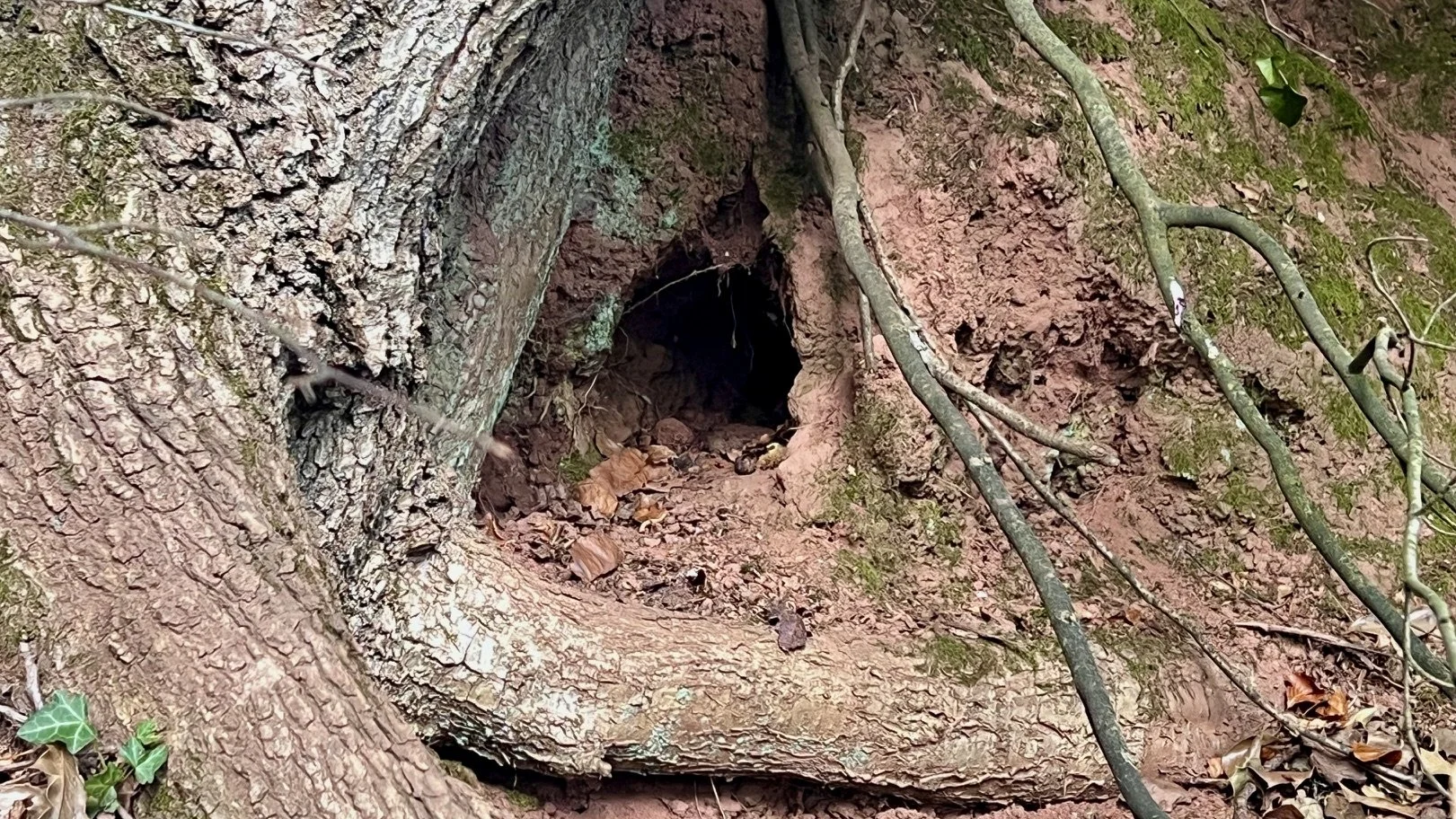
A cavity beneath tree roots may provide a ready-made refuge, but the entrance alone does not reveal which animal made it, uses it or what it does there.
You notice a flattened patch beneath the brambles. There is no hole or obvious structure, just an oval area where the vegetation looks more compressed than everything around it. A faint trail enters from one side.
Did an animal sleep here? Perhaps.
A little further along the same woodland edge there is something much more obvious: a broad entrance disappearing beneath exposed roots, with bare soil outside and a worn path leading towards it. What animal made that hole, and is it still using it?
At first glance these seem like different wildlife-sign problems. One is a possible resting place above ground; the other an underground refuge. In practice, I would investigate both in much the same way. If you’re trying to identify what animal made a hole or is using a burrow, the entrance gives you a starting point, but the tracks, spoil, hair, bedding and trails around it will usually get you much closer to the answer. The same applies above ground. The shape of flattened vegetation may suggest a resting animal, but it is the associated evidence that begins to tell us what actually happened there.
So whether we are looking at a badger sett, rabbit warren, deer bed, fox lie or possible otter couch, the first job isn’t to name it……..it is to read the place.
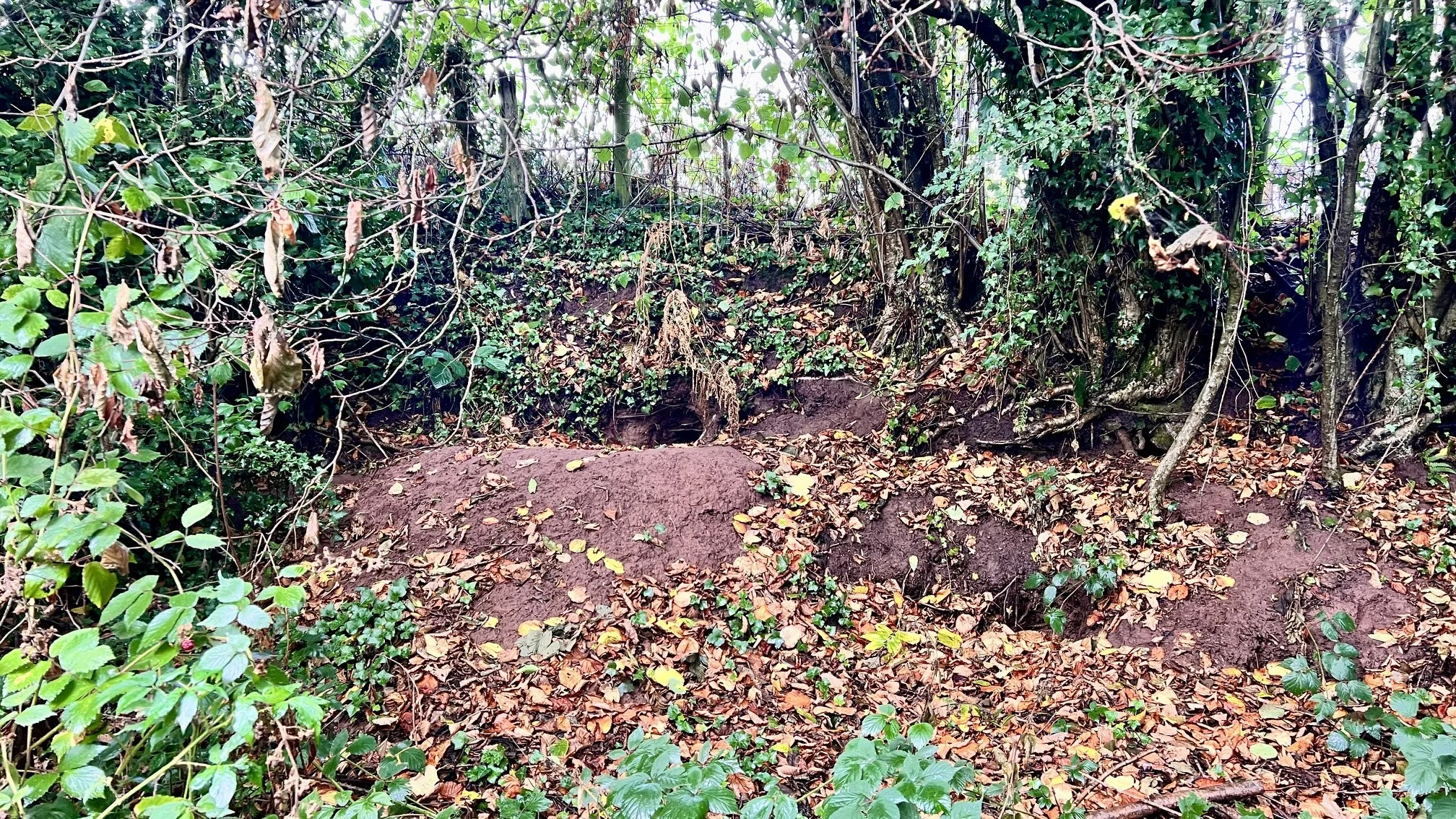
A resting site is rarely just an entrance. Step back first and look at the surrounding slope, cover, spoil, routes and other openings before deciding what you are looking at.
What Counts as an Animal Resting Place?
It is easy to think of an animal’s resting place as somewhere permanent. Wild mammals are rarely that obliging.
Badgers may use substantial underground sett systems. Rabbits create warrens. Foxes can use earths, but may also lie above ground in secluded cover. Deer can leave little more than a compressed patch of vegetation. Otters use enclosed holts but can also rest above ground among dense bankside vegetation.
There are also existing cavities beneath roots, rocks, fallen trees and human structures that animals may investigate or use without having excavated them.
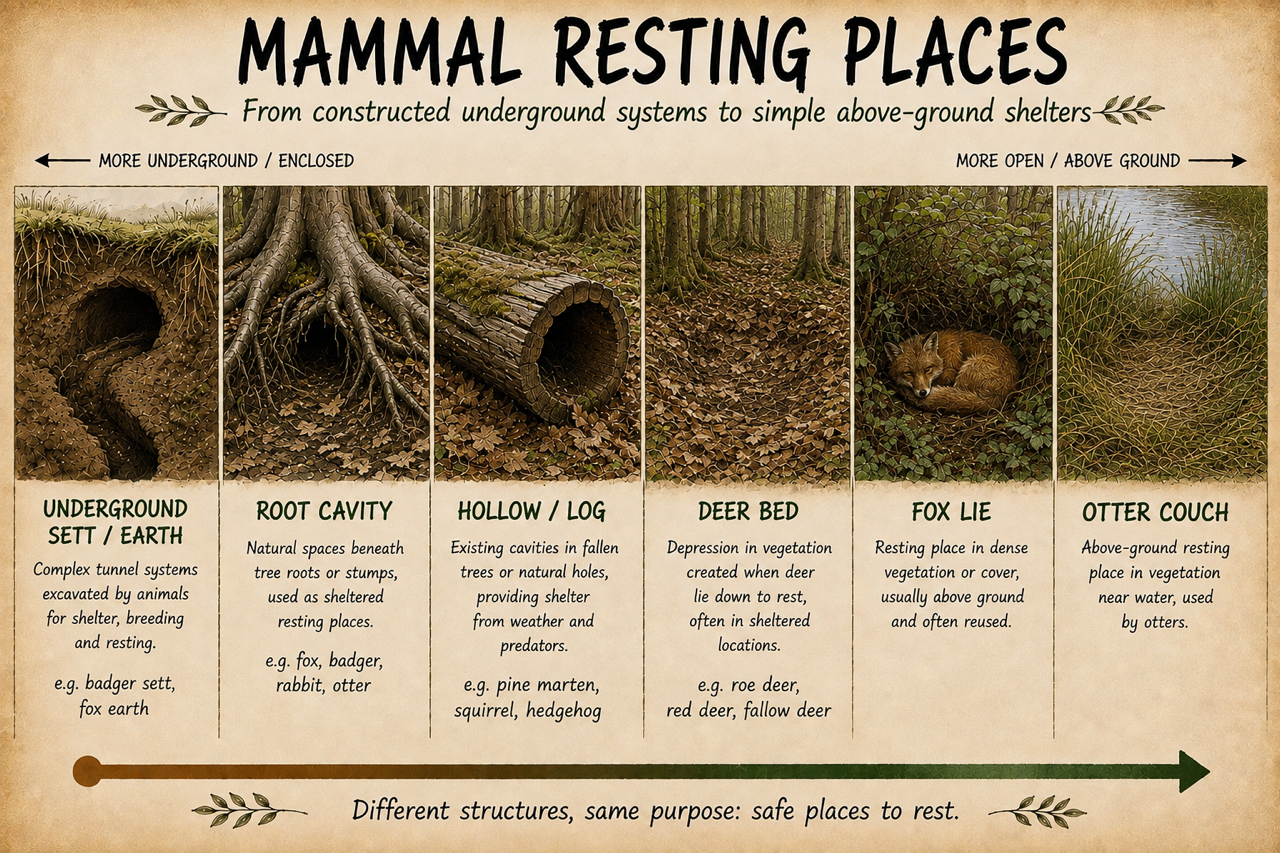
The structures are very different, but the field problem is essentially the same:
What evidence shows how this particular place is being used?
Finding an animal’s track at a burrow proves presence more readily than residence. A fox may investigate a rabbit warren. An otter can pass through dense vegetation without lying up there. A deer may walk across a depression created during an earlier visit.
I find it useful to keep three questions separate:
Was the animal here?
Is it repeatedly using this place?
What was it actually doing here?
Sometimes the first question is easy and the third remains unanswered, that is perfectly acceptable.
Start With the Place, Not the Bed or Burrow
If we were standing beside either of those sites, I would spend a moment looking around before approaching.
Where are we?
Is the feature on a dry woodland slope, beneath a hedge, beside water, inside dense bramble or among long grass? Is it sheltered or exposed? Are there obvious animal trails nearby? Does the site sit between feeding habitat and thicker cover?
For a burrow, the surrounding ground may tell us something about drainage, soil and how the site connects with other habitat. For a possible surface bed or lie, dense cover, shelter, dry ground or several routes away may make the location plausible as somewhere an animal could rest.
But plausible is the important word. A sheltered position does not prove that an animal selected it for shelter. A deer bed close to feeding habitat does not demonstrate that proximity to food was why the deer lay there. The site gives us context and possible explanations, but the physical signs still have to establish use.
Did the Animal Pass Through, or Did It Actually Rest?
This is one of the most useful distinctions with above-ground sites.
A trail shows movement. To infer resting, I want evidence that movement stopped and became concentrated in one place.
Look at the shape of the disturbance, passage often produces something roughly linear:
Entry → Movement through → Exit
Resting may produce:
Entry → Localised compression or disturbance → Exit
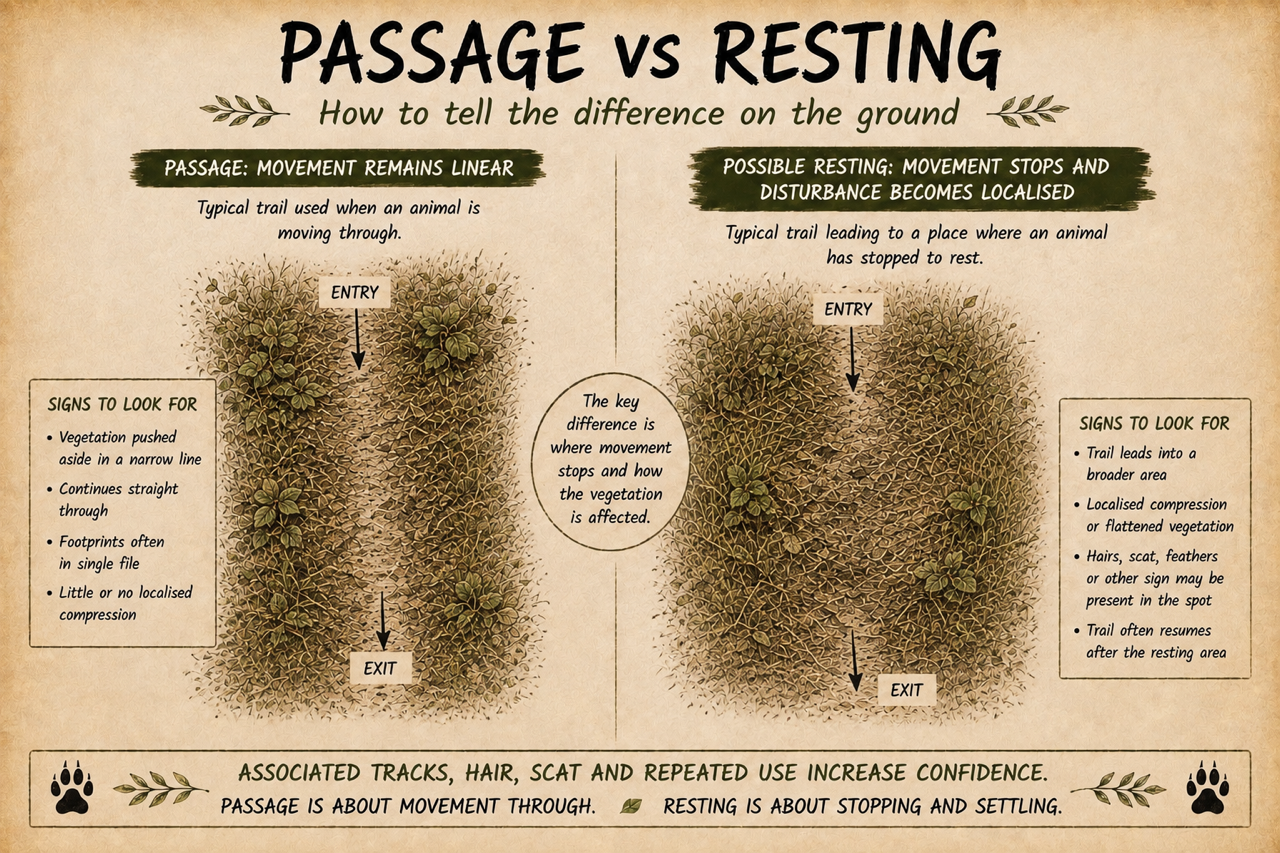
Imagine a narrow trail beneath bramble. Stems are pushed aside along its length and the route continues out the other side. That is good evidence of passage. Now imagine the trail reaches a broader oval patch where vegetation is pressed down over roughly the area an animal’s body might occupy. Several hairs occur among the flattened stems and the obvious route effectively terminates there. Resting becomes a reasonable hypothesis.
Notice that even now the evidence has not necessarily told us which animal rested there. We may have strengthened our interpretation of what happened before establishing who was responsible. That distinction is useful.
What Does an Above-Ground Resting Place Look Like?
Sometimes there is surprisingly little to see. Grass may be flattened into a shallow depression. Bracken can be compressed. Leaf litter may have been pushed aside or compacted. Beneath dense vegetation there may simply be a patch that looks smoother than the surrounding ground.
Flattened vegetation alone is weak evidence.
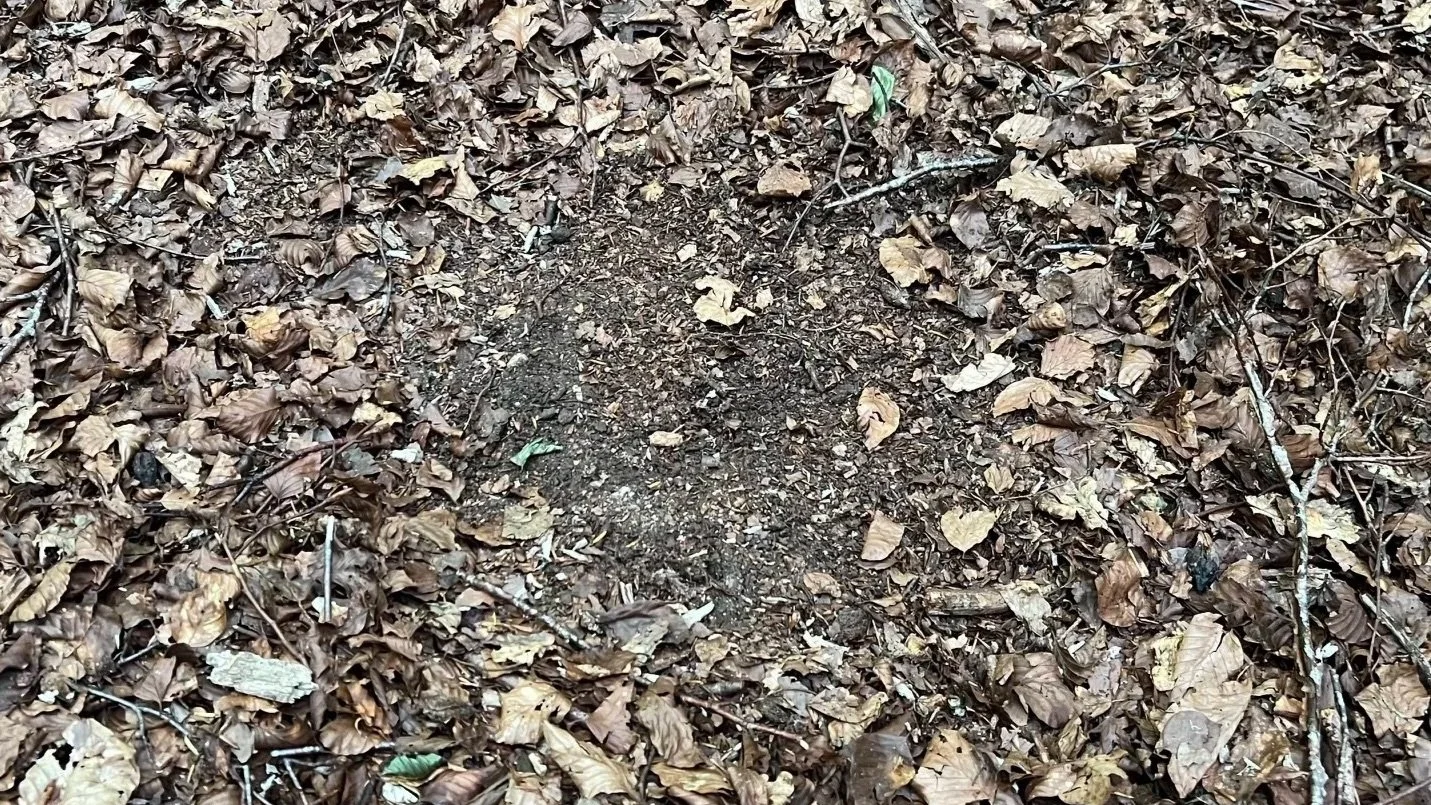
A possible mammal bed in woodland leaf litter. The localised compression is worth investigating, but the depression alone identifies neither the species nor its function. Look for tracks, hair, droppings and evidence of repeated use.
Wind, livestock, dogs, people and fallen branches can all produce disturbance. So once you find a possible bed or lie, work outward:
Is there a trail approaching it?
Are identifiable footprints present?
Is hair lying within the compressed area?
Are droppings nearby?
Are there several similar features?
….. and can you establish that the animal associated with those signs stopped there rather than simply passed through?
That last question prevents a lot of wishful identification.
Reading Deer Beds
Deer provide one of the clearest opportunities to practise this. When a deer lies down, its body may compress grass, bracken or leaf litter into a roughly body-sized depression. Sometimes the outline is obvious. At other sites there is little more than an oval patch where the vegetation lies differently. If we found one together, I would look around the edges before calling it a deer bed.
Are deer slots present on the approach or immediately beside it? Is hair embedded within the compressed vegetation? Are droppings nearby? Are there other similarly sized depressions? One flattened patch remains ambiguous. Several body-sized depressions associated with convincing deer sign make bedding much more plausible, although they could represent several animals, repeated visits or a mixture of both.
Only after establishing the bed would I begin asking why deer might be resting there. Perhaps it is sheltered, perhaps it lies just inside cover near feeding ground. Those are behavioural hypotheses. The bed itself tells us something simpler: a deer probably stopped and lay here.
Understanding why may require repeated observation.
Otter Holts, Couches and Lay-ups
Otters are particularly useful because their resting sites challenge the assumption that a mammal refuge must be a hole.
An otter may use an enclosed holt beneath roots, within a bank or in another sheltered cavity. It can also rest above ground in dense vegetation at sites commonly described in ecological fieldwork as couches or lay-ups.
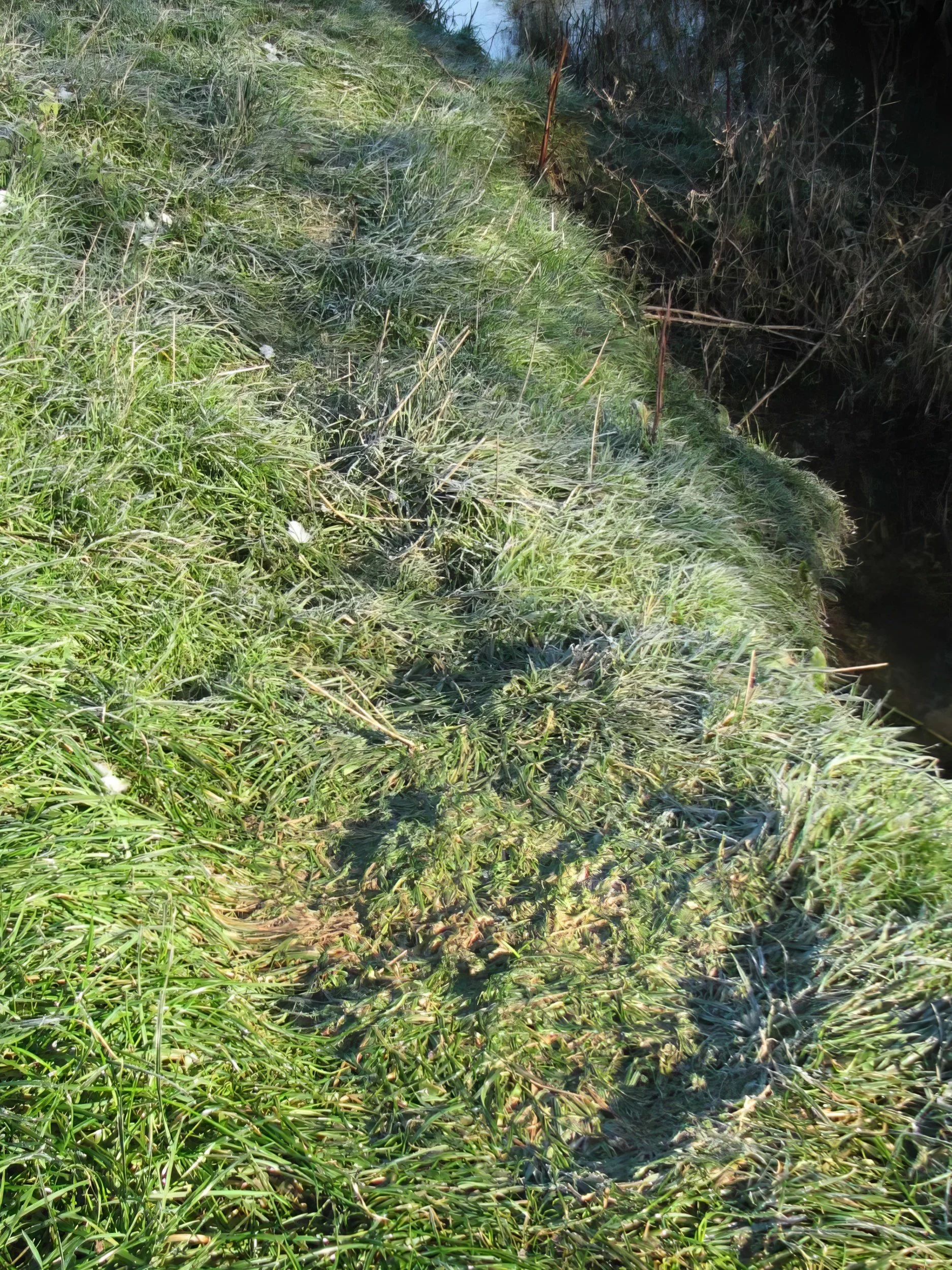
An otter couch can be little more than a locally flattened resting place close to water. Its position and associated signs matter more than any neat, diagnostic shape. Photograph courtesy of Robin Lewis, Severn Otter Project.
Terminology varies slightly between sources and survey practice, so I would not become too rigid about the label. What matters in the field is recognising that an otter resting place can be above ground as well as enclosed underground.
Suppose we find flattened vegetation beside a river, that does not establish an otter couch. Now suppose a recognised otter route enters the same patch, footprints occur on nearby mud and spraint is present elsewhere along the route. We now have good evidence that otters use this part of the bank. The localised compressed area gives us a further reason to consider resting. Tracks and spraint establish otter presence more securely than they establish that this particular depression was used as a couch. Several independent clues need to agree before I would become confident about its function.
There is also a legal reason not to push the investigation too far.
Otters are European protected species. In England and Wales it is an offence to damage or destroy an otter breeding site or resting place, including when the animal is not actually present. Otters also receive protection against certain forms of disturbance and obstruction of access to places used for shelter or protection.
Crucially, that protection is not confined to an obvious underground holt. If the evidence begins to suggest that dense bankside vegetation contains an active otter resting place, pushing into it simply to obtain a better photograph or confirmation is exactly the wrong approach.
Fox Lies: Where Confidence Is Harder
Foxes provide a useful contrast because an above-ground resting place can be difficult to establish from signs alone.
A fox does not need to spend every resting period underground in an earth. Dense, secluded vegetation may also be used for resting. But suppose we find a fox trail disappearing beneath bramble and flattened vegetation beyond it. What have we actually established?
Fox presence along the route may be strong if we have good footprints or other sign. The flattened patch gives us a possible resting site. Even finding fox hair there strengthens the association between the fox and the place more readily than it proves resting. To become substantially more confident about a lie, I would want a distinct area consistent with the body having settled there, repeated evidence of use, or ideally direct observation or trail-camera footage showing the animal lying down.
Without that, possible fox resting place is a perfectly respectable conclusion.
Underground Refuges: Start Outside the Entrance
Now return to the broad hole beneath the roots.
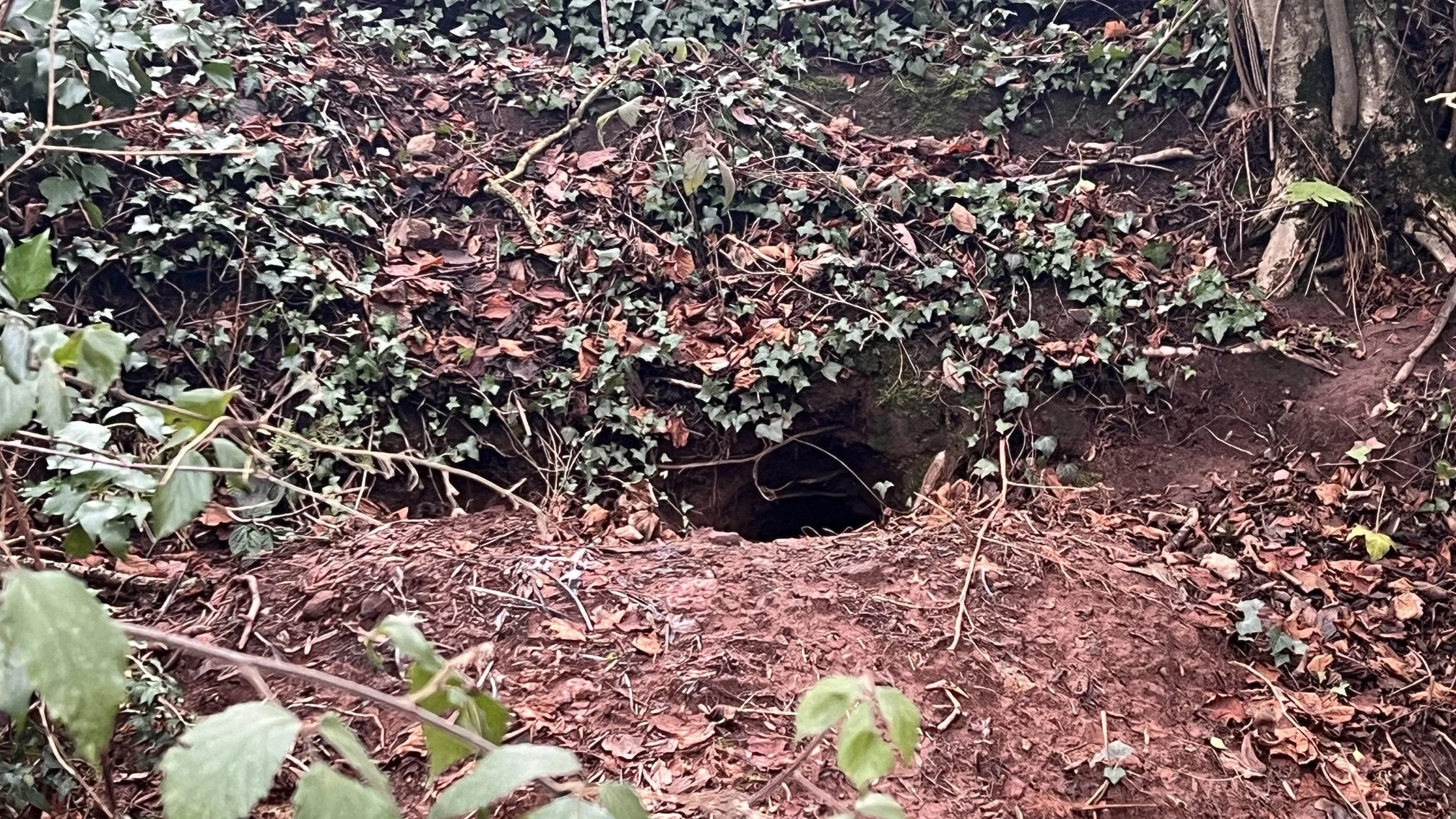
Tree roots and established banks can provide structure around an underground entrance. The setting is informative, but associated signs are still needed before assigning a species.
Underground structures appear more identifiable because we have something obvious to measure. That can be misleading.
A hole might form part of a badger sett, fox earth or rabbit warren. It could also be an older structure subsequently investigated or used by another species. Roots, erosion and collapsed ground can produce cavities that look surprisingly convincing. So before identifying the occupant, look around the entrance.
Is there a trail approaching it?
Is the threshold polished or compacted?
Is spoil present?
Can you find tracks, hair, bedding or droppings?
Are there other entrances nearby?
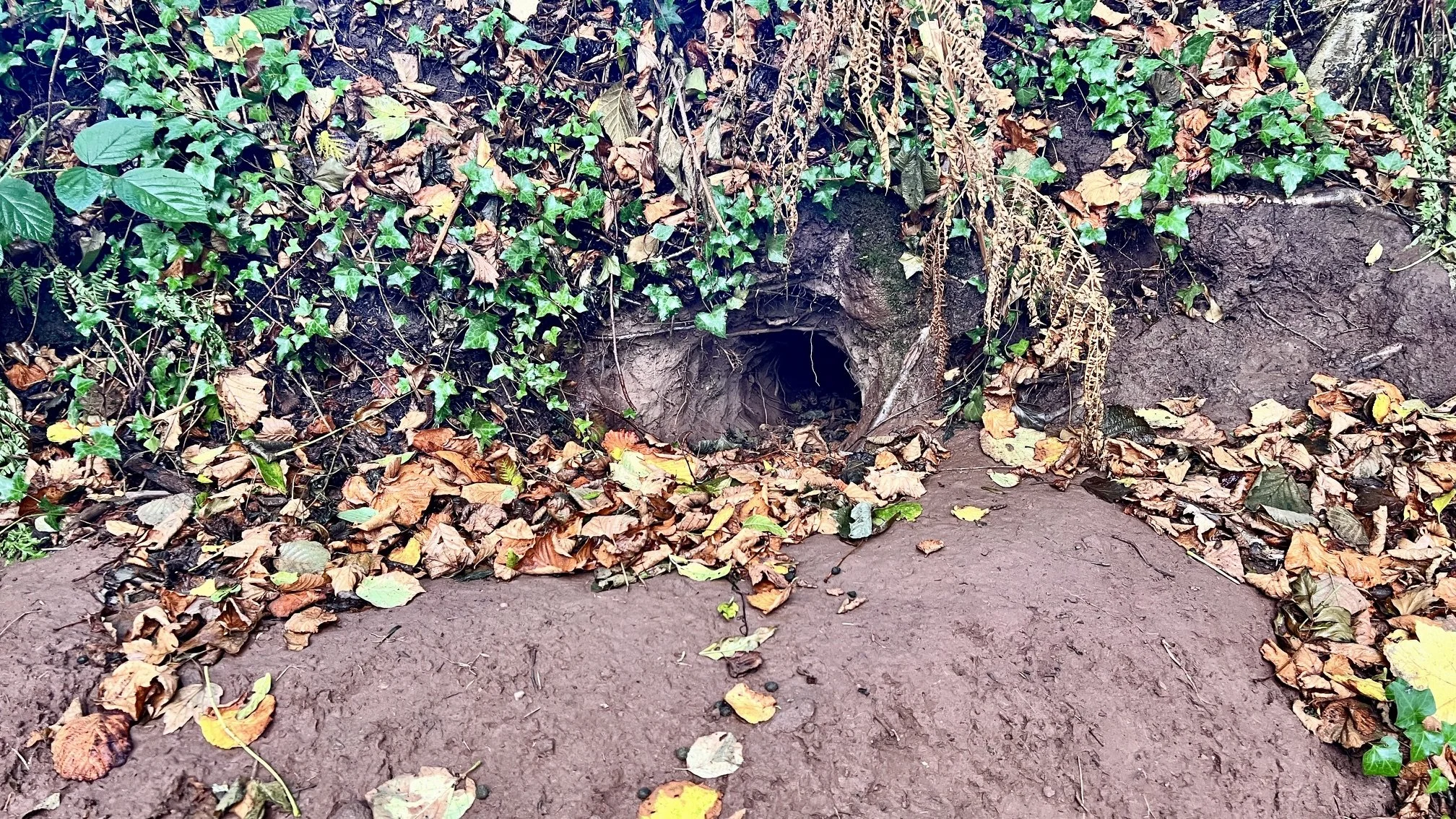
Describe first, identify later: entrance profile, excavated spoil and the worn route through it are all observations. None needs a species name attached yet.
Size is still useful, particularly at the extremes. A hole only a few centimetres across and an entrance approaching 25 centimetres clearly suggest very different-sized animals. The problem comes once plausible species overlap. Then a few centimetres of entrance width can easily be outweighed by soil collapse, enlargement, roots or reuse by another animal.
Measure width and height when useful, but treat those measurements as one line of evidence rather than an identification key. A broad, flattened entrance is compatible with badger use. It becomes persuasive evidence of a badger sett only when other signs support the interpretation.
Spoil, Hair, Tracks and Bedding
If we’re standing beside a possible burrow, I would probably spend more time looking around the entrance than staring into it.
Fresh excavation may leave spoil.
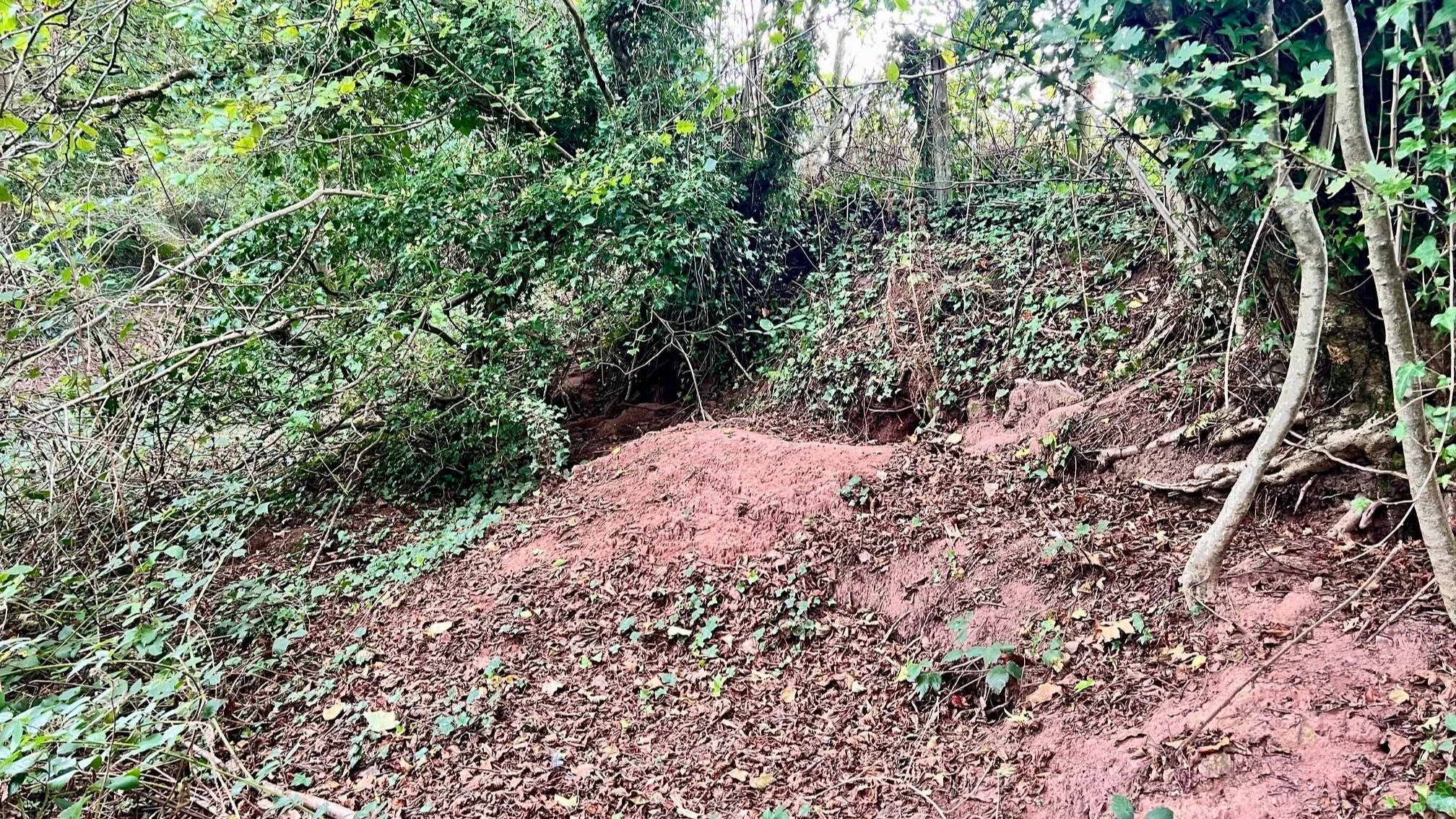
Excavated material can extend surprisingly far from an entrance. Fresh-looking spoil may indicate recent digging, but excavation alone does not establish current occupancy.
Rather than deciding that soil “looks two days old”, look for relationships that establish sequence:
Does loose earth lie over recently fallen leaves?
Are roots freshly broken?
Are footprints impressed into the new spoil?
Then look at places an animal has little choice but to touch. Exposed roots, brambles and low wire can collect hair when an animal repeatedly squeezes past. Tracks may be clearer further along the approach route than immediately outside a busy entrance, where repeated traffic has churned the ground.
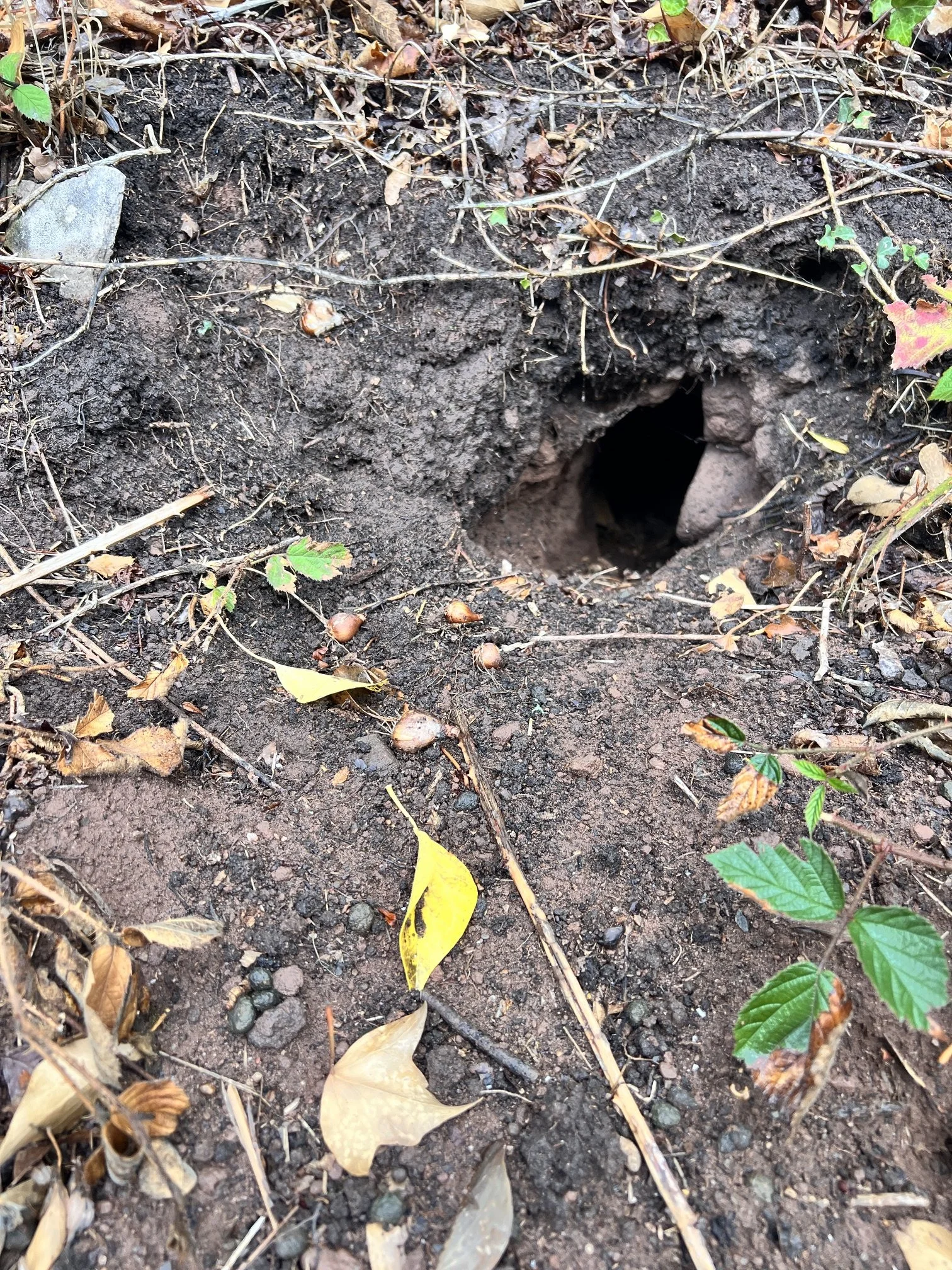
Associated sign deserves the same caution as the entrance. Droppings beside a hole show that an animal used this patch of ground; they do not automatically identify the animal that excavated or occupies the structure.
Bedding can also contribute to the picture around badger setts.
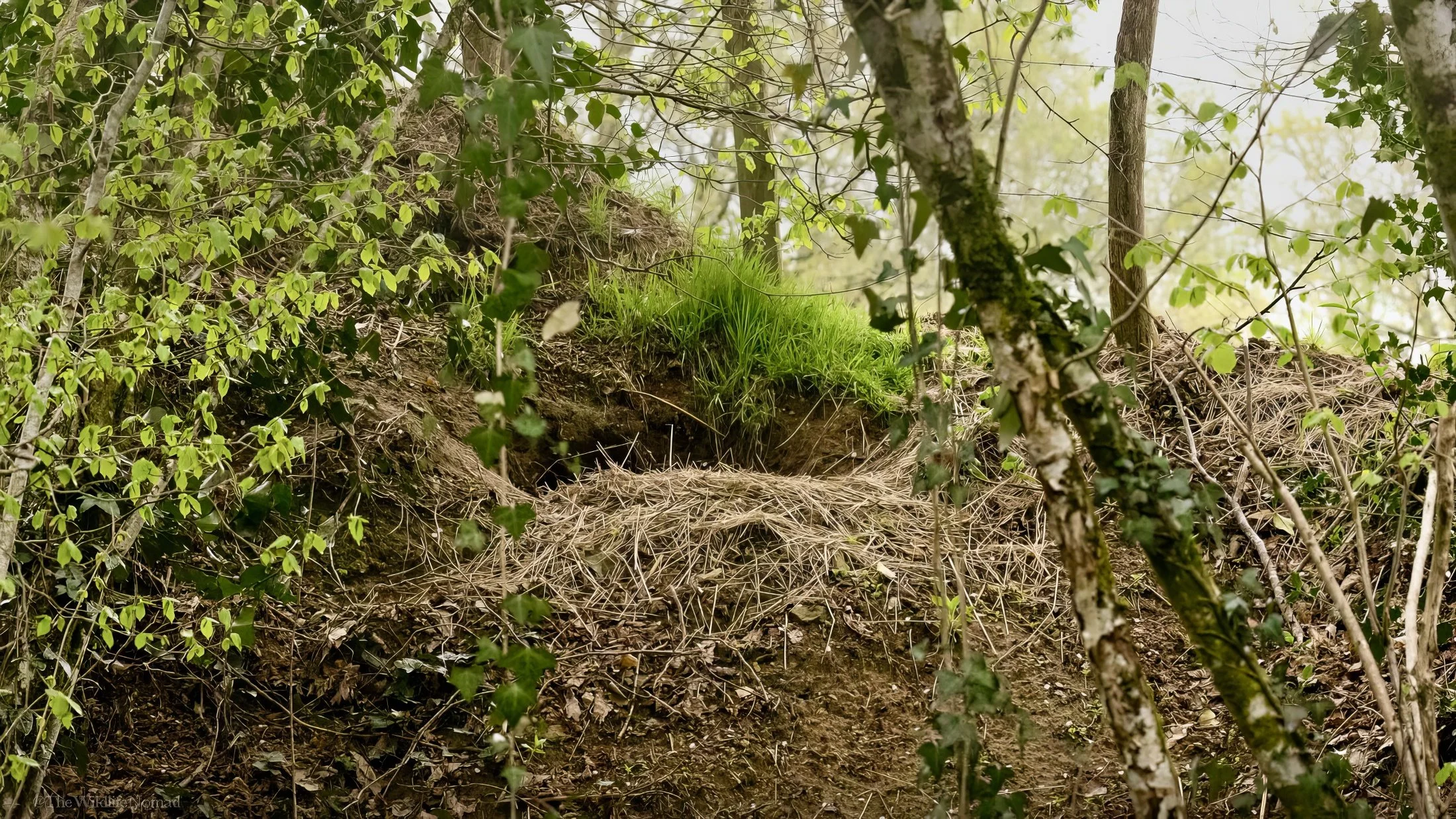
Bedding material can be more informative than the entrance itself. Record what is present and whether it appears newly moved before deciding what it tells you about recent use.
Current government guidance lists signs such as fresh bedding, footprints, well-used runs, clear entrances and spoil when assessing current badger use. Fresh bedding strengthens the interpretation, especially when several other signs agree. It should not carry the identification alone.
Think in combinations. Suitable entrance + badger tracks + characteristic hair + spoil + bedding + well-used approaches is a very different proposition from: large hole.
One Hole or a Larger Site?
Before deciding what you have found, step back again. Is this really one isolated entrance? Search the surrounding bank and vegetation:
Are there other holes?
Do trails connect them?
Are some entrances clear while others are partly obscured?
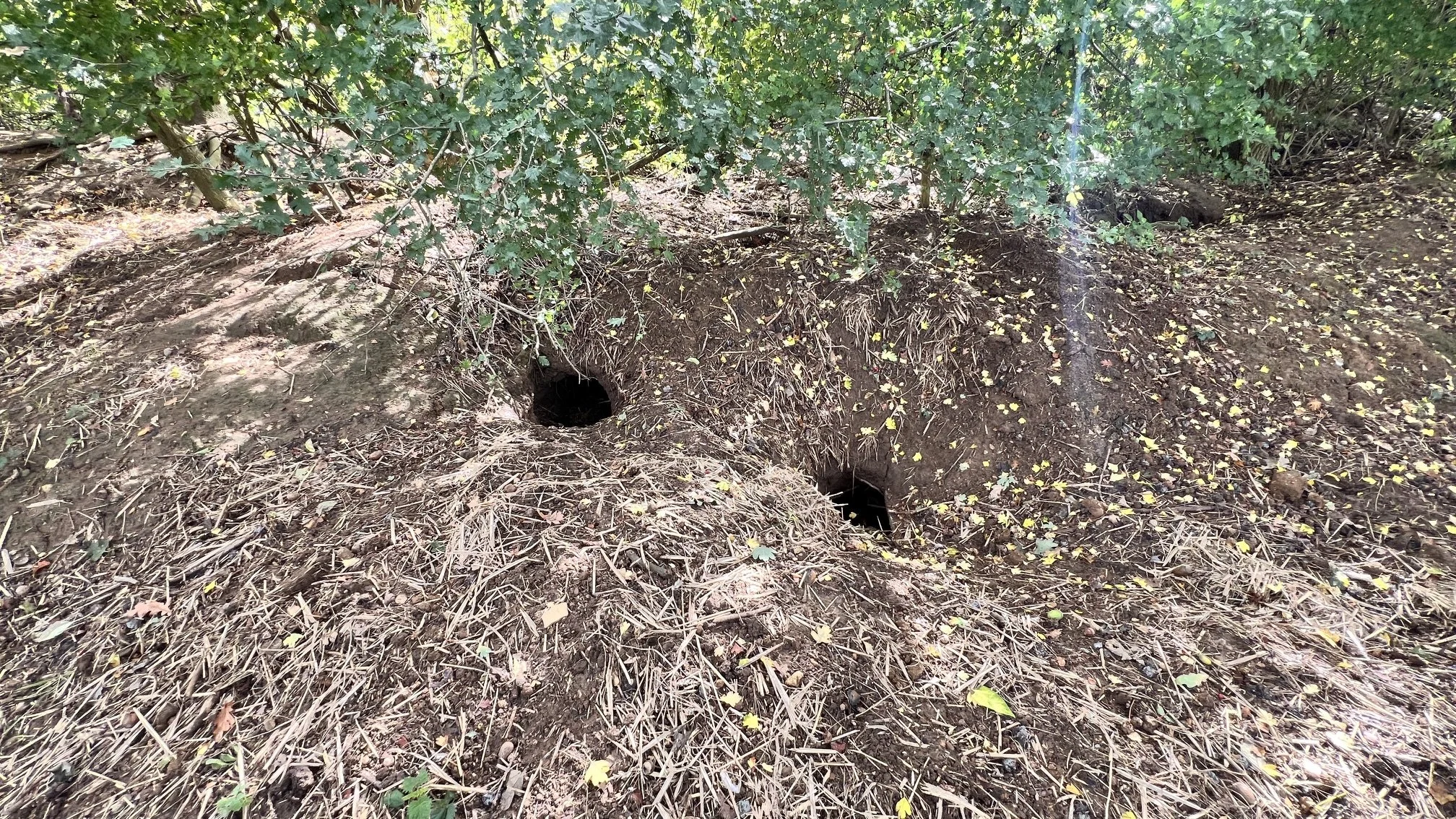
Several entrances may belong to one wider burrow system. Look for connecting routes, shared spoil and repeated disturbance rather than treating every hole as a separate refuge.
With badger setts and rabbit warrens in particular, focusing on the most conspicuous entrance can give a poor impression of the larger structure…..and don’t assume that identifying one species excludes another.
Large burrow systems can sometimes be used by more than one species during the same period, just as old burrows may be occupied sequentially. Finding fox evidence around a larger burrow system, for example, does not automatically establish that foxes excavated it or that no other species is using it.
The same logic works above ground. One possible deer bed may be difficult to interpret. Several similarly sized depressions connected by deer trails create a stronger pattern, although they still do not tell us automatically how many deer were involved or when every bed was made.
Read the site as a network rather than treating its most obvious feature as the whole story.
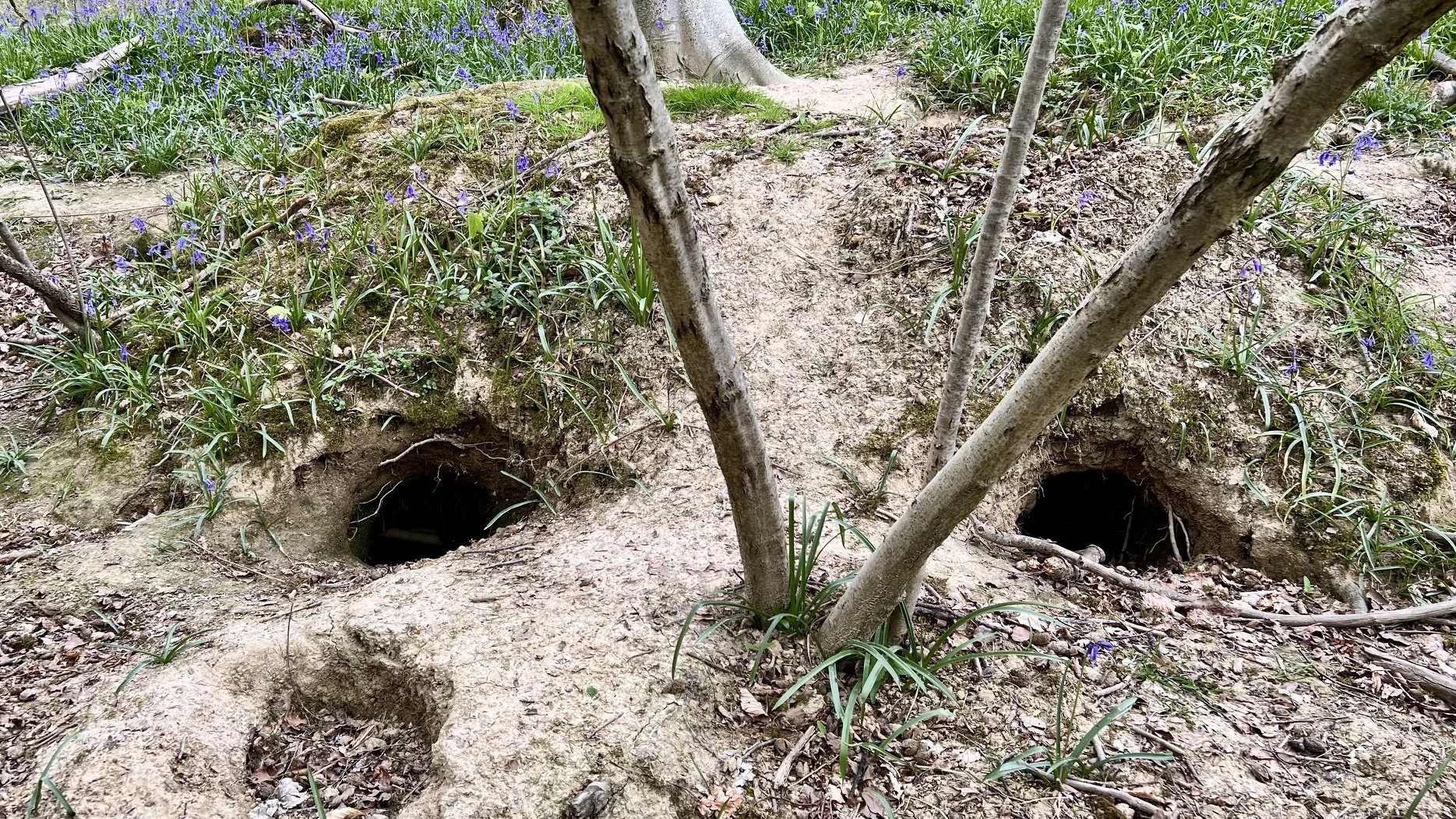
Two prominent entrances are only part of this woodland site. Step back and the connecting bare ground, slope, cover and possible routes become as important as either opening on its own.
Badger Setts and the Law
Badger setts are where curiosity needs particularly careful limits.
The Protection of Badgers Act 1992 defines a sett as a structure or place displaying signs indicating current use by a badger. The legislation protects setts against actions including damaging or destroying them, obstructing access and intentionally or recklessly disturbing a badger while it occupies a sett, except where lawful licensing applies.
Current use does not mean you need to see a badger inside the sett when you inspect it. The legal definition turns on signs indicating current use, which is another reason why tracks, bedding, spoil, entrances and well-used routes matter. No single sign should be treated as an automatic legal test in isolation.
For us as naturalists or photographers, the practical response is simpler.
Once the evidence gives you good reason to suspect an active badger sett, you do not need to poke a camera into the entrance, shift debris or get physically closer to prove the point. Move outward. Read the paths. Look for tracks at natural recording surfaces. Search for latrines and hair catches without interfering with the sett itself.
There is an important difference from otter protection here. Badger legislation specifically defines and protects the sett displaying signs indicating current use. An ordinary patch of ground where a badger has lain above ground does not become a legally protected “sett” simply because a badger rested there.
Otter law expressly protects breeding sites and resting places, which can include above-ground refuges.
Is the Site Being Used Now?
An impressive burrow may no longer be regularly used.
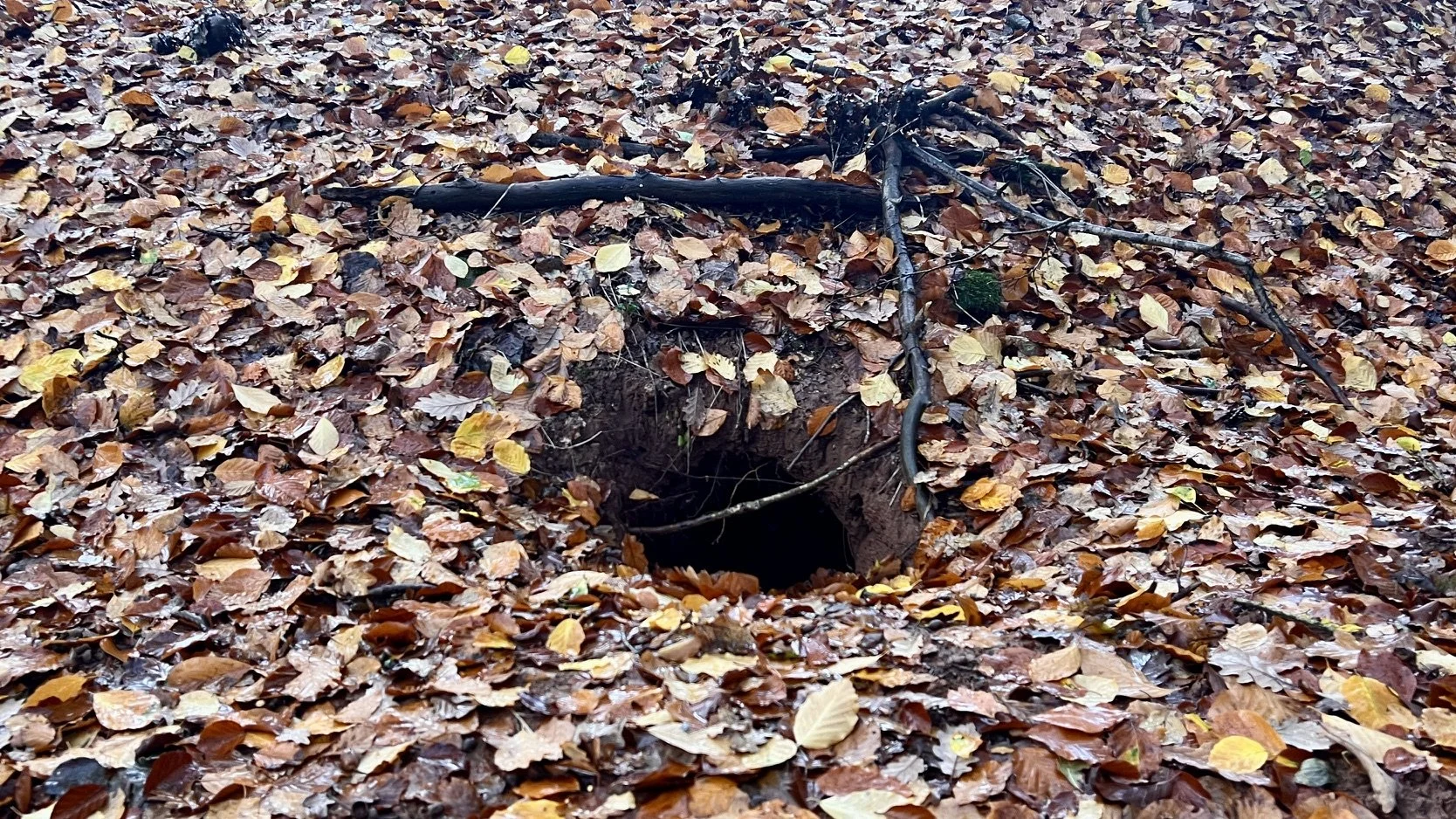
An entrance can remain physically obvious while giving very little evidence of recent passage. That is different from proving that the underground system is unoccupied.
Equally, an unobtrusive surface resting place may be used intermittently without accumulating dramatic sign. Rather than deciding something simply “looks active”, search for evidence of recent change:
If leaves fell overnight and have since been pushed from an entrance, movement likely occurred afterwards.
If fresh spoil lies over those leaves, excavation likely occurred afterwards.
At a possible surface bed, recent slots leading into newly compressed vegetation provide useful relative evidence.
Repeated visits are better still. Photograph the site without altering it and return later:
Has new spoil appeared?
Are fresh tracks present?
Has bedding moved?
Has a suspected bed acquired new compression or hair?
The point is not that persistence proves repeated use. New change does.
The Animal Using the Site May Not Have Made It
Burrows are useful resources. A rabbit warren may be investigated by mustelids or foxes. Existing cavities can be enlarged or temporarily occupied by another mammal.
Suppose a trail camera records a polecat entering a rabbit burrow. The evidence supports that the polecat entered the burrow, it does not automatically support that the polecat lives here. It might be hunting, investigating, sheltering temporarily or resting. Likewise, filming a fox walking through a cluster of deer beds establishes fox presence there. It tells us nothing by itself about who created the depressions.
Who created the structure, who currently uses it and what they do there can be three different questions.
How Confident Are You That It Was Resting?
I find a simple hierarchy useful:
Passage: tracks or a trail establish movement through the site without convincing evidence of stopping.
Possible resting: a plausible body-sized depression, cavity or sheltered spot exists, but corroborating evidence is limited.
Probable resting: the physical feature is accompanied by evidence associating the animal with that particular spot and supporting it having stopped there.
Repeated resting: new evidence over time indicates renewed use of the same site or nearby resting features.
A depression that still looks the same a week later does not prove that an animal returned. Fresh compression, new tracks, new hair or direct observation might.
Trail Cameras Should Test a Question
A trail camera can help enormously, but decide what question you want answered, E.g. Which species enters this burrow? Is this approach route still active? Does the fox simply pass through this patch of cover, or does it actually lie down here? Those are testable questions.
Repeated footage of an animal lying down, remaining there for a meaningful period or returning to the same resting position provides much stronger evidence than footage of it pausing briefly.
And the obvious camera position is not necessarily the best one. A camera directly over a refuge may increase disturbance when one positioned further along the approach route could answer the same question. With badgers and otters this can have legal implications as well as ethical ones. Wildlife photography or filming can require licensing where it involves prohibited disturbance or interference with protected sites.
Know When You Have Learned Enough
There is a contradiction in investigating resting places. The closer we get, the greater the chance that our investigation changes the behaviour we are trying to understand. Once the evidence points towards an active refuge, I become less interested in approaching it.
Do not push vegetation aside to inspect a suspected couch. Do not put equipment into a burrow. Do not repeatedly walk directly to a sett simply to see whether anything has changed.
Move outward instead. Find the approach trail. Locate mud where tracks record movement. Look for hair at natural constrictions. Observe from a suitable distance.
A resting place is somewhere the animal has chosen to stop, and good fieldcraft means allowing it to continue making that choice.
A Field Method for Reading Resting Places
Whether we find a badger sett, rabbit warren, deer bed or possible otter couch, I would work through the same sequence:
Place → Structure → Associated Sign → Recent Use → Occupancy → Function
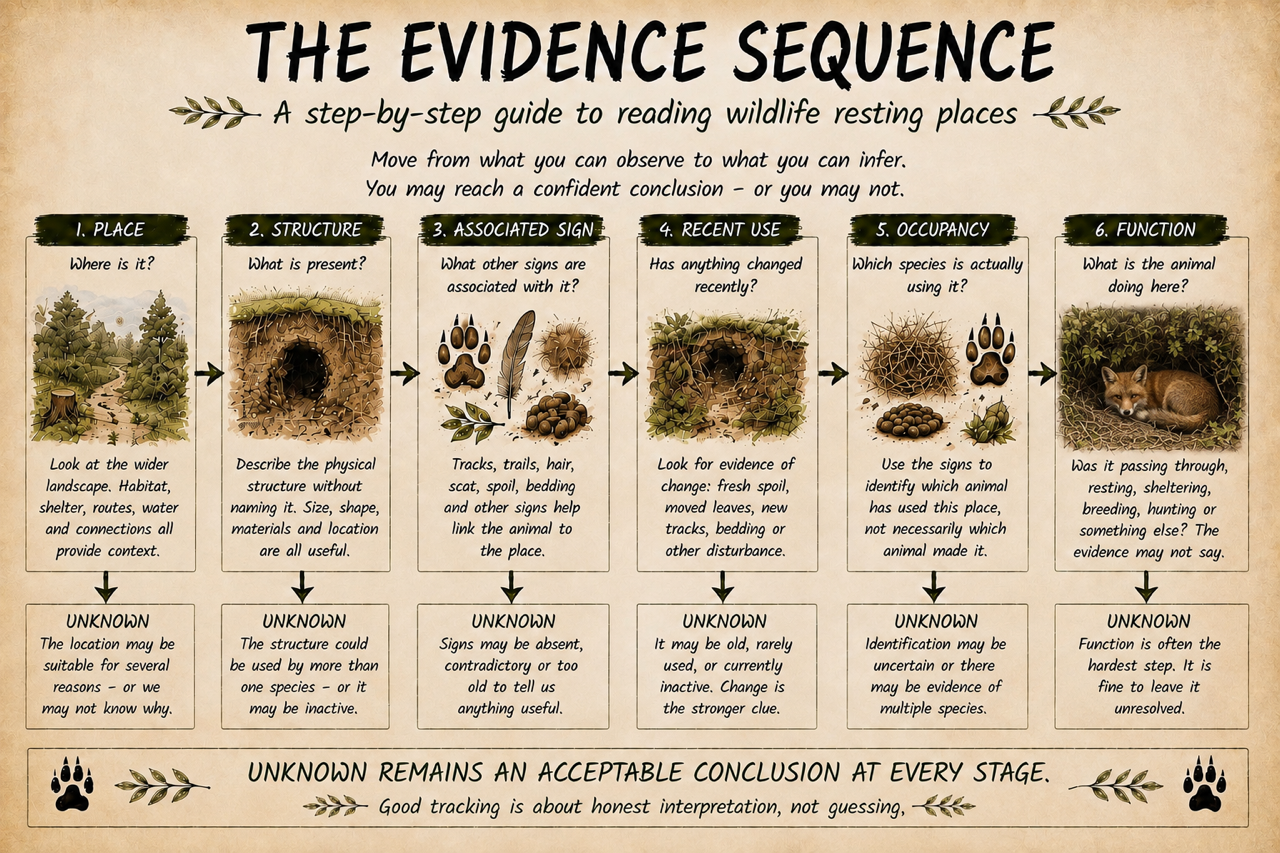
First ask where the feature sits in the landscape.
Then describe what is physically present without naming it.
Search for independent associated evidence: tracks, trails, hair, droppings, spoil, bedding or other sign.
Ask whether you can establish recent change.
Then decide which species the evidence actually shows using the site.
Only after that ask what it was doing.
…….and this final step may remain unresolved.
You can identify the animal confidently while still being unable to determine whether it was resting, sheltering, hunting, breeding or simply investigating. That is not a weakness in the method. It is an accurate reflection of the evidence.
Read the Place, Not Just the Hole
A broad hole in a bank draws your attention, so does a neat oval pressed into grass. Neither tells the whole story.
Look at the trail approaching it. Check the mud nearby. Examine the root where an animal brushes through. Notice whether soil sits above or below fallen leaves. Search for hair, droppings, bedding and other signs. Then, where it is safe and lawful, return another day and look for change.
The strongest identification rarely comes from matching a hole or depression to a photograph in a guide. It comes from independent pieces of evidence beginning to agree. Sometimes they won’t.
You may leave with active mammal burrow (occupant unknown) or probable mammal resting place (species unknown) or perhaps deer present (evidence insufficient to establish that this depression was used as a bed).
Those are not failed identifications. They are good tracking.
So whether you find a hole beneath tree roots, an oval depression in woodland or flattened vegetation beside a river, resist asking only:
“What lives here?”
Ask instead:
“What evidence shows which animal used this place, what does it actually tell me the animal did here, and how much can I learn without disturbing it?”
That question will usually take you much further.
Frequently Asked Questions
What animal made a hole in my garden or woodland bank?
Start with entrance size and shape, but don’t stop there. Very small and very large holes can narrow the likely animals considerably, but dimensions become less reliable where species overlap. Look for spoil, footprints, hair, droppings, approach trails and additional entrances. Also remember that the animal using a burrow today may not be the animal that originally excavated it.
How can I tell a fox earth from a badger sett?
Entrance shape can narrow the possibilities, but associated evidence is usually stronger. Badger use may be supported by spoil, well-developed paths, bedding, characteristic hair, footprints and nearby latrines. Fox tracks, scat and other fox sign can support fox use. A large entrance alone is insufficient for a confident identification, and larger burrow systems may sometimes be used by more than one species.
How can I tell if an animal burrow is currently occupied?
Look for change rather than simply a tidy entrance. Fresh tracks, new spoil, displaced leaves, bedding, hair and repeated activity along approaches all help. A single visit rarely establishes either regular occupation or abandonment, so unobtrusive repeat observations are often much more informative.
What is the difference between an otter holt and an otter couch?
Terminology varies slightly, but in ecological fieldwork a holt generally refers to an enclosed refuge, often underground, beneath roots or within a bank, while couch or lay-up is commonly used for an above-ground resting place in vegetation. Both can function as legally protected otter resting places, so the absence of an obvious hole does not make a site unimportant.
Are animal dens and resting places protected by law?
It depends on the species and site. Badger setts displaying signs indicating current use are specifically protected under the Protection of Badgers Act 1992; current use does not require a badger to be visible at the time. Otter breeding sites and resting places are protected under the Conservation of Habitats and Species Regulations 2017, including when an otter is absent, and this protection can include above-ground resting sites. Deer beds and ordinary fox lies do not automatically have equivalent site-specific protection.
Explore More…..
How to Identify a Badger Sett: Signs, Activity & Sett Types
Animal Trails & Wildlife Pathways: How to Read Them
How to Read the Landscape and Find More Wildlife: A Guide to Predictive Fieldcraft