

How To Get Close to Wildlife Without Disturbing It
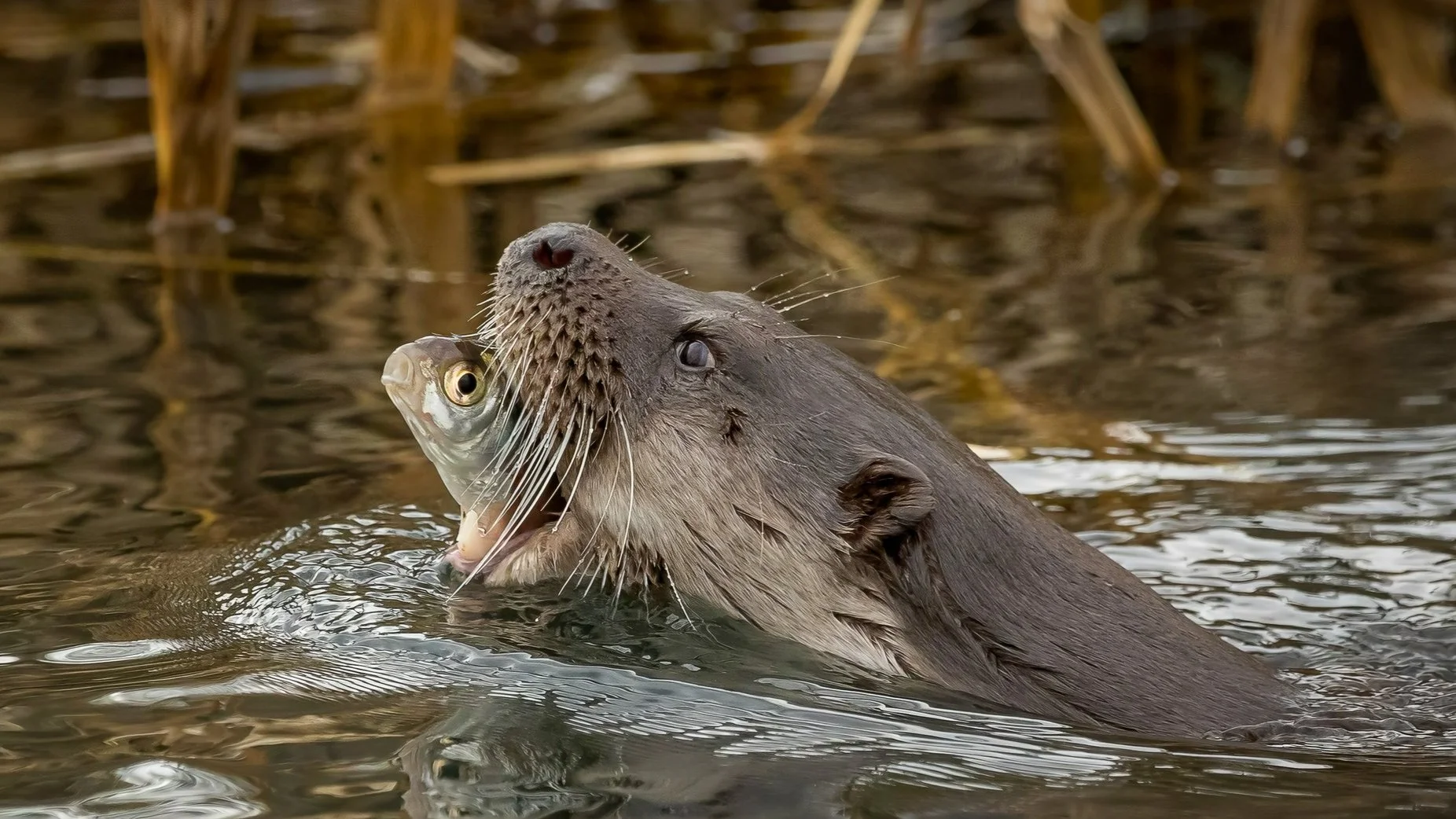
It's one of the questions I'm asked more than almost any other.
"How do you get so close to wildlife without scaring it away?"
People often expect the answer to involve expensive camouflage clothing, moving impossibly slowly or learning some secret stalking technique known only to experienced wildlife photographers. It's an understandable assumption because, at first glance, getting closer seems to mean covering the distance between you and the animal. Over the years I've come to realise that the opposite is usually true.
In fact, I think the question itself is slightly flawed because, most of the time, I don't approach animals at all. Instead, I try to understand where they're already going, why they're going there and when they're likely to arrive. Once I think I've answered those questions, I quietly position myself somewhere along that journey and allow the animal to solve the problem of distance for me.
That single shift in thinking changed my wildlife photography more than any camera, lens or piece of camouflage equipment ever has. It also transformed the way I experience wildlife because I stopped trying to persuade animals to tolerate my presence and started allowing them to behave naturally, often without ever realising I was there.
The difference sounds subtle, but it fundamentally changes the way you look at the countryside. Instead of asking, Where is the fox? or Where can I find a deer? you begin asking a completely different set of questions:
Why is the fox using this field edge instead of crossing the open meadow?
Why are the deer feeding here this evening?
Why does every badger seem to emerge from the woodland using the same narrow gap in the hedge?
Those questions are far more powerful because they force you to stop thinking about individual animals and start reading the landscape itself.
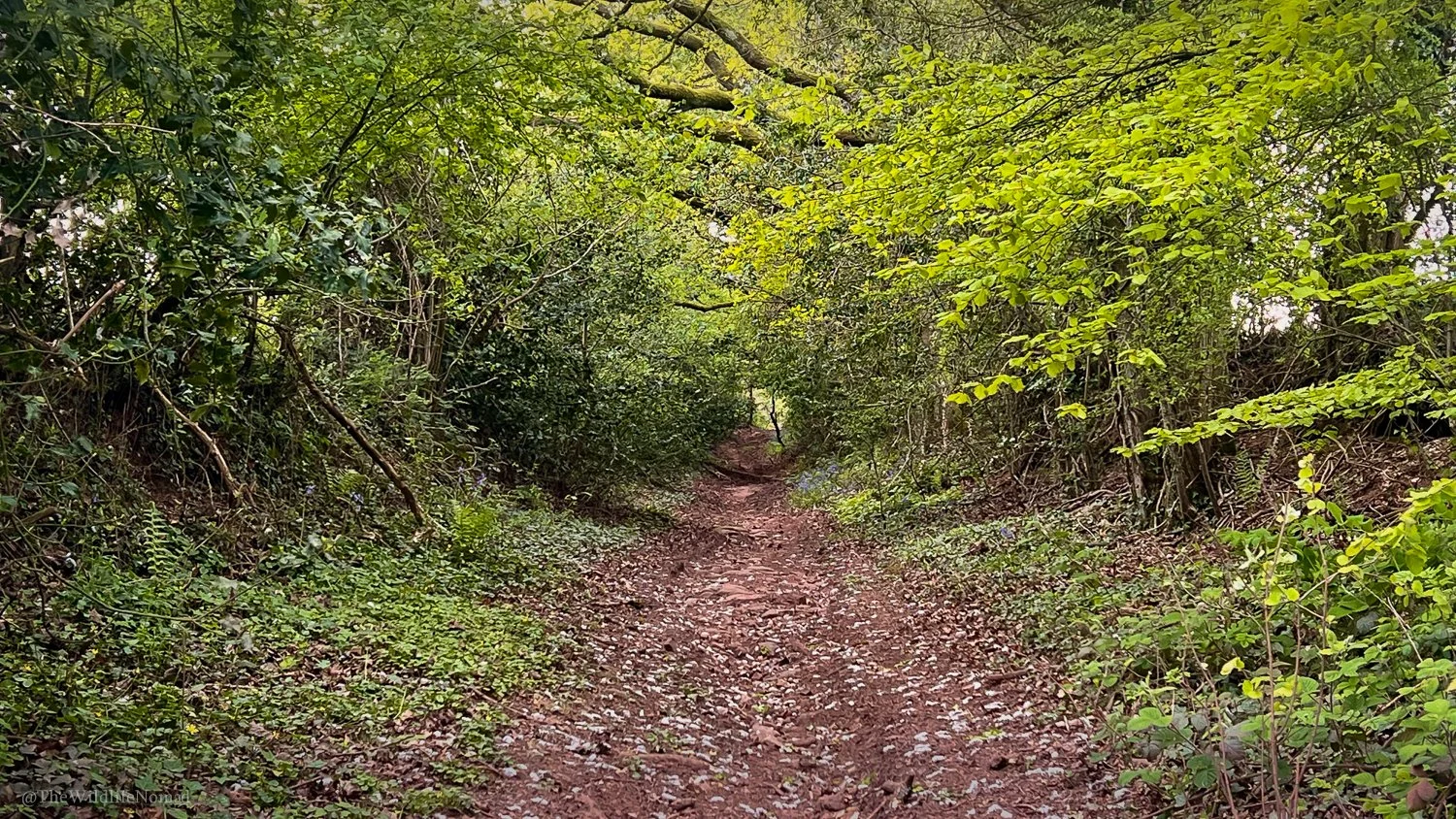
The countryside is full of clues
The biggest misconception in wildlife photography is that finding wildlife depends on luck.
Luck certainly plays a part. Anyone who spends enough time outdoors will eventually stumble across an unforgettable encounter they never expected. But the people who consistently enjoy close views of wildlife usually aren't luckier than everyone else. They've simply learnt to recognise the clues that animals leave behind.
Those clues are everywhere.
A narrow trail worn through long grass.
Fresh footprints in soft mud beside a stream.
A line of cropped grass leading away from a rabbit warren.
A woodland edge where several game trails converge before disappearing beneath the trees.
A blackbird suddenly giving a sharp alarm call from a nearby hedge.
Individually, none of these tells you very much. Together they begin to reveal how animals are using the landscape. You're no longer searching randomly. You're building a picture of movement, feeding, security and behaviour.
This is what I mean when I talk about predictive fieldcraft.
Rather than reacting to wildlife once you've seen it, you're trying to predict where it's likely to appear before it arrives. That doesn't make the countryside predictable in the absolute sense. Wild animals will always surprise us. But it shifts the odds remarkably in your favour because your decisions are based on evidence instead of hope.
Stop thinking about the animal
One of the hardest lessons for any wildlife photographer to learn is that animals are usually much better at detecting us than we are at detecting them.
A fox doesn't need to see you clearly to know you're nearby. A roe deer can detect the slightest movement from an astonishing distance, while rabbits, despite being one of our commonest mammals, survive precisely because they spend every waking hour looking and listening for danger. Their hearing is sharper than ours, their sense of smell infinitely better and their behaviour has been shaped by thousands of generations of avoiding predators.
If your plan is simply to outwit those senses by creeping ever closer, you've accepted the most difficult challenge possible.
That isn't to say stalking never works. There are certainly occasions when a careful approach is the best option, particularly if you've accidentally encountered an animal or the terrain gives you little choice. But in my experience those situations are the exception rather than the rule.
Most successful wildlife photography begins long before the animal appears.
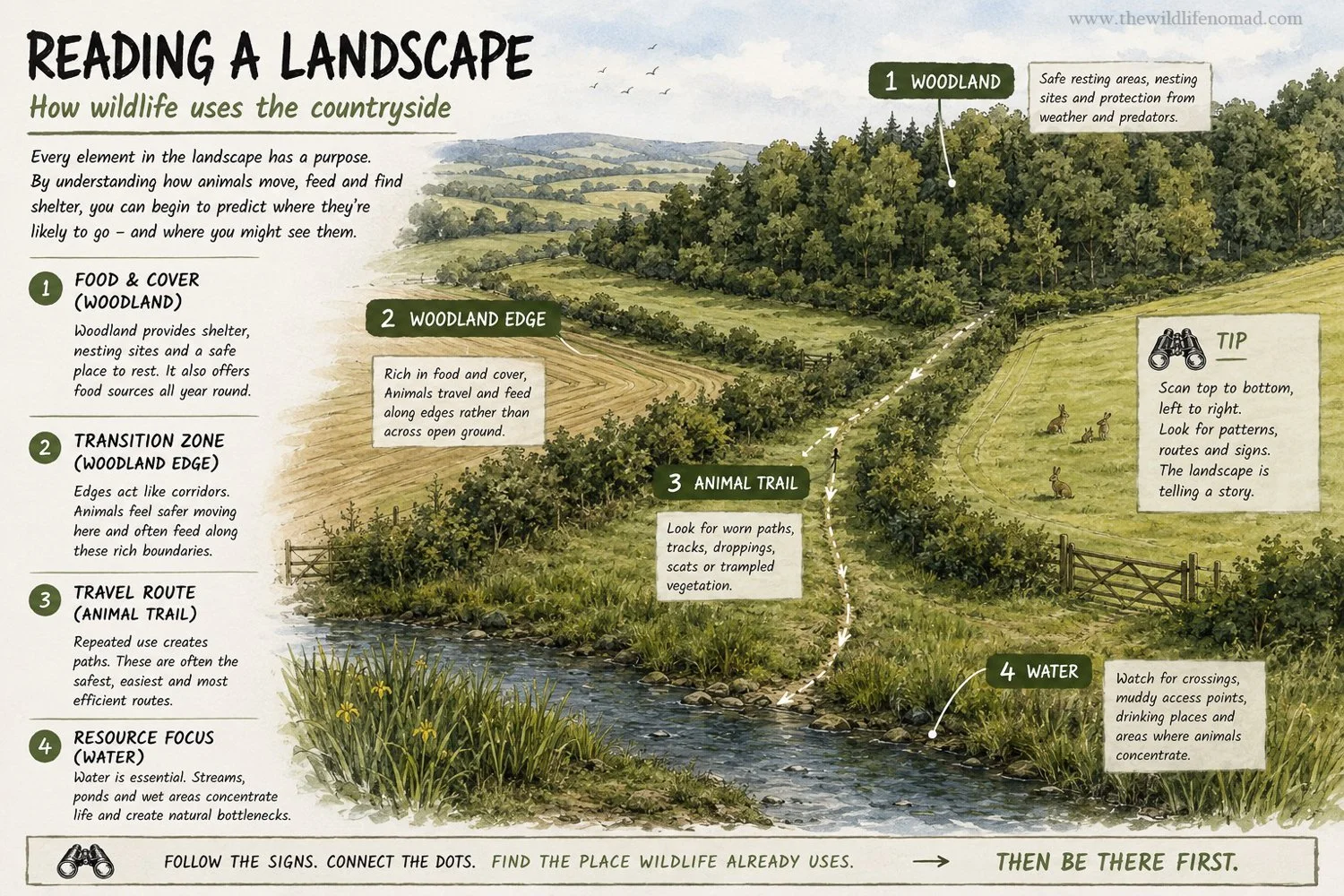
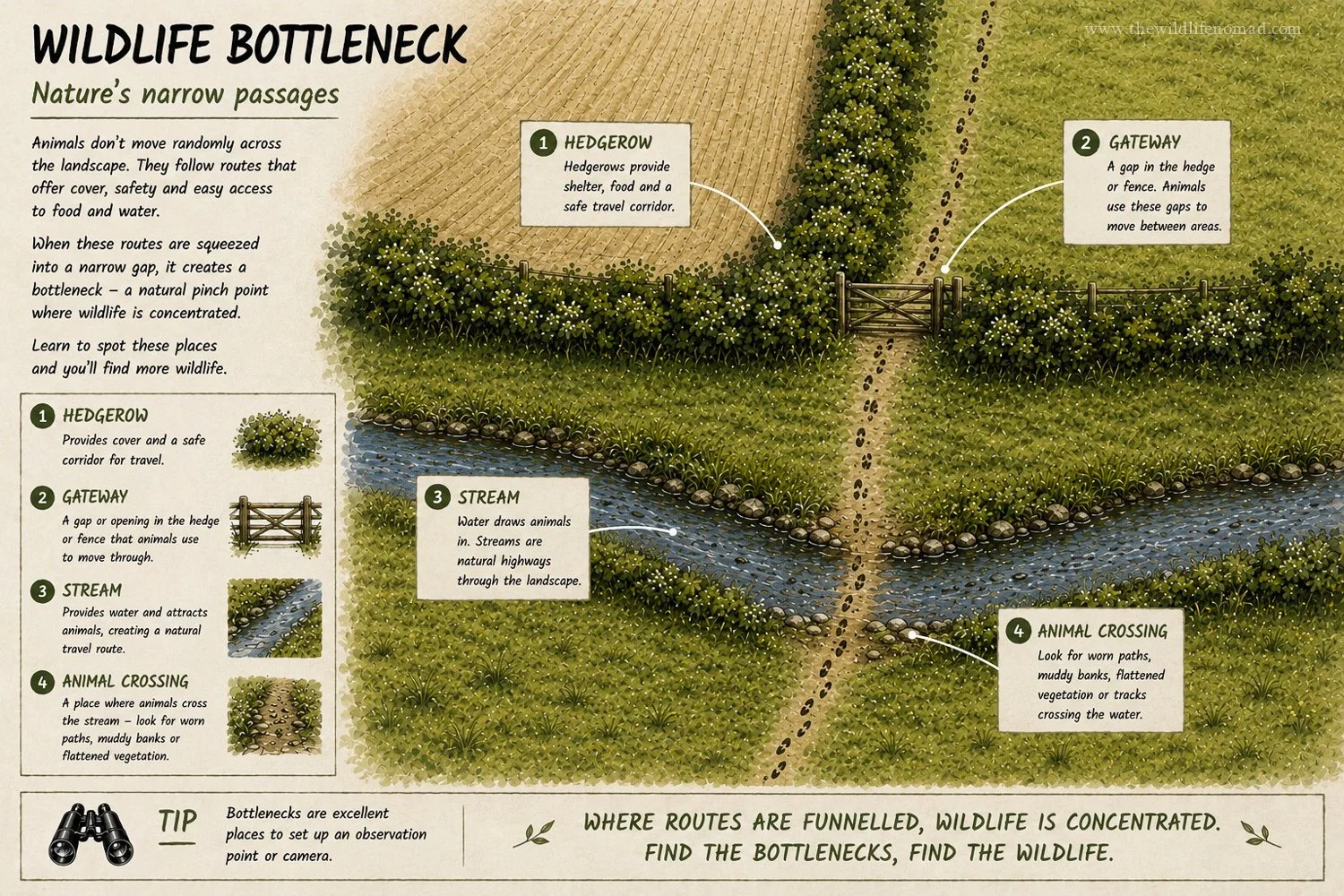
Rather than asking how I can shorten the distance between myself and a fox or a deer, I try to understand how it's already using the landscape. Where is it feeding? Where does it feel secure? Which routes does it favour? Are there natural bottlenecks where several paths come together? Does it have to cross a stream at a particular point? Is there a woodland edge that offers both cover and easy access to open feeding areas?
Answer those questions first and you no longer need to force an encounter.
All you need is the patience to wait for one.
That may sound passive, but it isn't. It's an active process of observation, interpretation and decision making. In many ways it demands considerably more concentration than wandering through the countryside hoping to stumble across wildlife because every decision about where you sit is based on information you've gathered beforehand.
Let the landscape do the work
Every autumn I spend time photographing rutting red deer and fallow deer in a local deer park. Like many popular wildlife locations, it's visited by photographers every day during the rut, and it's fascinating to watch the different approaches people take. Many spend hours walking from one group of deer to another, edging a little closer each time the animals move.
I used to do exactly the same thing, but eventually I realised the deer were teaching me a far more useful lesson.
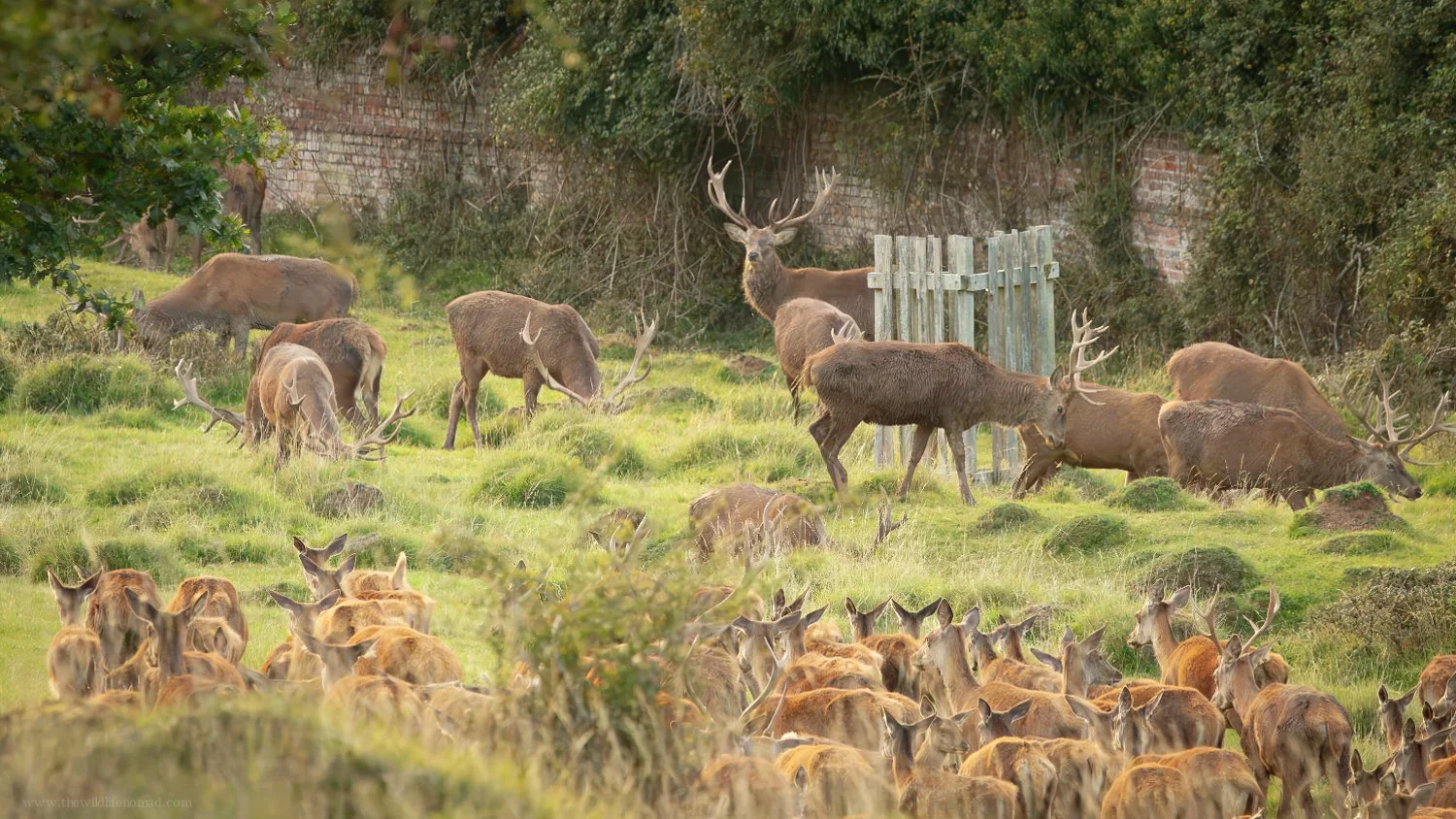
Chasing wildlife and trying to close the gap led to distant shots of wary subjects.
Morning after morning, and evening after evening, they crossed the same ridge using almost exactly the same line through the landscape. The individual animals changed, the size of the groups varied and the light was never quite the same, but the route itself remained remarkably consistent because it simply made sense from the deer's perspective.
The crossing linked an area of woodland, and a sheltered grazing area, avoided the steepest ground and provided a straightforward route between feeding and shelter. In other words, it functioned as a natural wildlife corridor. The deer weren't choosing it because it suited photographers. They were choosing it because the landscape encouraged them to.
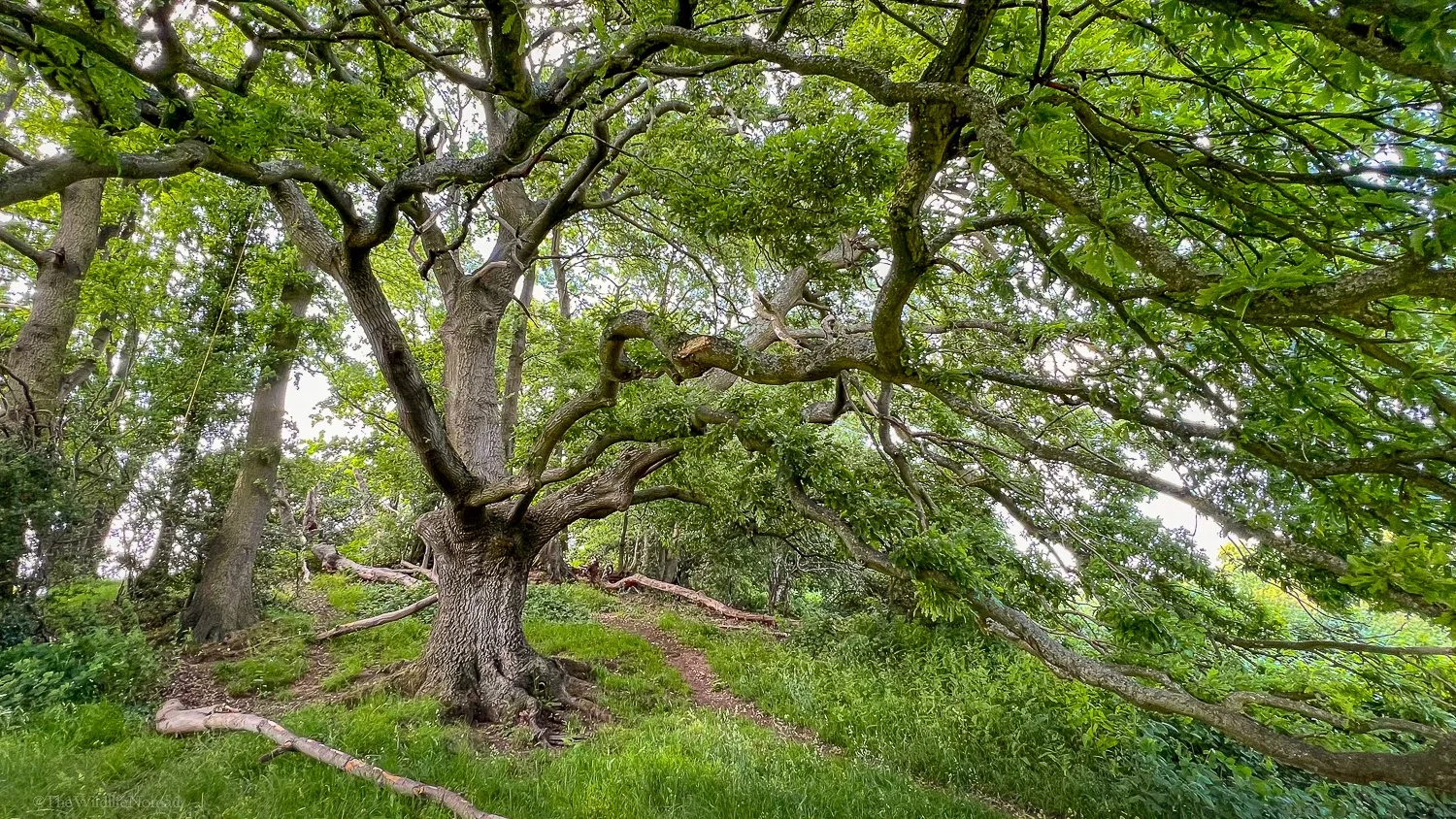
Now, instead of following the deer, I choose a tree overlooking that crossing point, make sure the wind is favourable, settle myself quietly against the trunk and wait.
Sometimes nothing happens…….sometimes the deer appear half an hour later.
Occasionally they walk so close that they're within fifteen or twenty feet of where I'm sitting.
Ironically, that's far closer than I could ever hope to achieve by trying to stalk them.
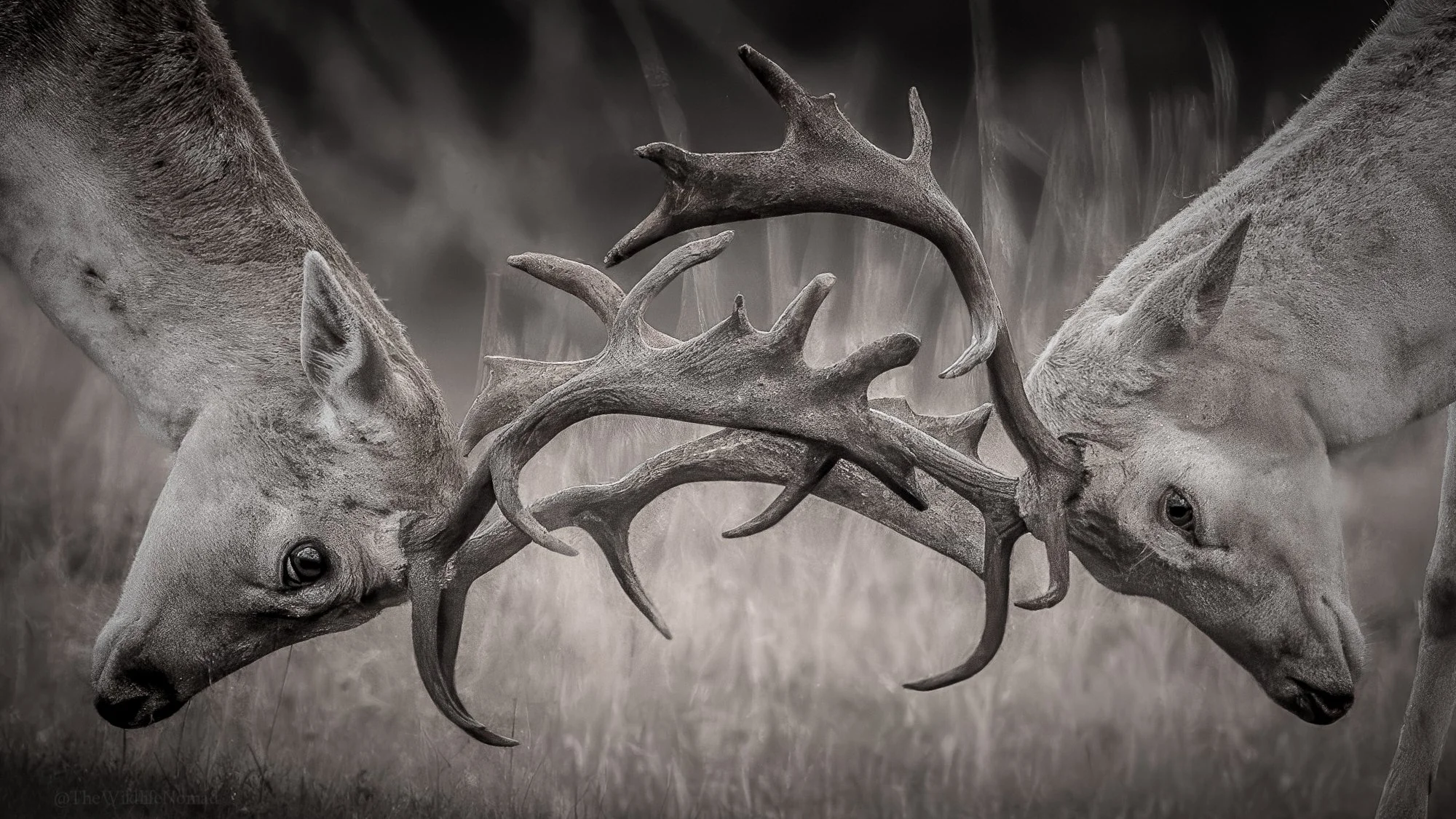
Understanding the deer’s behaviour and placing myself where they were most likely to be relaxed and familiar with their route allowed me to capture some very special “ up close” moments.
The important lesson isn't that I found the perfect tree. It's that I found a place the deer already intended to use. Once you begin recognising wildlife corridors, bottlenecks and well-established routes through the landscape, the countryside starts solving the problem of distance for you.
That's a lesson that applies almost everywhere.
Badgers repeatedly use the same paths linking their sett with feeding areas and territorial latrines. Foxes favour woodland margins, field edges and old tracks because moving through cover is usually safer than crossing open ground. Otters return time and again to the same narrow stretches of river where fish naturally concentrate. Even rabbits, despite appearing to feed almost at random, quickly reveal predictable routines if you spend enough time watching them.
Wildlife is rarely wandering without purpose.
Most of the time it's responding to food, shelter, water and security in ways that become surprisingly predictable once you learn how to read the landscape.
Becoming part of the landscape
Once you've found the right place, the next challenge is making sure you don't undo all that careful preparation.
People often ask whether camouflage clothing is essential and, while it certainly has its place, I think it's given far more credit than it deserves. Over the years I've watched photographers dressed head to toe in the latest camouflage patterns announce their presence from hundreds of metres away, not because their clothing was wrong, but because they'd overlooked three much simpler things that almost every wild animal notices long before it registers the colour of your jacket.
Shape.
Shine.
Silhouette.
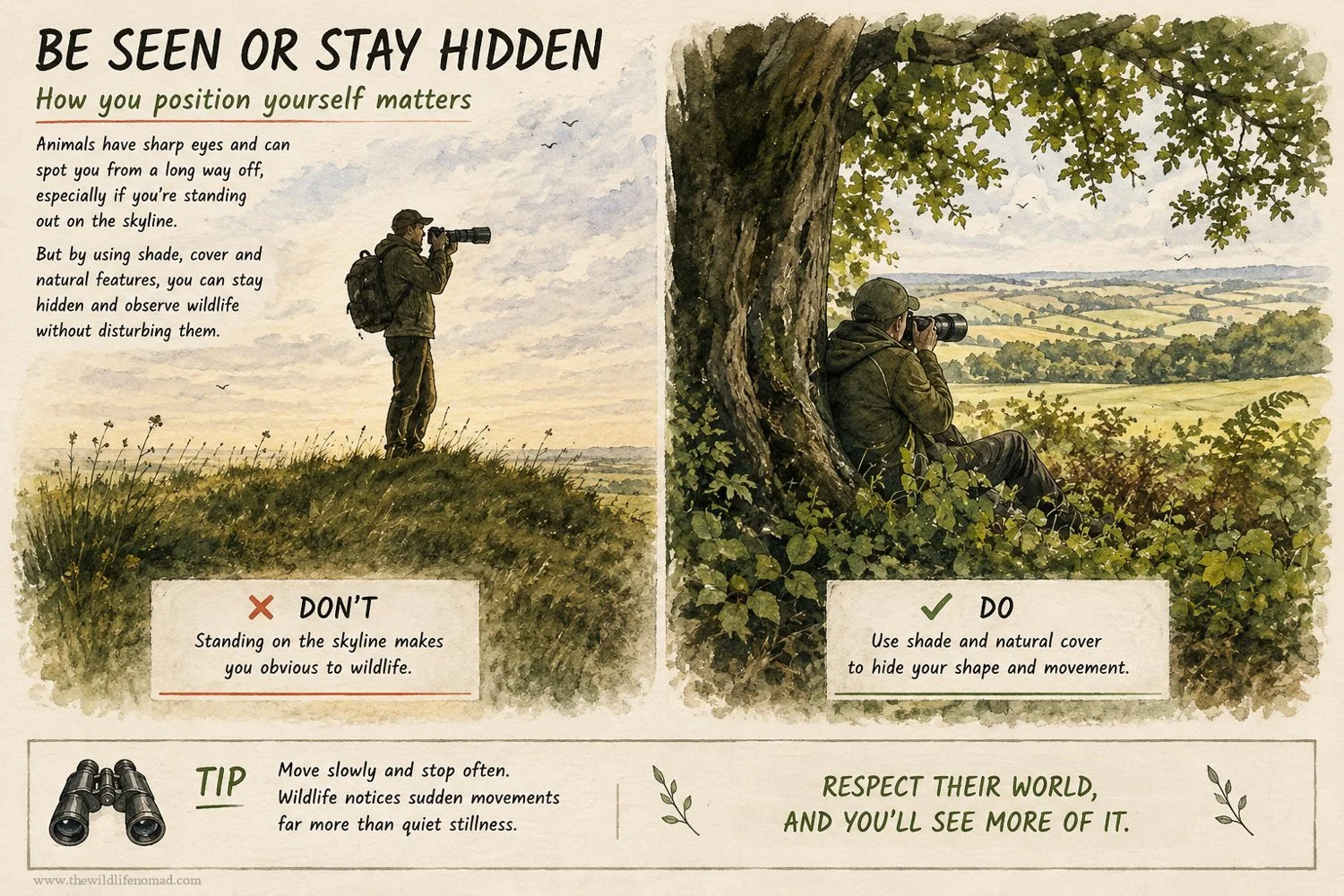
Animals don't recognise camouflage patterns in the way we imagine they do. What they recognise is when something in the landscape suddenly looks unfamiliar. Human beings have a distinctive outline. We stand upright, our shoulders form a recognisable profile and our heads sit high above the surrounding vegetation. Breaking up that outline is often far more important than blending into the background. Sitting quietly against the broad trunk of an old oak, tucking yourself into the shadow of a hedge or allowing surrounding vegetation to soften your profile will usually achieve far more than buying another camouflage jacket.
Then there's shine, something that's remarkably easy to overlook because our own eyes quickly learn to ignore it. A watch face catching the evening sun, the barrel of a telephoto lens reflecting the light or even the lenses in a pair of glasses can create a brief flash that simply doesn't belong in an otherwise natural landscape. To us it's barely noticeable. To a cautious deer or fox, it can be enough to trigger a second look, and sometimes a second look is all it takes for an encounter to be over before it has really begun.
The final consideration is silhouette, and in my experience it's one of the commonest mistakes wildlife photographers make. It's astonishing how often people unknowingly position themselves against the skyline or in front of a bright opening where every small movement becomes obvious. Before I settle anywhere, I spend almost as much time thinking about what's behind me as I do about what's in front of me because a dark backdrop that absorbs my outline is almost always preferable to one that advertises it.
None of these things guarantees success. Fieldcraft never comes with guarantees. What they do is quietly shift the odds back in your favour without asking the animal to change its behaviour.
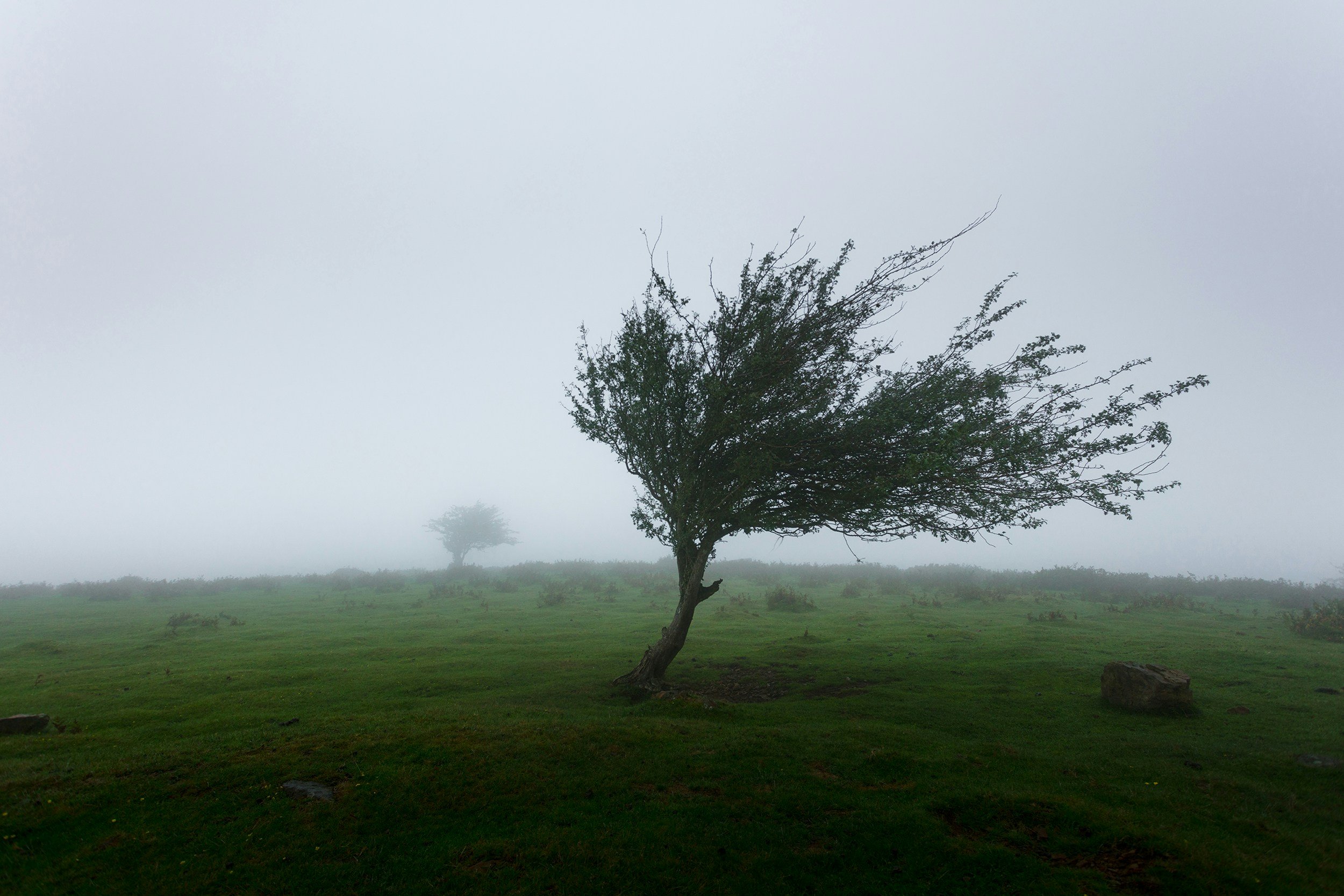
Why wind is important to wildlife watching
If camouflage is overrated, the wind is almost certainly underrated.
We naturally think about what an animal can see because vision dominates the way we experience the world, but for many mammals smell provides an equally important, and often more reliable, source of information. Long before a fox sees you, it may already know you're there. A badger emerging from its sett doesn't need to inspect every shadow if the breeze has already carried your scent across the woodland. Even deer, with their remarkable eyesight and hearing, place enormous trust in their noses when deciding whether something deserves their attention.
For that reason, I probably spend more time considering the wind than almost any other aspect of an encounter. Before I sit down I'll often watch leaves moving in the canopy, throw a few strands of dry grass into the air or simply stand still for a few minutes to understand how the air is flowing through the landscape. Valleys channel it, woodland slows it, sunny slopes create rising currents and as evening approaches it can begin to behave very differently from the way it did an hour earlier.
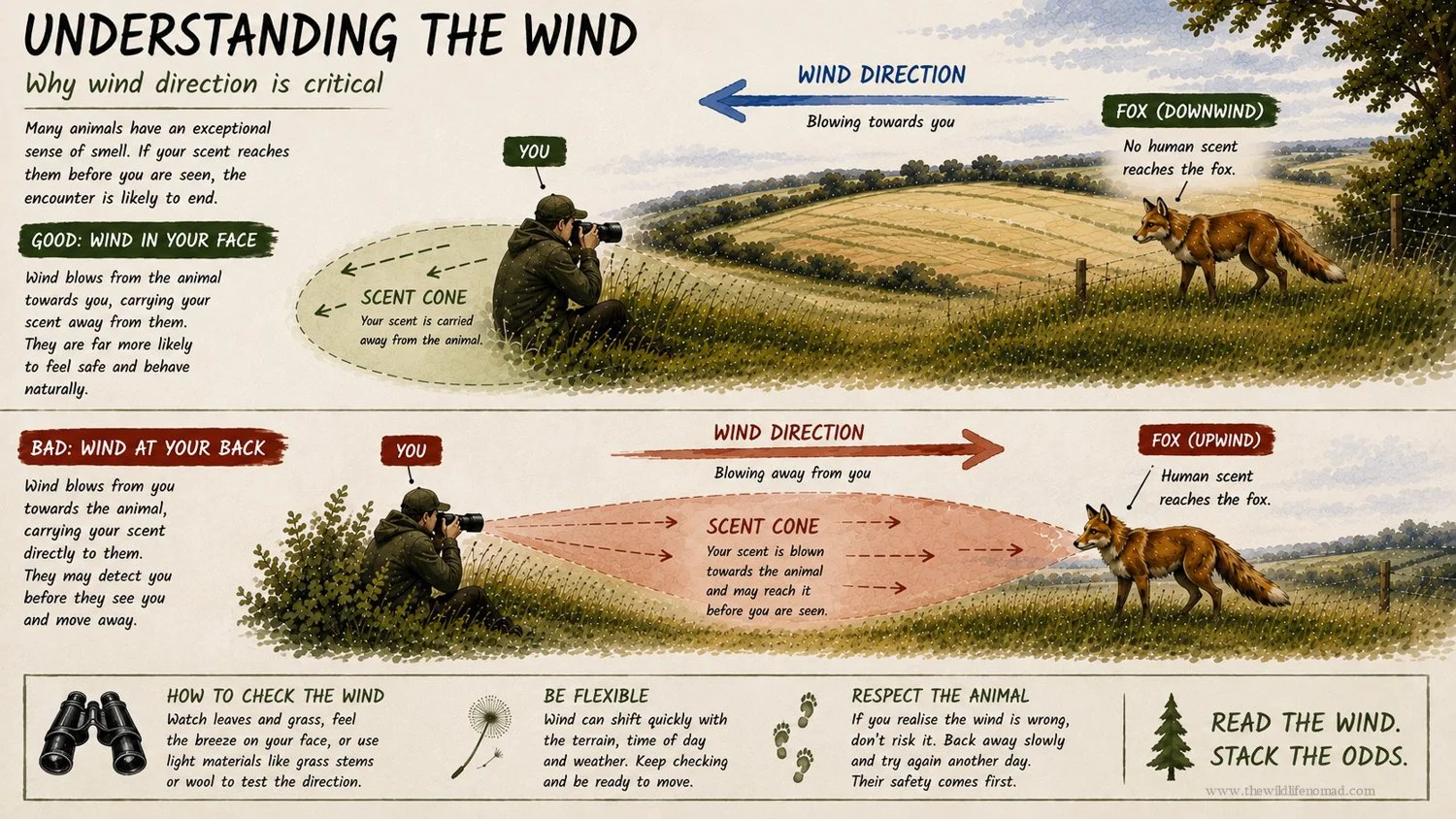
I learnt that lesson the hard way while photographing foxes approaching an active earth through a meadow of long grass. Everything appeared to be working perfectly. I'd arrived well before sunset, chosen a position that overlooked the route I expected the foxes to use and, most importantly, made sure the breeze was carrying my scent harmlessly away from the earth. As the hours passed I became increasingly confident that all I needed now was patience.
What I hadn't appreciated was that the wind had quietly changed.
By the time I realised, it was too late. Instead of drifting away behind me, my scent was now blowing directly across the route the foxes normally used. Somewhere beyond the long grass, entirely unseen, a fox caught my scent, altered its plans and disappeared without me ever knowing how close it had been. I'd spent the best part of five hours in what I believed was the perfect position, only to discover that it had stopped being perfect long before the fox arrived.
It was a frustrating evening, but an invaluable lesson because it reminded me that fieldcraft isn't something you do when you first sit down. It's something you continue doing until you leave.

Learning the rhythm of a place
Perhaps the biggest difference between experienced field naturalists and beginners isn't that they somehow notice more wildlife. It's that they've learnt what normal looks like.
Everything in nature has a rhythm. Sit quietly beside a woodland ride and, after a while, the movement of the leaves stops feeling random. Watch a stream for long enough and what first appeared chaotic begins to reveal familiar patterns. Listen to a summer hedgerow and the background chorus of birds gradually becomes so familiar that you stop consciously noticing it altogether. Only once you've absorbed that rhythm do the small interruptions begin to stand out, and those interruptions are often the first indication that something interesting is about to happen.
A roe deer feeding peacefully may suddenly lift its head and stare towards a patch of woodland. A fox that has been trotting with quiet confidence pauses to test the air with unusual intent. A badger stops halfway through a stride, one front paw suspended, listening into the darkness. Blackbirds erupt into alarm calls from somewhere ahead, while a robin begins ticking insistently from deep inside a hedge.
None of those behaviours necessarily means they've detected you. Another fox may have entered the area. A sparrowhawk might have drifted overhead. Someone could be approaching along a footpath beyond your view. The important point isn't to jump to conclusions. It's to recognise that something has disturbed the normal rhythm of the landscape.
Whenever I notice that change, I stop thinking about photography and start asking questions instead. Has the wind shifted? Did I move without realising? Is another predator nearby? What has changed since the last few minutes? More often than not, those questions lead to a better understanding of what's happening than simply keeping my eye pressed against the viewfinder and hoping for the best.
Over the years I've become convinced that this habit of paying attention to the first subtle change is far more valuable than reacting to the final dramatic one. Most people notice wildlife when it runs away. I'd rather notice the tiny behavioural change that happens ten seconds earlier because that's usually the moment when there's still time to learn something, or quietly correct a mistake.
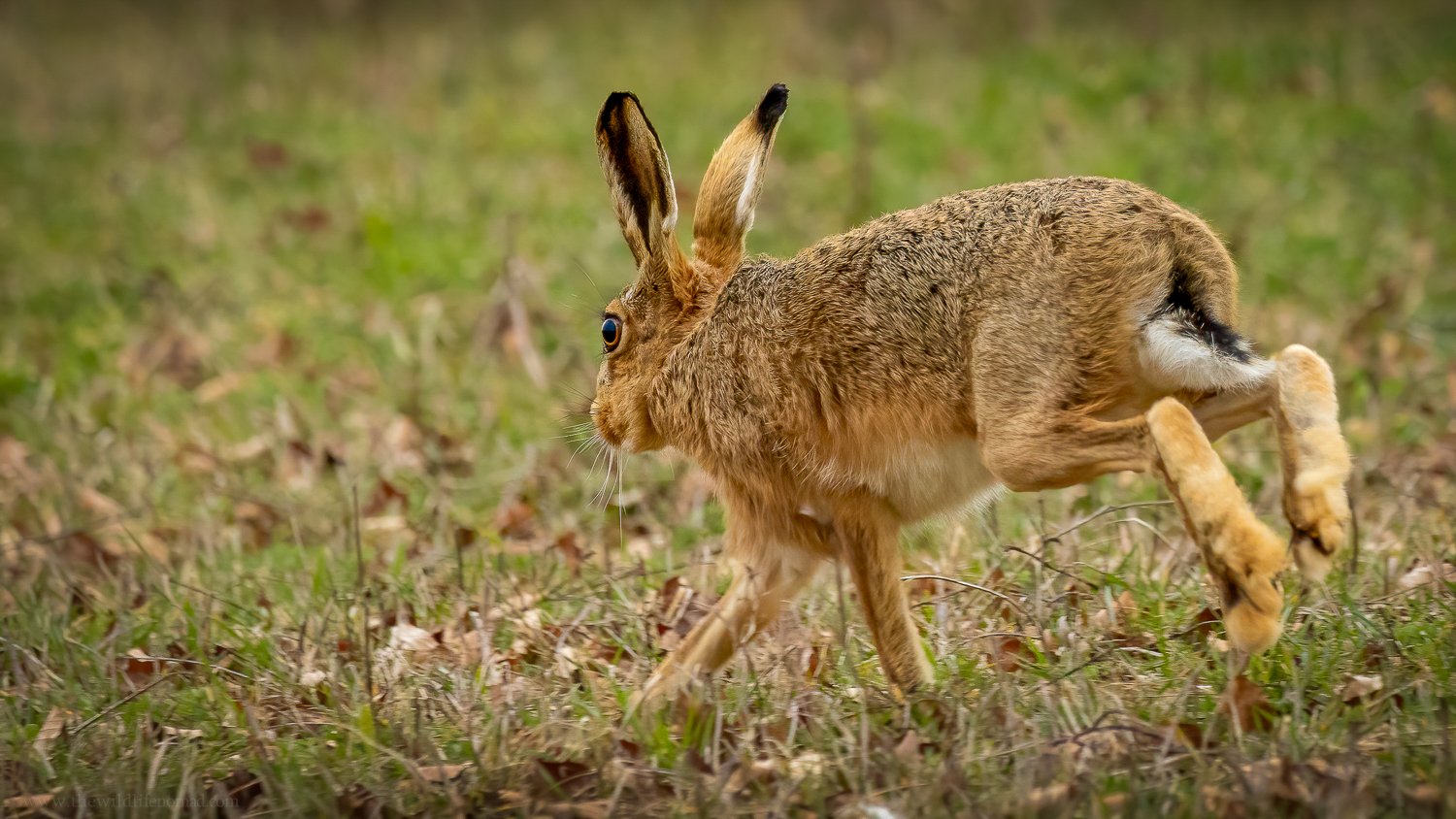
Learning the rhythm of a place helps to reduce the number of “bum” shots you get :-)
The best teachers are often the commonest wildlife
People are often surprised when they ask which species has taught me the most about getting close to wildlife.
They're expecting me to mention pine martens, otters or perhaps badgers.
In reality, I'd probably say rabbits.
They're so common that many people stop paying attention to them, yet they're among the finest fieldcraft teachers you could ask for because every aspect of their lives revolves around avoiding becoming somebody else's meal. Their hearing is exceptional, their eyesight is perfectly adapted to detecting movement and their behaviour has been refined over thousands of generations by predators that were every bit as determined as today's wildlife photographers.
Try repeatedly stalking rabbits across an open field and you'll soon discover just how difficult it is. Eventually, though, something interesting begins to happen. You stop concentrating on the rabbits themselves and start noticing everything around them instead. You notice the cropped grazing lawns where fresh shoots are repeatedly nibbled short. You begin following narrow runs through the grass, spotting fresh footprints after rain and recognising the small piles of droppings that reveal where they spend most of their time.
Without really realising it, you've stopped looking for rabbits altogether.
You're reading the landscape.
That change in mindset transfers remarkably well to almost every other species you'll ever photograph because the principle is always the same. Tracks, feeding signs, worn paths, scent marks, alarm calls and well-used wildlife corridors are all fragments of a much larger story. Individually they tell you very little. Together they reveal where an animal is likely to be long before you've actually seen it, and once you begin thinking that way, getting close without causing disturbance becomes less about stealth and much more about understanding.
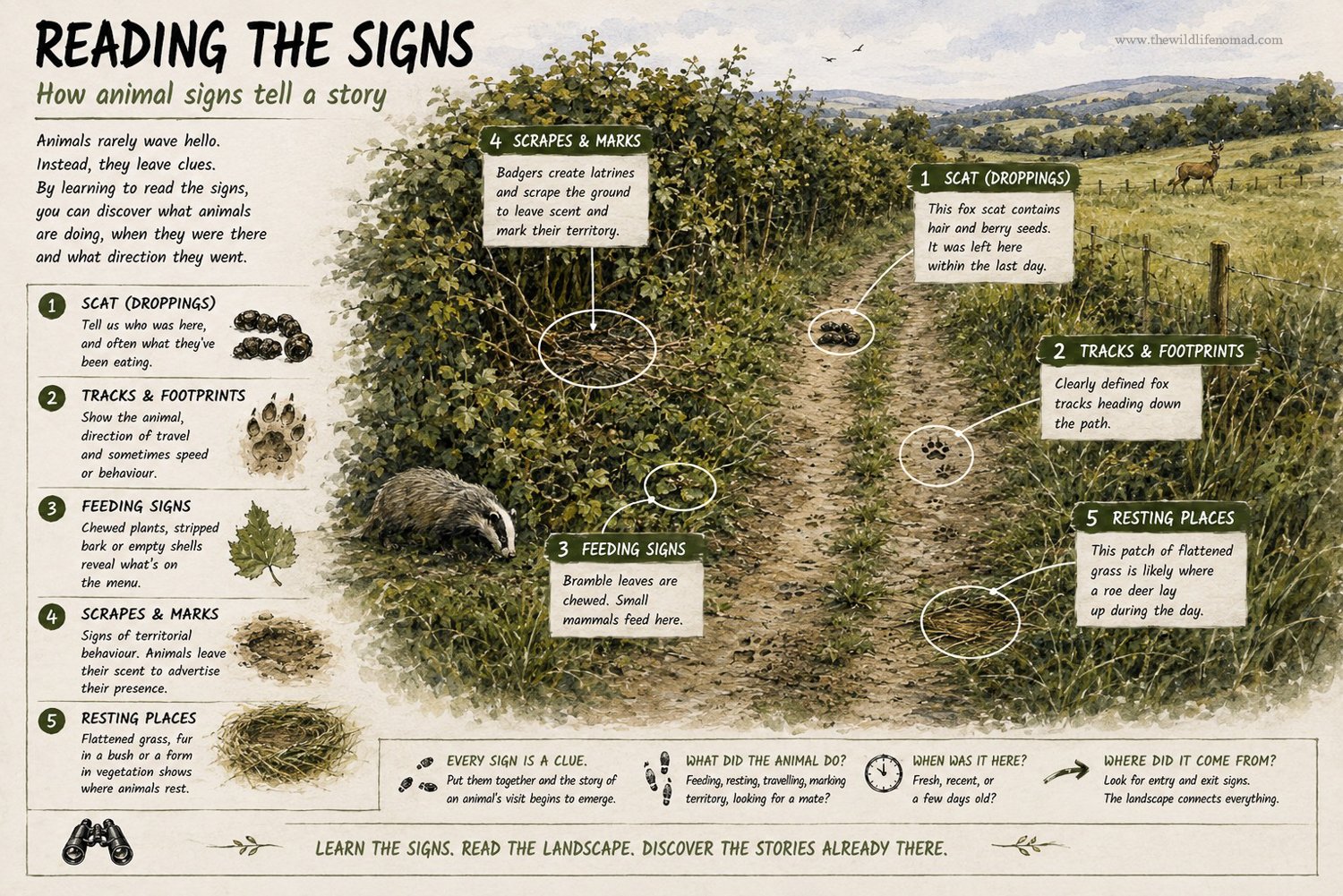
The photograph isn't always the reward
One of my favourite wildlife encounters never resulted in a photograph.
I'd gone out one evening to photograph foxes and had settled into position well before sunset. I'd taken care with the wind, tucked myself into the edge of some vegetation and found a comfortable place where I intended to remain until darkness. Everything about the evening felt promising and, after more than an hour of sitting quietly, I noticed movement approaching through the long grass.
It wasn't a fox.
It was a young roe deer.
Completely unaware of my presence, it walked steadily towards me until it was no more than three feet away. Only then did it stop. For a moment it simply stood there, looking directly at me with the sort of quiet curiosity that only young animals seem capable of. I can still remember holding my breath, convinced that the slightest movement would shatter the moment.
The irony wasn't lost on me. I'd come prepared with a long lens for distant foxes, yet the deer was now so close that photographing it was impossible. For nearly two minutes we simply watched one another before it turned, wandered back into the meadow and disappeared into the gathering dusk.
I came home without a single photograph.
Yet I still think about that encounter years later.
It reminded me that photography isn't always the reward. Sometimes the privilege lies in being accepted into an animal's world for a few brief moments without changing its behaviour. Those are often the encounters that stay with us longest because they remind us that our success shouldn't be measured only by the images we bring home, but by how little influence we had over the lives we were fortunate enough to observe.
Knowing when enough is enough
There's another aspect of fieldcraft that I think receives far less attention than it deserves.
Knowing when to leave.
It's tempting to think that once you've finally gained an animal's trust you should stay for as long as possible, making the most of every opportunity the encounter presents. Early in my photography I probably thought the same way. After all, close encounters are rare, and when you've worked hard to create one it's understandable to want just one more photograph, one more behaviour or one more chance to improve the composition.
Gradually, though, I've come to see things rather differently.
Once I've achieved what I came for, whether that's a photograph, an observation or simply the chance to watch natural behaviour unfold, I usually try to leave quietly and with as little disturbance as possible. The reason isn't because I believe my own presence is necessarily causing a problem at that moment. It's because I can't control what happens afterwards.
Wild animals learn from experience. If we repeatedly encourage them to tolerate people at unusually close distances, we have no way of knowing whether the next person they encounter will be as patient, respectful or ethical. The same principle influences how I think about baiting wildlife and about sharing precise locations online. Used carefully, both can appear harmless in isolation, but neither action ends with us. Once an animal becomes accustomed to a predictable food source, or once a location becomes widely known, the cumulative pressure created by other visitors is no longer under our control.
Good fieldcraft isn't simply about reducing the disturbance we create today.
It's about avoiding decisions that might increase disturbance tomorrow.
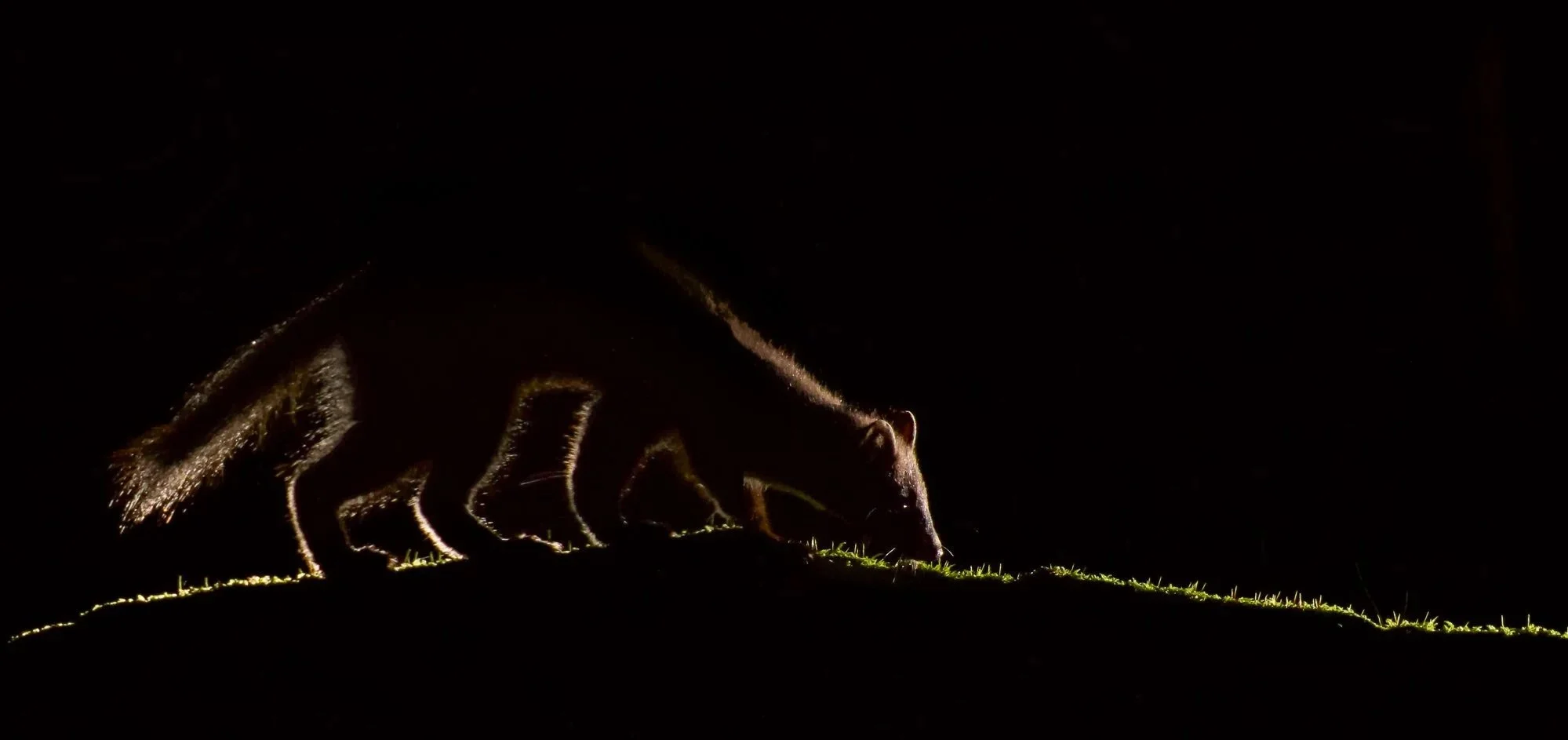
Patience is the one shortcut that doesn't exist
If I only had five minutes to prepare somebody for their first wildlife photography session, I probably wouldn't spend very much of that time talking about cameras.
I'd tell them to find water.
Whether it's a pond, a stream, a lake, a flooded ditch or simply a quiet drinking place used by mammals moving through the landscape, water concentrates life. Animals need it to drink, prey species gather around it and predators quickly learn where opportunities are most likely to arise. Time spent learning to read watercourses, crossings and the surrounding vegetation is almost never wasted because these places naturally become wildlife bottlenecks where movement is funnelled into predictable routes.
I'd then tell them to think carefully about the wind, choose a background that hides rather than advertises their outline and, most importantly, make themselves comfortable.
Then I'd ask them to do something that many of us find surprisingly difficult.
Sit still.
Don't keep checking your phone.
Don't stand up every ten minutes to see what might be happening over the next hedge.
Don't assume that because nothing has happened in the last half hour, nothing is about to happen in the next five minutes.
Simply watch.
As your eyes begin to slow down, you'll notice things that were invisible when you first arrived. A robin repeatedly dropping to the same patch of ground. A squirrel following exactly the same route between two trees. A rabbit emerging cautiously from cover before venturing a little further each evening. These observations may seem insignificant on their own, but together they become the foundation of future encounters because every visit adds another piece to your understanding of that place.
Nine times out of ten you'll go home without the photograph you imagined.
That isn't failure.
You've learnt where the wind begins to swirl as the evening cools. You've discovered which woodland edge the fox ignored and which one it preferred. You've noticed fresh feeding signs beneath an old fruit tree or realised that the deer crossed the stream fifty metres upstream from where you expected.
None of those things will necessarily produce a photograph today.
They may produce one next month.
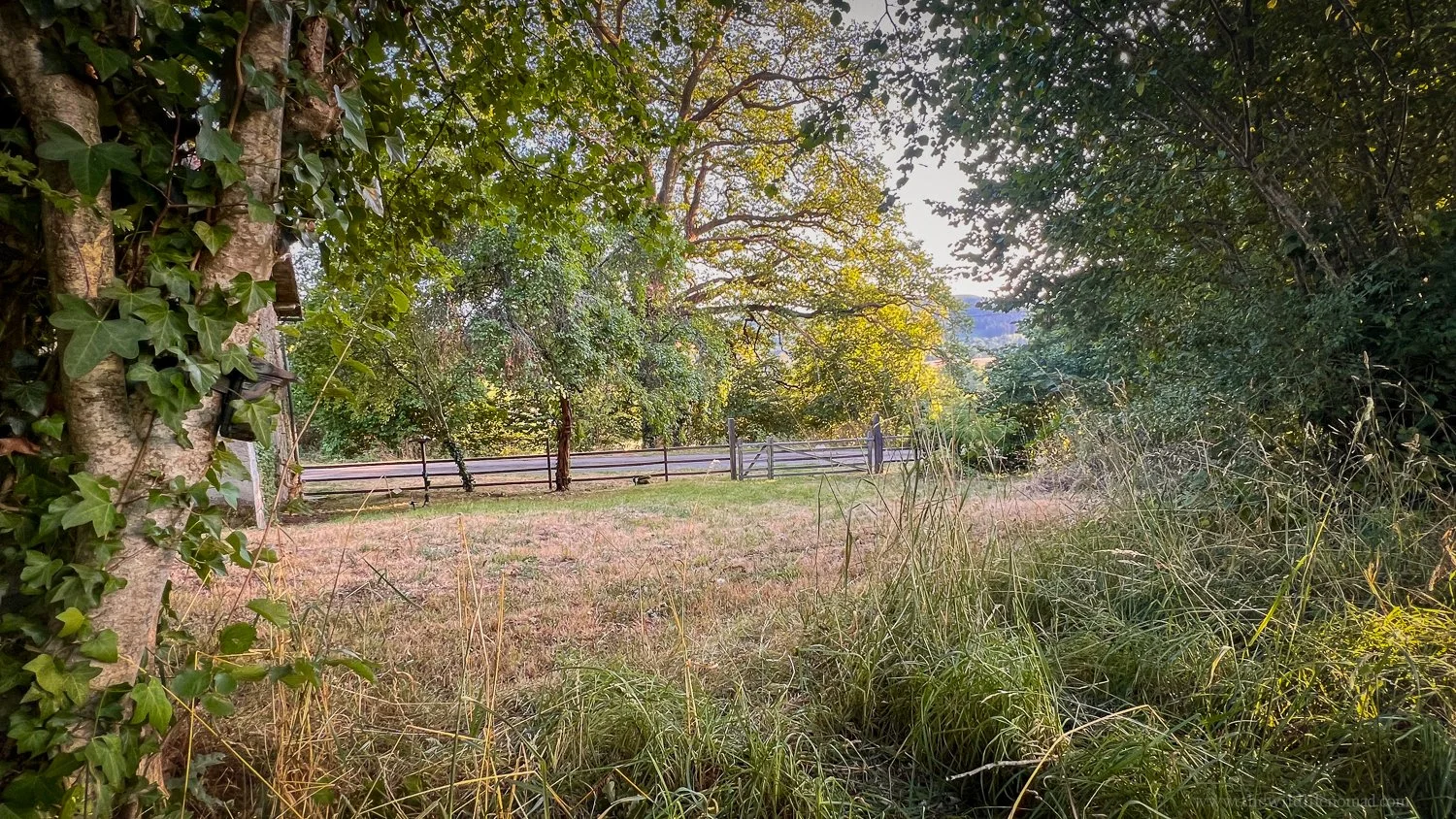
Ask a different question
So how do you get close to wildlife without disturbing it?
Most of the time, I don't.
I try to understand wildlife well enough that approaching becomes unnecessary.
For me, that's one of the biggest shifts any wildlife photographer can make because it replaces pursuit with observation, impatience with prediction and luck with understanding. Instead of treating every encounter as something to chase, you begin recognising that the countryside has been quietly revealing its patterns all along through tracks in soft mud, worn animal trails, feeding signs, woodland edges, alarm calls, watercourses and the countless other clues that wildlife leaves behind every single day.
The more you learn to read those clues, the less you find yourself forcing encounters and the more often they happen naturally.
Perhaps that's the greatest irony of all.
The moment you stop making closeness your primary objective is often the moment animals begin coming closer than you ever thought possible.
So before you head out on your next walk, don't ask yourself where you're most likely to find wildlife.
Ask yourself where wildlife is most likely to want to be.
Find a comfortable place. Pay attention to the wind. Read the landscape. Watch for the small changes that interrupt its rhythm, and allow the countryside to tell its story at its own pace.
Sooner or later, it usually does.
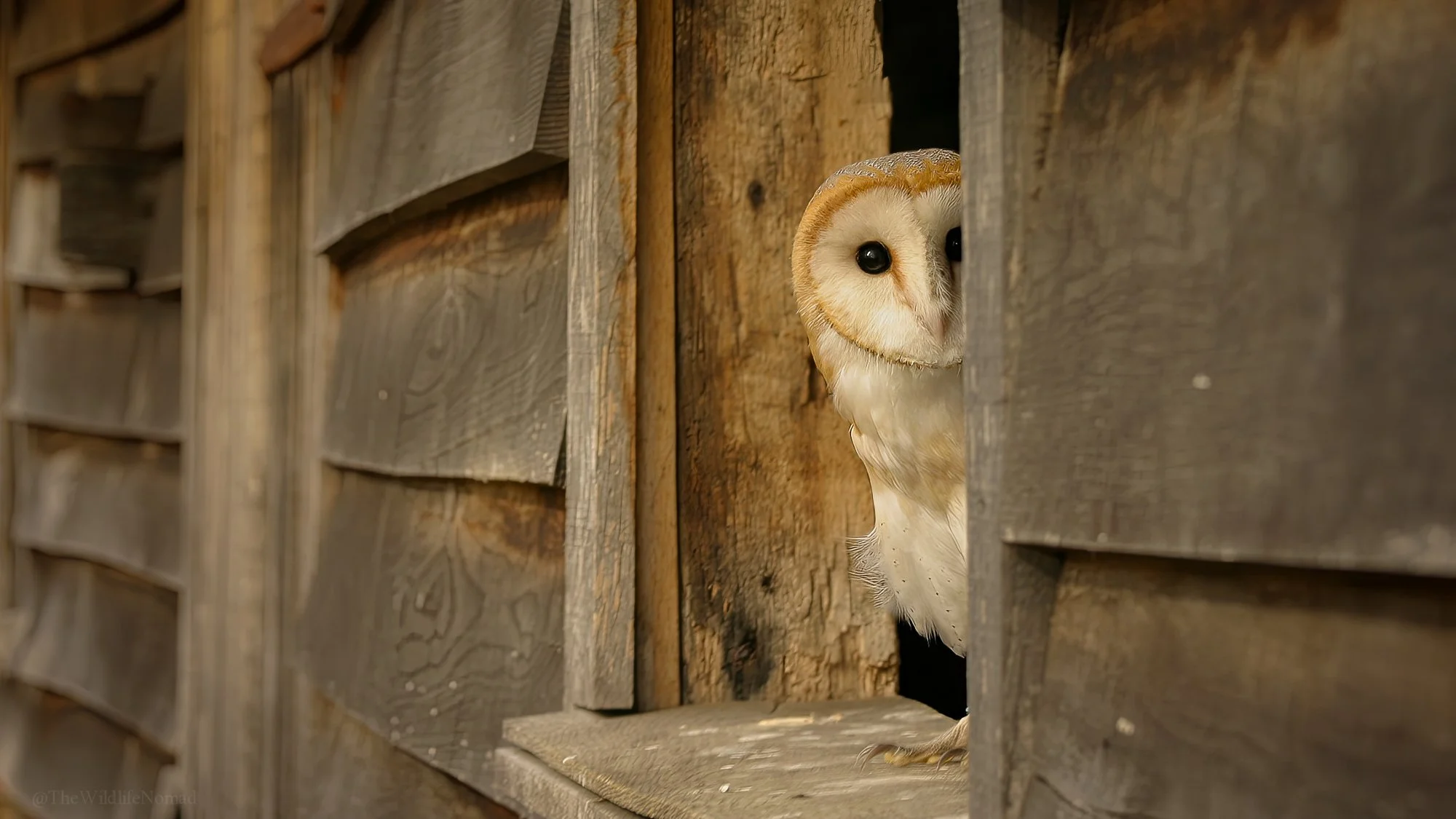
Frequently asked questions about finding wildlife
What time of day is wildlife most active in the UK?
Many British mammals are most active around dawn and dusk, when light levels are lower and the countryside is quieter. Foxes, badgers, deer, otters and rabbits often take advantage of these periods to feed or move between resting areas, although activity varies with season, weather and disturbance. Midday should not be dismissed completely, particularly in quiet places, during cold weather or when animals are feeding intensively.
Why do I rarely see wildlife when I go for a walk?
The commonest reason is that most people move through the countryside too quickly and noisily. Wildlife often detects us long before we detect it, then remains hidden or quietly moves away. Slowing down, stopping regularly, listening for alarm calls and watching woodland edges, field margins and watercourses will usually reveal more than covering a greater distance.
How can I tell whether an animal track is fresh?
Fresh tracks tend to have clean, sharply defined edges and may still contain moisture or displaced mud. Older prints gradually soften as wind, rain, frost, falling leaves and passing animals alter them. The best approach is to compare the track with recent weather conditions and look for a sequence of prints rather than relying on a single footprint.
Do wild animals use the same routes every day?
Many animals repeatedly use familiar routes because those paths provide safe, efficient access to food, water, shelter or resting places. Badgers, foxes, deer, rabbits and otters can all establish habitual lines of travel, sometimes using them for years. However, these patterns are not fixed. Seasonal food, vegetation growth, breeding behaviour, weather and human disturbance can all cause routes to change.
What equipment do I need to become better at finding wildlife?
You do not need expensive equipment to improve your wildlife watching. A good pair of binoculars, suitable clothing, a notebook and access to a map are usually enough. A small torch, field guide or thermal imager can be useful in some situations, but careful observation and patience will make a greater difference than most specialist gear.