

Why Fallen Fruit Creates Wildlife Hotspots (and How to Find Them)
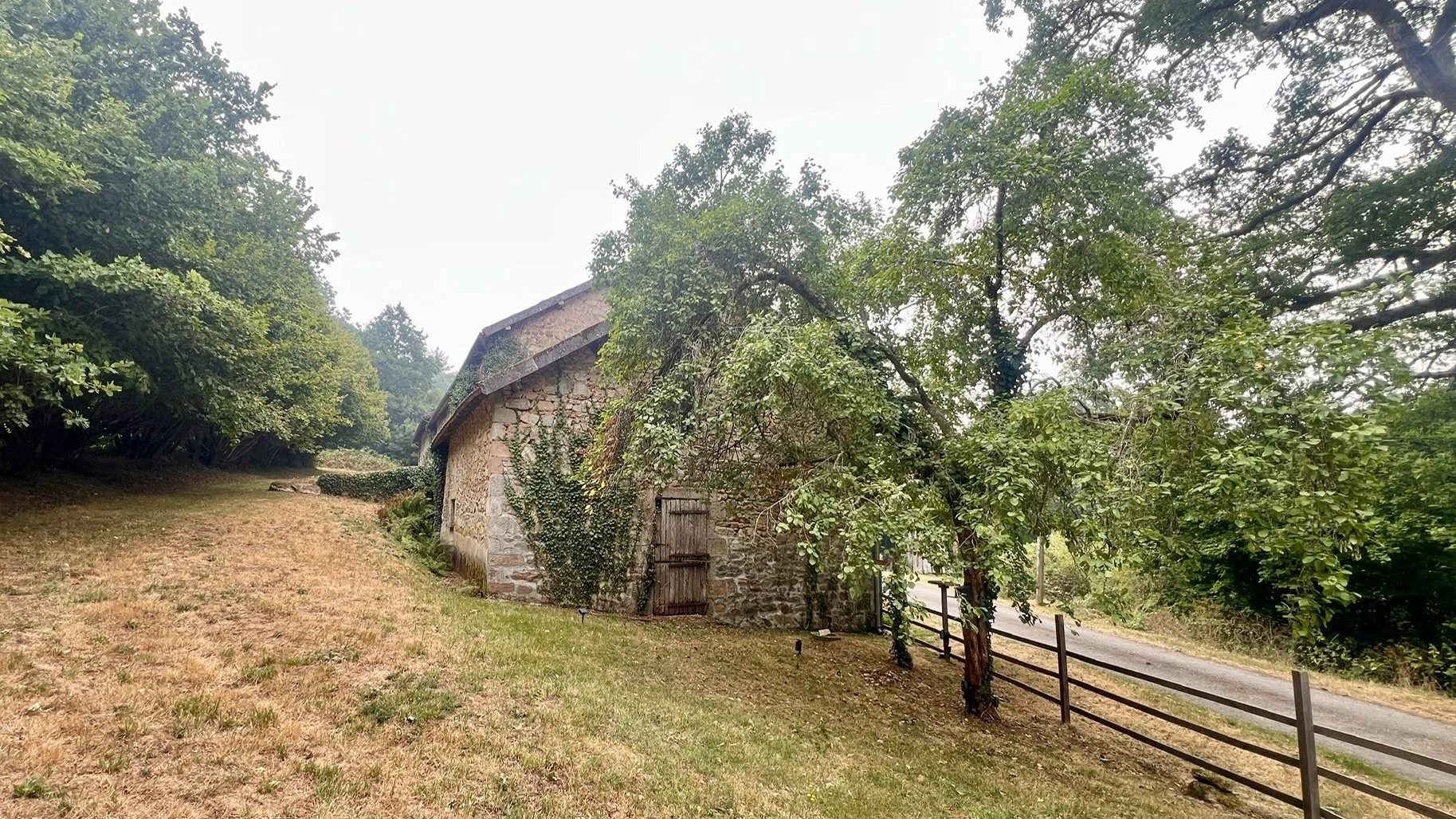
One Tree, Four Mammals and a Lesson in Fieldcraft
Every July, for a few short weeks, a single plum tree at Le Mas becomes one of the busiest places on the property.
Walk past it in the middle of the afternoon and you might wonder what all the fuss is about. A few overripe plums lie scattered across the grass. Wasps drift lazily between the fallen fruit. Hornets hum among the leaves overhead, and there’s a faint sweet smell of fermenting fruit hanging in the warm air. It doesn’t look particularly remarkable.
Come back after dark and it’s a completely different world.
Over the last four years that one tree has attracted pine martens, badgers, foxes and hedgehogs. Blackbirds, song thrushes and jays spend their days picking over what remains, while bank voles and mice appear beneath the cover of darkness. Tawny owls and barn owls also patrol the area after dark, potentially taking advantage of the increased small-mammal activity below.
It would be easy to conclude that all of this happens because animals like plums. That’s certainly true, but it misses the real story.
Fallen fruit can attract wildlife because it creates a concentrated, predictable source of energy. In Britain, apples, pears, plums, cherries and berries may be eaten by mammals and birds, while fermenting fruit also attracts insects and other invertebrates. The most productive trees tend to combine abundant food with nearby cover and safe access routes.
What I’ve come to realise is that fallen fruit isn’t simply food. For a brief period each year it creates a temporary wildlife feeding station, drawing together an entire community of species that would otherwise rarely use exactly the same place. If you know how to recognise these seasonal hotspots, they become some of the most predictable places to watch wildlife.
Interestingly, I didn’t arrive at that conclusion by watching animals feeding beneath plum trees. In fact, the first clue came from something much less obvious.
Years ago, while examining pine marten scats, I noticed they were packed with ivy seeds. Almost every sample contained them. At the time, I hadn’t really appreciated just how important seasonal fruit was to pine martens. Seeing those tiny seeds over and over again forced me to think differently. Rather than asking where pine martens were living, I started asking where their food was appearing throughout the year.
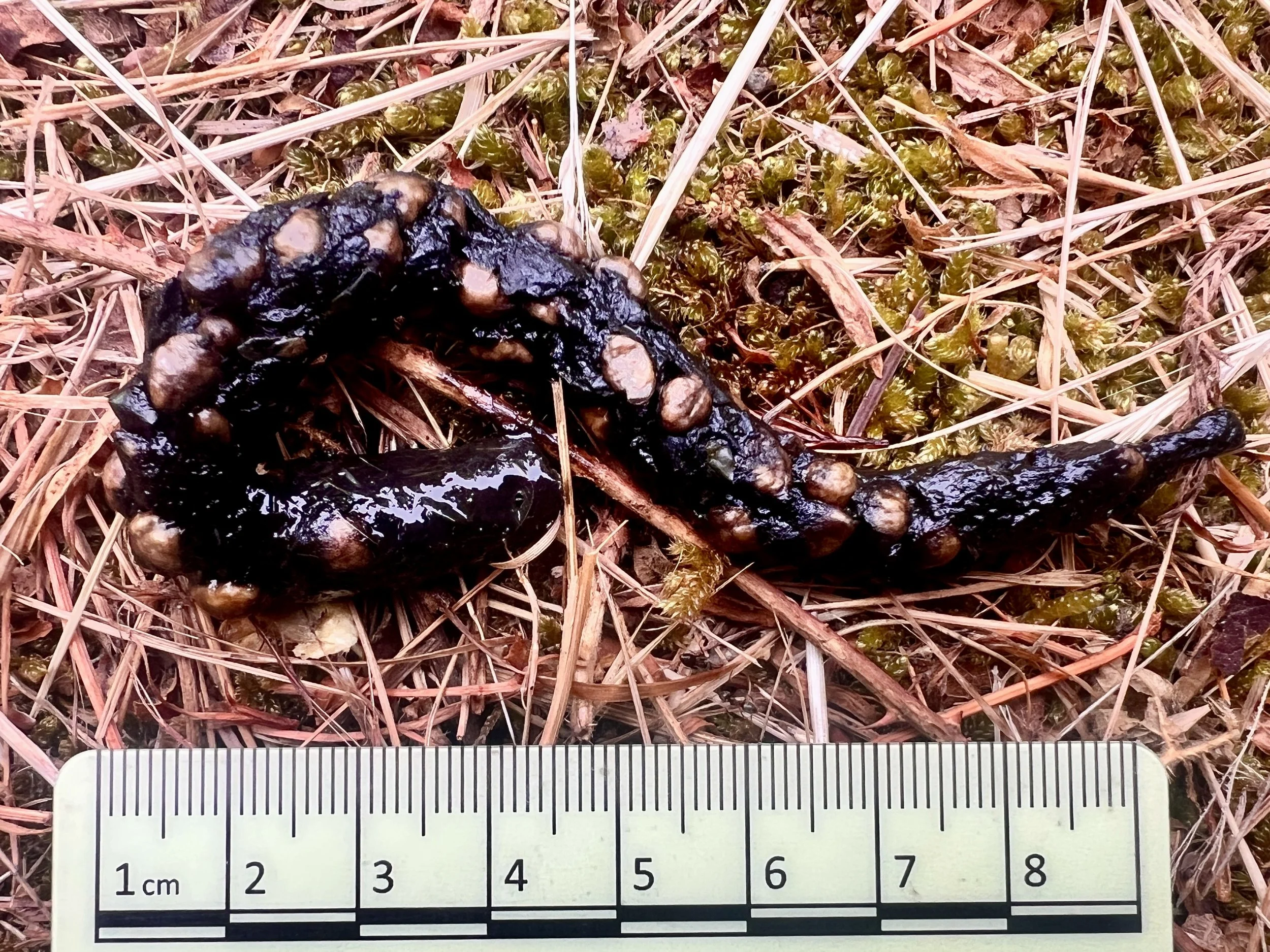
Examining Pine Marten scats led me to think about seasonal diet and how they and other wildlife were accessing resources around their territories.
That simple change in thinking altered the way I looked at the landscape.
Instead of treating fruiting trees, berry-laden shrubs and ivy-covered oaks as background scenery, I began to see them as seasonal feeding stations. Cherries in early summer. Plums a few weeks later. Walnuts in autumn. Ivy berries towards the end of winter. Each one offers a short-lived abundance of food, and wildlife responds remarkably quickly.
The plum tree at Le Mas has become the clearest example of that lesson.
When the Plums Fall Everything Changes
Every year the pattern repeats itself. For most of the summer there’s very little activity beneath the tree. Then, almost overnight, the first ripe plums begin to fall and everything changes.
Usually the first visitors are pine martens.
Often it’s a female with this year’s kits. Their appearance is remarkably well timed with the ripening fruit, and they begin making repeated visits throughout the evening and into the night. Before long, badgers begin arriving beneath the tree. Foxes follow later, typically during the quietest hours of the night, and hedgehogs come and go in the spaces in between the other night life. In the daylight, blackbirds, thrushes, jays and robins descend upon whatever has been left behind.
At first glance it looks like a random collection of species, all taking advantage of an easy meal. Spend enough evenings watching, though, and another pattern begins to emerge. None of these animals are simply turning up because there’s fruit on the ground.
They’re choosing this particular tree, and that raises a much more interesting question.
Why this one?
It Was Never Just About the Plums
The obvious answer is that this tree produces a lot of fruit. The more accurate answer is that it produces a lot of fruit in exactly the right place.
Not far away there are other plum trees. They fruit just as reliably, yet I’ve never recorded pine martens, badgers or foxes feeding beneath them. If fruit alone explained everything, all of the trees should be equally busy.
They aren’t. That’s what makes this particular tree so fascinating.
Over time I’ve become convinced that the wildlife isn’t choosing the tree, it’s choosing the combination of food and safety that surrounds it. The plums may be the attraction, but the landscape determines whether animals are prepared to take advantage of them (you can read more about how wildlife uses the landscape in a dedicated blog here).
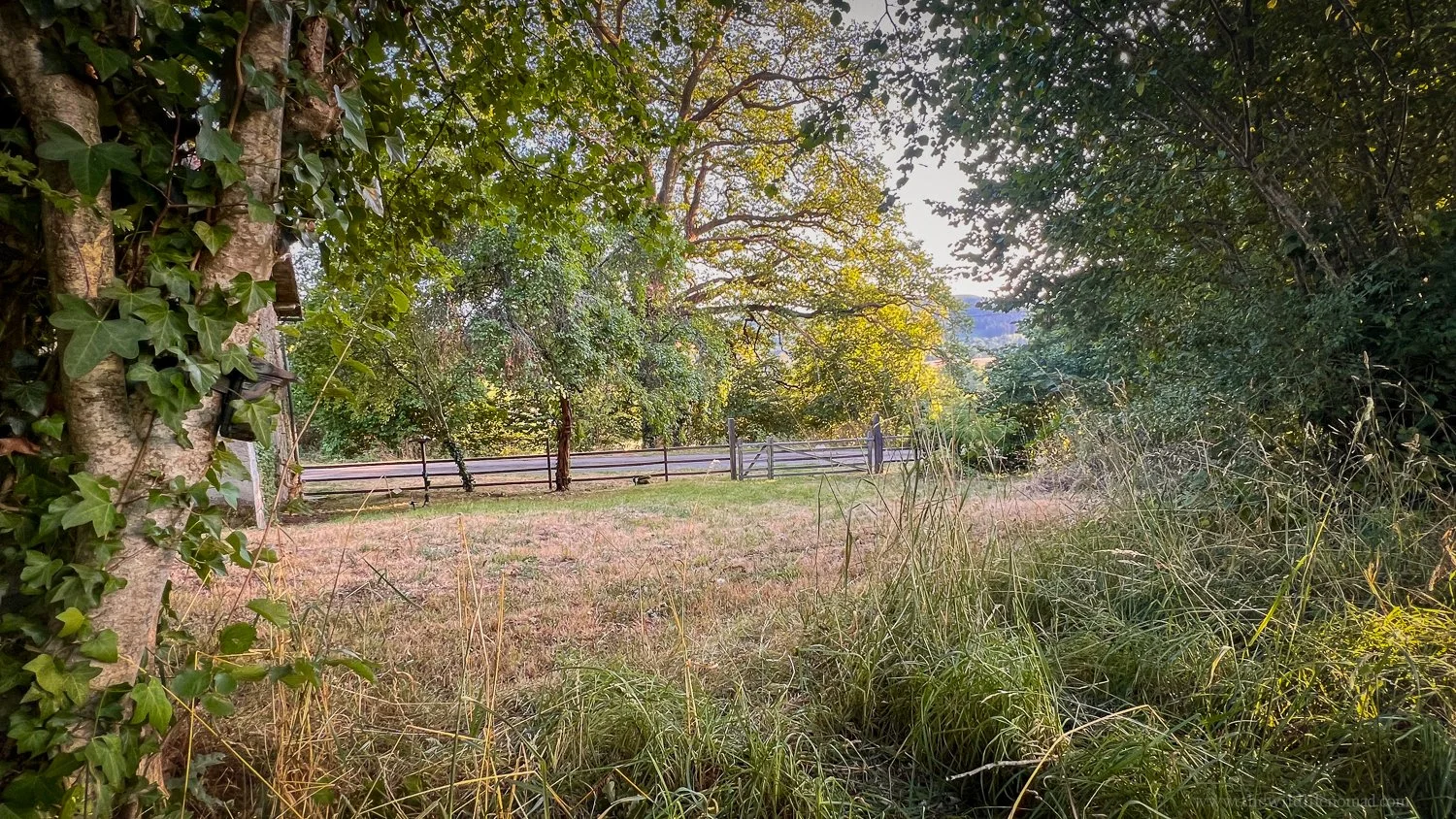
A view of the plum tree (centre by the fence) from the end of the hazel hedge. Behind me is the pasture where the badgers are able to approach and from a safe distance check for any danger before coming in to feed on the fallen fruit.
The tree sits at the far end of the property, well away from the house and where the dog spend most of his time. Human disturbance is minimal. Even if we’re outside, we’re unlikely to be heard from that distance.
Just as importantly, the tree is surrounded by escape routes.
Only a short distance away is a dense hazel hedgerow. Beyond that lies open pasture where badgers can pause, scan the area and decide whether it’s safe to continue. If anything feels wrong, they’re only a few seconds from cover again.
Hidden Routes Through the Landscape
The Pine Martens have another option all together.
Running beneath the lane is a concrete culvert measuring about 28 feet long and just 12 inches across. I hadn’t expected pine martens to use something like that, but after placing trail cameras at either end, it became clear that they travel through it regularly. The same tunnel is also used by bank voles, wood mice and even dormice. It acts as a hidden corridor beneath the road, allowing animals to move between scrub underneath a large oak tree and the plum tree without exposing themselves in the open.
That was one of the biggest lessons I’ve learned from watching this site.
Before then, I’d thought of culverts simply as drainage features. Now, whenever I find one in suitable habitat, I automatically wonder which animals might be using it as a movement corridor. It completely changed the way I read the landscape.
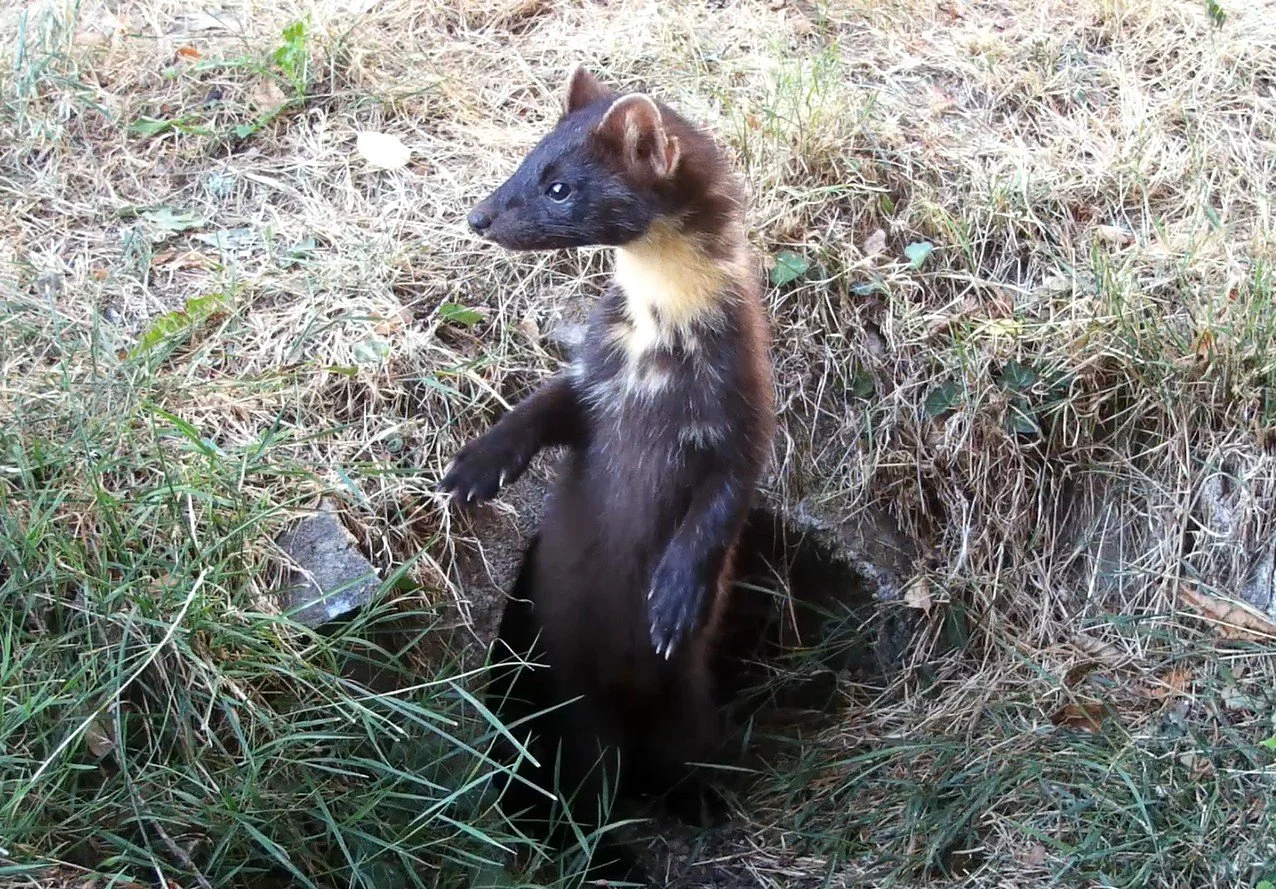
The Pine Martens have learnt that an old culvert that runs under our lane provides perfect hidden access to the base of our plum tree, allowing them to move from a sheltered position of safety under an old oak tree to an important seasonal food source.
If you remove the nearby cover, the concealed approach routes and the lack of disturbance, I suspect it would become a far less attractive feeding site, despite producing exactly the same crop of fruit.
That’s an important lesson because it’s very easy to fall into the trap of looking at individual features in isolation.
People often ask me where to find wildlife, expecting the answer to be a particular woodland, river or meadow. In reality, wildlife rarely responds to just one thing. Animals are constantly balancing opportunity against risk. A tree laden with fruit is valuable, but only if they can reach it, feed there with a reasonable degree of confidence, and disappear again without exposing themselves unnecessarily.
Once you start looking at the countryside through that lens, you begin to notice why some places become wildlife hotspots while others never quite live up to their promise.
Watching the different species beneath the plum tree has reinforced that idea time and again, but it’s also revealed something else I hadn’t expected. Although several mammals may use exactly the same feeding station during a single night, they rarely use it at the same time.
Instead, they appear to take turns.
A Shared Table, But Nobody Eats Together
One of the assumptions I made during the first year was that all these animals would eventually meet beneath the tree.
After all, if there’s an abundant food source that everyone wants to exploit, surely they’d all arrive together.
That isn’t what happened.
Instead, they seemed to operate an unwritten timetable. Pine martens are usually the first mammals to arrive, often appearing during the evening before darkness has fully settled. They remain active through much of the night, but their visits are surprisingly brief. A pine marten rarely stays beneath the tree for very long. It will dash in, grab several plums, disappear into cover and then, only a few minutes later, come racing back for more.
Badgers behave very differently.
Once they arrive, they settle in. I’ve watched individual badgers spend half an hour or more beneath the tree, methodically working backwards and forwards like a living vacuum cleaner. They don’t appear particularly selective either. Whether a plum is perfectly ripe or slightly underripe seems to matter very little. If it’s edible, it’s consumed, and they simply continue across the ground until very little remains (if you are interested in learning more about Badgers and how to recognise their tracks and other field signs, this blog is very helpful)
Foxes are different again. Although they also feed beneath the tree, they tend to appear later in the night when everything is at its quietest. They’re noticeably more cautious than the badgers, and in four years of watching I’ve never recorded foxes sharing the feeding area with pine martens or badgers. Whether that’s because they’re actively avoiding one another or simply operating on different daily rhythms, I can’t say with certainty. What I can say is that the trail cameras show remarkably little overlap.
It’s as though each species has found its own shift.
Same tree. Same Food. Very different strategies
The pine martens taught me something else I wasn’t expecting. Rather than sitting beneath the tree and eating until they were full, they often carried the fruit away. Sometimes I’d see one disappear with two, three or even four plums clamped between its jaws before vanishing into the nearby hedge or through the culvert. Within a minute or two it would return and do exactly the same thing again.
The first time I watched this happen, I assumed it was simply taking the fruit somewhere quieter to eat. Then it happened again. And again. Whatever was happening, the pine martens were clearly transporting food rather than consuming everything where they found it.
Whether they were caching the plums for later or carrying them back to dependent kits is impossible to say from the evidence I have. Both explanations are plausible. What matters is that they were behaving very differently from the badgers, despite exploiting exactly the same resource.
Even more remarkable was watching the family itself.
Over the years I’ve been able to recognise individual pine martens from the distinctive cream bib patterns on their throats. This year, for a few magical evenings, four animals fed beneath the tree at the same time. From those markings, I believe they were the adult female, her two kits and an older female that I strongly suspect was the kits’ grandmother.
I can’t prove that relationship, so it remains a well-supported interpretation rather than a certainty. Regardless, watching four pine martens moving around the same tree, and at times climbing into the branches together to feed on fruit that hadn’t yet fallen, was one of the most extraordinary wildlife spectacles I’ve ever witnessed.
As special as that was, there is another sight that perhaps means even more to me.
Every now and then, the cameras capture not one badger beneath the tree, but two.
That might not sound remarkable until you’ve spent time watching badgers. They can be surprisingly cautious animals. If they don’t feel secure, they’re gone in an instant. To see two feeding calmly alongside one another, completely absorbed in gathering fallen plums, tells me something important about that place.
It tells me they feel safe, and perhaps that’s the biggest lesson of all. Wildlife isn’t simply attracted to food, it’s attracted to places where food and security come together.
How to Find Your Own Wildlife Feeding Stations
One of the reasons I wanted to write this article is because I don’t want you to come away thinking this story is about one plum tree in rural France. It isn’t. The principle applies almost anywhere.

An abundance of food, that can be exploited safely is an ideal hotspot, even better if it is coupled with interconnected routes that offer cover and protection.
The species may change, the location may change, but the pattern doesn’t. Animals are constantly seeking out places where food is abundant, easy to gather and, perhaps most importantly, safe to exploit.
Once you start recognising those places, you stop relying quite so much on luck.
The mistake most people make is to look at a fruit tree as an isolated feature…..as just a tree. What they don’t see is everything around it.
When I find a fruiting tree, I rarely look at the branches first. Instead, I take a slow walk around the surrounding landscape. Is there a hedgerow leading directly towards it? Is there a woodland edge nearby? Could an animal reach the tree without crossing a hundred metres of open ground? Is there somewhere it can disappear if disturbed?
Those questions are often far more important than asking what species of tree it is.
A tree standing in the middle of an exposed field may produce a huge crop of fruit every year, yet attract relatively little wildlife because feeding there simply carries too much risk.
The fruit creates the opportunity. The surrounding landscape determines how safely they can exploit it.
Read the Ground Before You Watch the Tree
People often spend all their time scanning the canopy, hoping to spot movement among the leaves. I do the opposite. I look for partially eaten fruit. Fresh droppings. Tracks where the ground allows them to register. Small paths leading in from surrounding cover. Disturbed leaves. Even the insects can tell you a great deal. A tree buzzing with wasps, hornets and flies is usually telling you that fruit is falling and beginning to ferment, long before you’ve noticed it yourself. If you would like to know more about tracks and paw prints, and how to recognise fox, badger, deer and other mammals, this blog gives a great overview.
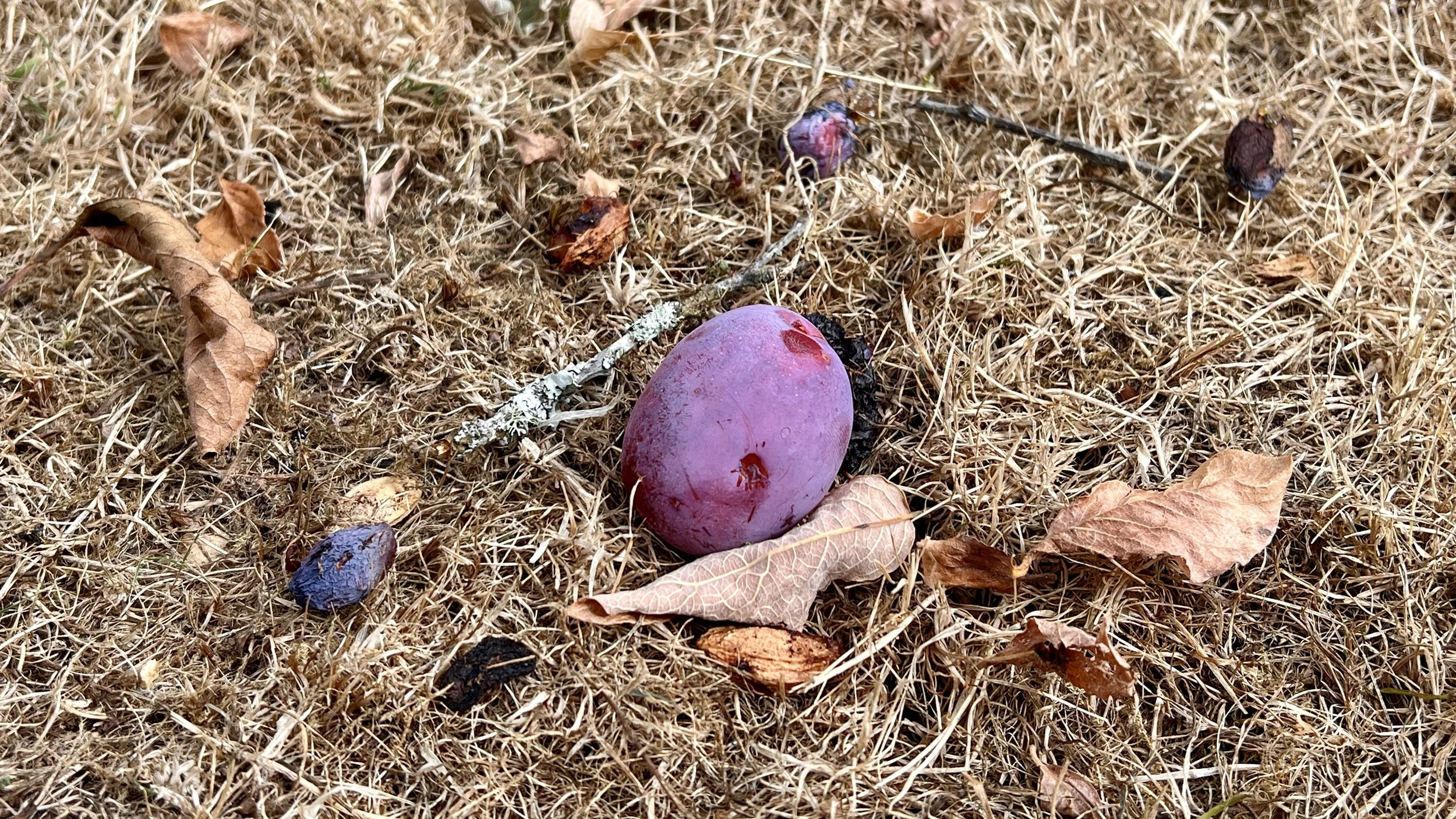
Fallen fruit are hugely attractive to both mammals and birds and should be the first place you look for signs of wildlife activity, such as feeding signs and footprints.
The wonderful thing is that this isn’t limited to plum trees.
In early summer I begin paying attention to cherry trees because I know they’re likely to attract wildlife. Later, as plums ripen, my attention shifts again. In Britain, walnut trees can become excellent places to watch badgers during autumn, while old orchards often attract a wonderful mix of mammals and birds once apples and pears begin falling. Blackberry patches, elderberries and other seasonal fruits all have their own communities of visitors.
Rather than memorising individual species, try thinking in terms of seasonal feeding stations.
Ask yourself one simple question. What is producing abundant natural food right now? Then ask another.
How would wildlife reach it?
Those two questions will often tell you far more than any field guide.
Stop Looking for Wildlife. Start Predicting it
Perhaps the biggest lesson this plum tree has taught me is that wildlife is far more predictable than we sometimes imagine.
People often tell me they’ve walked through an orchard in broad daylight and never seen a thing. My response is usually the same.
That doesn’t necessarily mean nothing is using it. You may simply have been there at the wrong time.
By the time the sun rises, the pine martens have usually disappeared into the woods. The foxes have slipped quietly away. The badgers are back underground. All that’s left are the clues. The buzzing insects. The well-worn paths. The scent of ripe fruit. The occasional footprint. The fruit with fresh tooth marks. Every one of them is evidence that the place comes alive when we’re asleep.
Long before you think about cameras, lenses or settings, spend time understanding why wildlife chooses one place instead of another. Learn to recognise those seasonal opportunities. Accept that nature is constantly changing, and that today’s hotspot may be somewhere completely different six weeks from now.
Because once you start thinking like that, something rather satisfying happens. You stop wandering through the countryside hoping to stumble across wildlife.
Instead, you begin making educated predictions about where you expect to find it.
The next time you pass an old orchard, a solitary apple tree beside a hedgerow or a plum tree dropping fruit onto the grass, don’t simply admire the fruit or glance into the branches.
Pause for a moment, look at the ground, look at the surrounding cover.
Ask yourself how a badger would approach it, where a tawny owl would wait before hunting beneath it, or how a fox might reach it without ever being seen.
Because that tree may not simply be producing fruit.
For a few short weeks each year, it may be one of the busiest wildlife feeding stations in the landscape, quietly revealing itself to anyone prepared to read the signs.
Other Blogs That You May Enjoy
European Pine Marten (Martes martes) Diet, Foraging Ecology, and Caching Behaviour
How to Find More Wildlife: Why Most People Look for Wildlife the Wrong Way
Fox Paw Print Identification: Fox Tracks vs Dog Tracks | Wildlife Nomad
Frequently Asked Questions
1. Should you leave fallen fruit on the ground for wildlife?
Yes, in most cases. Fallen fruit provides seasonal food for many birds and mammals, while the insects and other invertebrates it attracts can support additional wildlife such as hedgehogs. If you have more fruit than you need, leaving some beneath trees or in a quiet corner of the garden can benefit wildlife. However, it’s sensible to remove excessive quantities of mouldy fruit from lawns or paths where it could create a slipping hazard or encourage wasps in heavily used areas.
⸻
2. What wildlife is most likely to visit an orchard?
Traditional orchards can be exceptionally rich wildlife habitats. Depending on the season and location, orchards may attract badgers, foxes, hedgehogs, deer, mice, voles and, in some areas, pine martens. Many will exploit fallen fruit directly, while others are drawn to the insects and other invertebrates concentrated around it. During the day, orchards attract blackbirds, thrushes, jays, woodpeckers and a host of insects, making them excellent places for wildlife watching throughout the year.
⸻
3. When is the best time to watch wildlife feeding on fallen fruit?
Many of the mammals likely to visit fallen fruit in Britain are most active from dusk through the night, particularly at disturbed sites. The most productive time varies by species and location, so trail cameras are often the best way to establish when a particular feeding site is being used. Birds tend to feed during daylight, while insects are active throughout warm days. If you’re hoping to watch mammals without disturbing them, the last hour before darkness or the first hour after sunrise are often the most rewarding times to observe from a discreet distance.
⸻
4. Can fallen fruit attract unwanted pests?
Fallen fruit can attract wasps, flies and rodents, particularly if large quantities are left to ferment. In a natural setting, however, these animals form part of a healthy ecosystem and often attract predators such as owls, foxes and other wildlife. If fruit is falling close to patios or children’s play areas, consider leaving some for wildlife elsewhere in the garden while clearing heavily used areas.
⸻
5. Which fruit trees are best for attracting wildlife?
Traditional orchard and fruit trees can be extremely valuable for wildlife, and apples, pears, plums, cherries and damsons are particularly valuable because they provide blossom for pollinators in spring and fruit later in the year. Mature trees growing close to hedgerows, woodland or other cover are often used by more species than isolated trees standing in open ground.