

Species Spotlight: The Northern Goshawk
Part One - A New Beginning in the Wye Valley

A New Territory
Moving house resets your relationship with the land. You start again, learning the paths, meeting people, and building a picture of how wildlife uses the place. Since moving to our new home in the Wye Valley, I’ve been in that stage of exploration. The lanes, the woods, and the ridges all feel full of potential, but somehow a little empty due to my lack of knowledge. As always, I began with research: maps, satellite imagery, and old wildlife reports. One name kept cropping up: the northern goshawk (Accipiter gentilis).
If you shaded the UK’s goshawk strongholds, the Forest of Dean and the Wye Valley would be among the darkest. Mixed woodland, conifer blocks, open rides, and steep slopes give these hawks exactly what they need. The valley may be new to me, but it’s long-established territory for the goshawk.
Never one to shy away from the difficult (and as I have never photographed a goshawk) I’ve set myself a year-long challenge: to find, study, and eventually photograph the birds that live here. This is part one of that journey.
The Northern Goshawk: Forest Hunter, Silent Shadow
If you walk in mature plantation or mixed woodland, a goshawk has possibly watched you without you knowing. They are large, broad-winged hawks built for tight spaces and short, explosive chases. Everything about them is made for ambush. The northern goshawk is the largest of Britain’s true hawks, well above sparrowhawk in size and power. Females are bigger — up to 60 cm long with a wingspan near 120 cm. Males are around 48–55 cm with a wingspan close to a metre. That size gap helps them divide prey choices.
They look like giant sparrowhawks, but there are clear differences. Goshawks are chunkier, deep-chested, with thick, feathered legs and a strong head. Their wings are broad and rounded, their tail long and square. Up close the face is unmistakable: a bold white eyebrow, a heavy-browed look, and eyes that shift from yellow in juveniles to orange and red in adults. The plumage is slate above and finely barred below, suited to dappled light.
Calls are most often heard in late winter and early spring, the carrying kek-kek-kek of display and territory. For most of the year, though, they are quiet.
Habitats and Range
In the UK, goshawks favour large, mature woods. Conifer plantations with clearings and rides, mixed broadleaf slopes, and deep valleys all feature. Once wiped out by persecution, they returned through reintroductions and natural recolonisation and now breed in selected parts of Scotland, England (Forest of Dean, Wye Valley, New Forest to mention three), Wales, and the Borders.
Breeding, Behaviour, and Territory
Courtship starts early. February and March are the months for display: calm, clear mornings when pairs rise high above the canopy, calling and looping over their territory. They build large stick nests in mature trees with clear approach routes. The female lays two to four eggs, incubating them for about five weeks. Chicks fledge around six weeks later, then stay dependent for a time before dispersing. Once the young are independent, the adults melt back into the trees. Most sightings are fleeting: a pale flash along a ride, a heavy shape crossing a gap, or the alarm of crows and jays giving them away.
Long-term studies in the Forest of Dean and Wye Valley show that goshawk territories here are relatively compact compared to more open regions. Each breeding pair holds roughly 10–20 km² (1,000–2,000 ha) of woodland mosaic: a blend of conifer and broadleaf with good prey and nesting options. In landscapes with dense forest cover, that’s enough to support one pair every 4–7 km. Within that wider range sits the core nesting area, often 150–300 ha of mature woodland. This is the defended heart of the territory, the zone where the nest or alternate nests lie, where the adults hunt most frequently, and where disturbance can have the greatest impact. Many pairs maintain two to four alternate nests, each a few hundred metres apart, rotated from year to year depending on disturbance or tree health.
In lowland Britain, nests are typically 1–3.7 km apart, sometimes as close as 750 m where the topography blocks the line of sight. Nests within the same woodland can be reused for a decade or more, even as different individuals take over.

The Goshawk’s Year

Mistaken Identity: Goshawk or Sparrowhawk?
Many of us (including me) have called a big female sparrowhawk a goshawk at some point. Once you’ve seen a real goshawk well, the difference is obvious. Sparrowhawks are slimmer with snappier wingbeats and a lighter flight. Goshawks move with weight and purpose. The chest is deep, the tail long, the wings broad. Perched, the thick, feathered legs give them away.
Behaviour helps too. Sparrowhawks tolerate gardens and suburban edges; goshawks keep to larger woods, moving through them like ghosts.
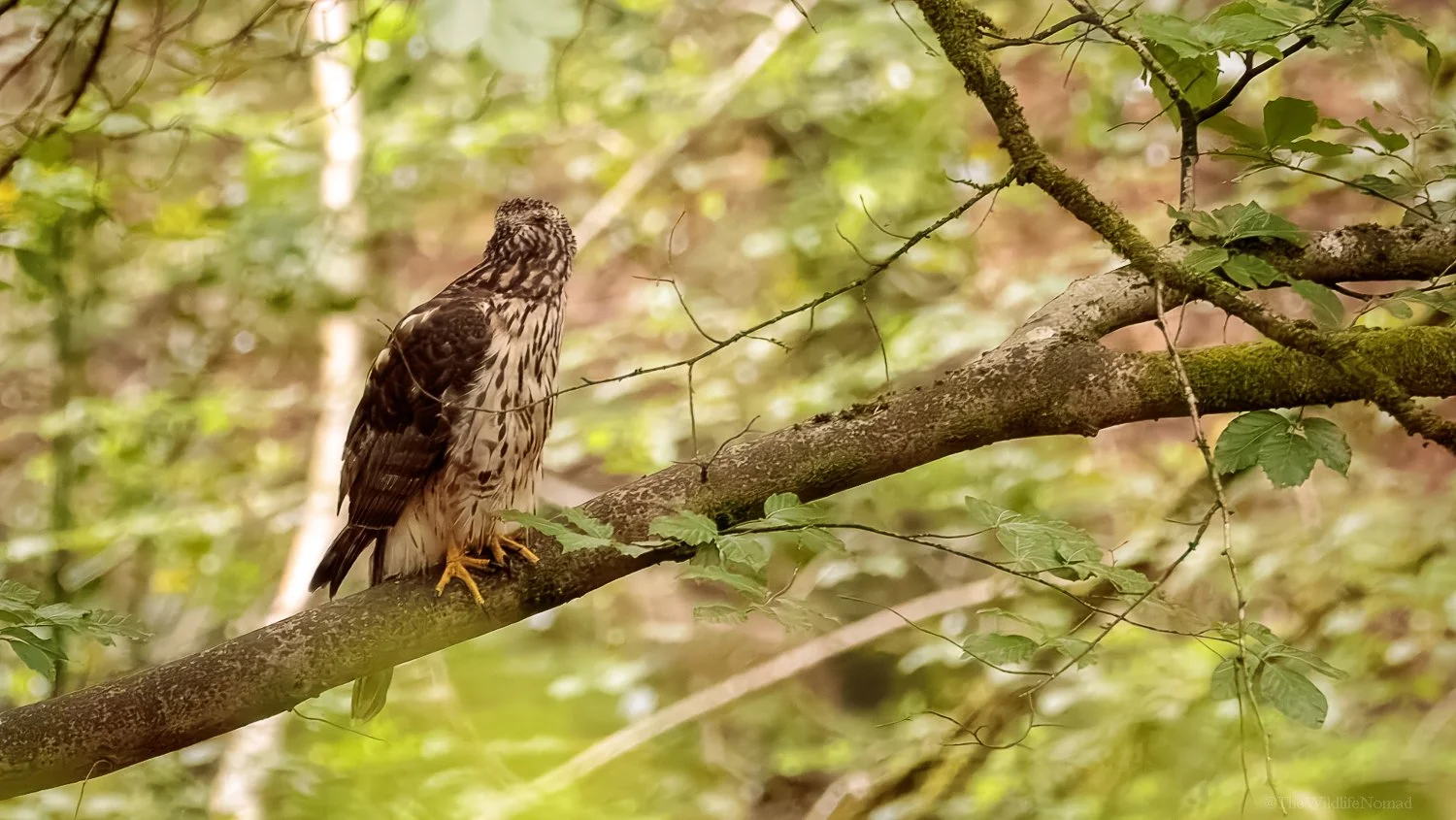
It’s an easier mistake to make than you might think. I took the image below about 4 years ago whilst looking for wild boar in the Forest of Dean. Eyes trained at ground level, I only noticed this juvenile, perched about 30ft up, a long time after they had spotted me. I managed to get just 2 shots off before it flew, and despite it’s head being turned away in both shots, I now know it’s clearly a Goshawk. At the time though, I put it down to a missed opportunity to beef up my Sparrowhawk portfolio, and the RAW file was never processed, until last week, when I was trawling through my 1000’s of unprocessed images and found it……..my first ever Goshawk image (however bad).
Goshawk Field Signs: Reading the Woods for Their Presence
Finding a goshawk is often about reading sign. They leave consistent clues around territories and feeding areas. Learn these and your chances rise without the need to push close.
Plucking posts and feeding perches
Male goshawks most often use plucking posts when provisioning the female and chicks in Spring. Look for favoured stumps, logs, wind-thrown root plates, and stout low branches used repeatedly to strip prey. True goshawk plucking posts show medium to large feathers (pigeon, jay, pheasant) with cleanly sheared quills and the possibility of snapped shafts. The remains form a focused patch rather than a random scatter. Expect these posts within 50–200 m of the nest, often uphill. Plucking posts with more than one prey item are strong signs of an active nest.
In conifers, expect posts on stumps, felled stems, and root plates. In broadleaf woods, look for logs, edges, and low branches.
Feather piles under cover
Goshawks often carry prey to sheltered spots to feed. Under dense boughs or at ride edges you may find neat feather piles where the bases are bitten off, tidy and concentrated, unlike the scattered mess left by foxes or crows.
Whitewash and pellets
White, chalky droppings on trunks, roots, or branches beneath favoured perches are another giveaway. Pellets are compact, grey, 3–5 cm long, full of fur, bone, and feather. These signs often mark regular perches or rest points and can remain visible for several years, even after a pair has moved.
Alarm networks
Crows and jays are excellent informants. A moving line of alarm calls often tracks a goshawk in flight. Pause and scan the rides; that heavy, barrel-chested silhouette crossing the gaps is what you’re hoping for.

Field Note: Ethics and Observation Distances
Goshawks are Schedule 1 birds. It’s illegal to intentionally or recklessly disturb them while nesting, building nests, or caring for eggs or young.
Field workers follow clear rules:
Keep 300–500 m away from any active nest.
Limit visits to 5–10 minutes if close approach is unavoidable.
Avoid all approach once chicks are 30 days old; premature fledging can occur.
Observation from distant ridges or using long lenses is the ethical option.
Your best chances come outside the breeding season, especially on still mornings in February or March when pairs display high above the canopy.
Remember, regardless of the season, if at any point the birds change their behaviour, look stressed, or disturbed, you have moved to too close. Immediately back away and leave the area. It is critical as wildlife lovers we respect and protect them, and that includes accepting responsibility when we get it wrong.
Long-Term Territory Fidelity
Goshawks may hold the same territory for a decade or more, though not always the same individuals. Generations reuse the same tracts of woodland, rebuilding old nests and using the same vantage perches and plucking sites year after year. Once a goshawk claims your valley, it can become a fixture in its ecology, a lineage rather than a fleeting visitor.
The Legality and Ethics of Photographing Goshawks
Because they’re Schedule 1 protected, photographing or filming near active nests requires a specific licence from Natural England, NatureScot, or Natural Resources Wales.
Even outside breeding, the principle is the same: distance, discretion, and welfare first.
If you want images, collaborate with licensed raptor workers who can guide you to safe vantage points well beyond the disturbance radius. Long lenses, silent shutters, and patient observation will reward you with authentic moments…….without harm.
A Lucky Encounter
With all that in mind, I expected to wait until late winter to see one. I assumed my first sighting would be a high display on a still morning. I pictured long walks through forestry tracks, scanning the skyline for that broad-winged outline.
Instead, it happened at home in October!
Early this morning, I stepped out the back door while the tea brewed. A few tits were fussing on the feeders. Beyond the garden wall, the field drops to a fringe of woodland. At the top of one tree a crow sat silhouetted, so I lifted the camera for a few frames. The crow kept glancing down, wings raised, unsettled.
Following its gaze, I saw him……a male goshawk, perched about eight feet below on the same tree. Orange eye bright. Bold white eyebrow. Heavy legs. Deep chest. He sat for half a minute before two crows dived at him. He launched, crossed the field low, and slipped over the lane into the far trees.
I rattled a few shots. They’re distant and grainy, but they serve as proof. Not a sparrowhawk. Not a buzzard. A goshawk, right here, within sight of the house!

One of the handful of shots I rattled off from the backdoor step. It’s soft as this is a huge crop of the original image, but this coupled with my other sightings gives me hope of much better images to come throughout the rest of the year and 2026.
Evening and Morning: Two More Encounters
Later that same day, as dusk settled over the valley, I saw goshawks again, this time 3 birds high to the south-east, rising and circling in the last thermals of the day. One bird repeatedly dived and looped, playful and restless, while the other two drifted steadily above. No calls, just silent power against a pale sky.
The next morning, standing in the same spot, I heard a single “kek-kek-kek” call twice from the woodland to the south. The sound was sharp and unmistakable, a presence declared, close and confident.
These back-to-back encounters suggest more than passing birds. The trio almost certainly represents a family group, probably a pair and one of this year’s fledged juveniles. The looping, diving flight fits the behaviour of a young bird practising aerial control, still shadowing the adults as it learns the bounds of the territory. The dawn calling the next day was likely one of the adults re-asserting their hold on that southern woodland or maintaining contact with the youngster.
Together they paint a vivid picture of continuity: not just a sighting, but the rhythm of a resident pair raising and guiding their young through the turning season. Watching them from the garden, silent at dusk, vocal the following morning, felt like I had been given a tiny glimpse into one of the valley’s secrets.
Looking Ahead
That glimpse has reshaped my plan for the coming months. I’ll start by mapping the local woods, logging where any plucking signs appear and how they cluster. Knowing that each pair controls around 10–20 km² means that much of what I’ll find in this stretch of valley will likely belong to one resident pair. The steps ahead are straightforward:
Contact the local NRW office to find out who monitors local goshawk numbers and welfare.
Investigate mature stands with good canopy cover and open rides. Try to identify core zone.
Visit the core zone in winter, when leaves are down and disturbance risk is low.
Search for any repeat plucking signs and feather piles, especially on stumps or root plates. if feasible place trail cameras overlooking regularly used plucking sites.
Record whitewash, pellets, and feather piles to map activity zones.
Keep well outside the core zone in spring. Distant observation, not intrusion.
Watch alarm networks of crows and jays for short glimpses.
Part Two will follow my efforts to learn more about “my” goshawks, what I’ve learnt about reading woodland structure to locate territories, distinguishing goshawk sign from other predators, and planning low-impact observation sessions that meet both ethical and legal standards.
For now, it’s enough to know they’re here……. silent, powerful, and watching from the trees. The Wye Valley belongs to them, and slowly, it’s starting to feel like home for me too.
Watch. Wait. Protect.
Related Blog Articles Worth Reading
Working with the Darkness: How to Master Low Light this Winter
Listening as Fieldcraft: How Sound Awareness Transforms Your Wildlife Photography
Eyes in the Woods: Mastering the Use of Trail Cameras for Wildlife Watching and Photography
——————————————-
Northern Goshawk FAQs
Are goshawks found in the UK?
Yes. Northern goshawks (Accipiter gentilis) are now re-established across much of Britain, with strongholds in the Forest of Dean, Wye Valley, Northumberland, and parts of Scotland and Wales. They prefer large, mature woodlands with a mix of conifer and broadleaf trees.
What is the difference between a goshawk and a sparrowhawk?
Goshawks are much larger and broader-winged, with powerful builds and deep chests. They have bold white eyebrows and red or orange eyes as adults. Sparrowhawks are slimmer, lighter, and usually found in gardens and towns, while goshawks stick to wild woodland.
When is the best time to see a goshawk?
Late winter and early spring (February to March) are ideal. On calm, clear mornings, pairs perform high display flights above the canopy as part of courtship. Outside the breeding season, goshawks are secretive and best detected through field signs or mobbing calls from crows and jays.
What signs show that goshawks are present in an area?
Look for pigeon feathers neatly stripped at plucking posts, whitewash droppings beneath perches, compact grey pellets, and alarm calls from corvids. These clues often reveal where goshawks hunt or rest, even when you never see them directly.
Is it legal to photograph goshawks in the UK?
Yes, but only with care. Goshawks are Schedule 1 protected birds, meaning it’s illegal to disturb them or photograph near an active nest without a special licence. The best time to photograph them ethically is outside the breeding season, during winter or early spring display flights.