

Watching Badgers at a Wildlife Junction: Lessons from an Interrupted Study
How a remote camera helped me investigate badger movements around an ordinary Wye Valley gateway, and how escaped cattle brought the study to an unexpected end.
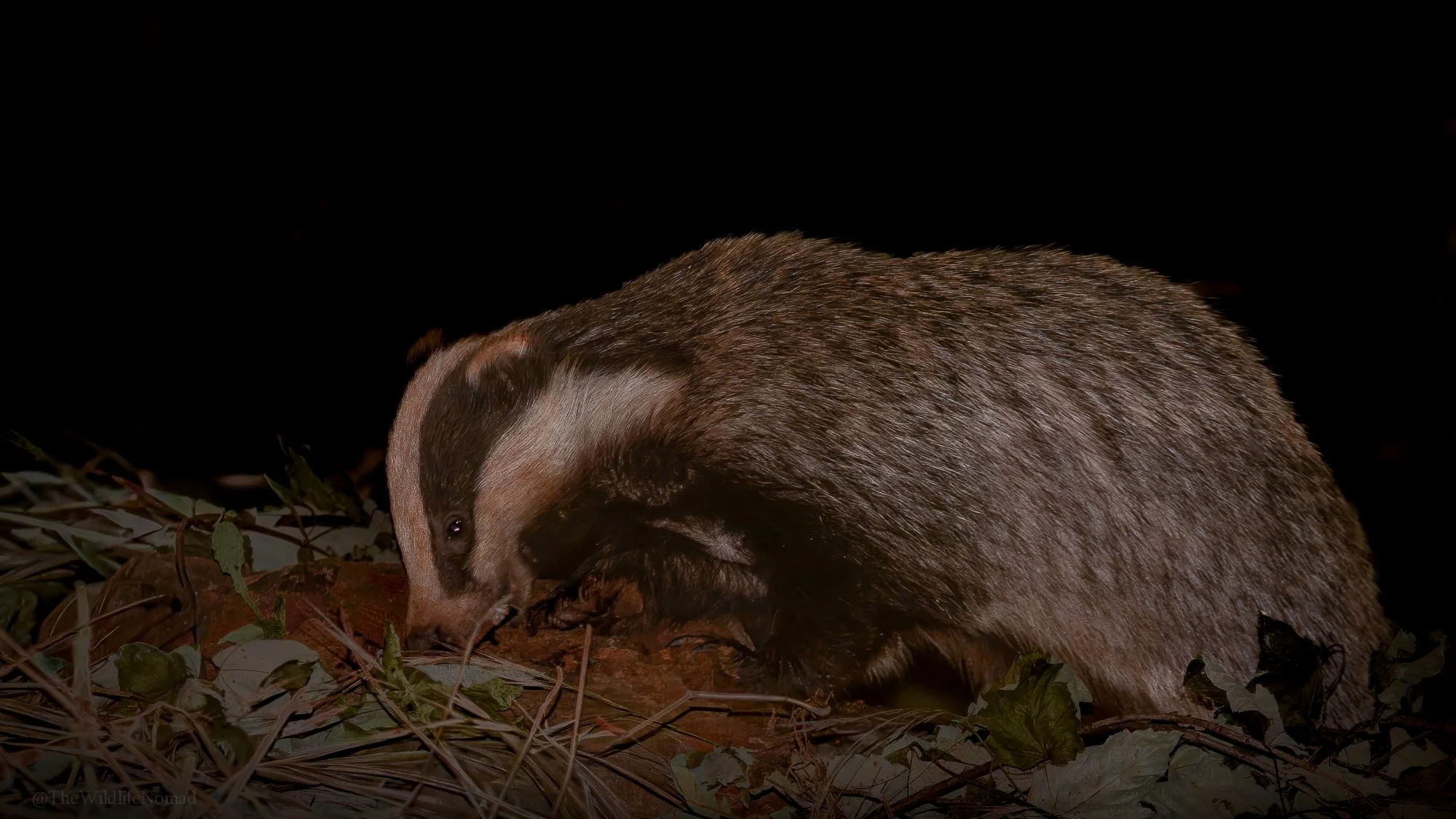
> Fieldwork update, September 2026: This study did not run according to plan. Escaped cattle entered the lane, knocked the monitoring camera from its clip and then trampled it. The camera stopped working, leaving me without the continuous record needed to complete the comparison I had planned. I have decided to restart the study in spring 2027 with a better experimental design and a much more secure installation.
An Ordinary Gate with More Going On Than I Realised
Some places in the countryside give away their importance immediately. A large badger sett or a muddy crossing covered in tracks is difficult to overlook. Others reveal themselves much more slowly.
The gate at Greenwood belongs to the second group.
At first glance, it is simply an entrance beside a sunken lane. The lane runs between banks and hedges, giving animals a sheltered route through the landscape. Open pasture lies on one side; on the other, a wooded bank rises steeply above the track. There were also signs of digging on the bank that suggested a possible badger outlier sett, although I could not establish that from the visible evidence and had no reason to investigate the entrances more closely.
What interested me was not the gate itself but the way several features met around it. An animal travelling along the lane could remain in cover, move out towards the pasture or turn towards the wooded bank. It looked less like a destination and more like a decision point.
Once I began paying attention, the evidence accumulated. Badger prints appeared in suitable ground. I found shallow snuffle holes among the leaves and occasional black-and-white hairs caught low on the wire. From the house, I also watched badgers through my thermal imager as they foraged in the field opposite, sometimes drifting towards the lane before disappearing from view.
I knew badgers were present. What I did not know was how this particular gateway fitted into their nightly movements.
That is the distinction I am increasingly interested in. Finding a track or seeing an animal tells you that a species has been there. The more useful question is what brought it to that particular place, which route it followed and whether that movement through the landscape is likely to be repeated.
The only practical way to answer that here was to keep watching after I had gone indoors.
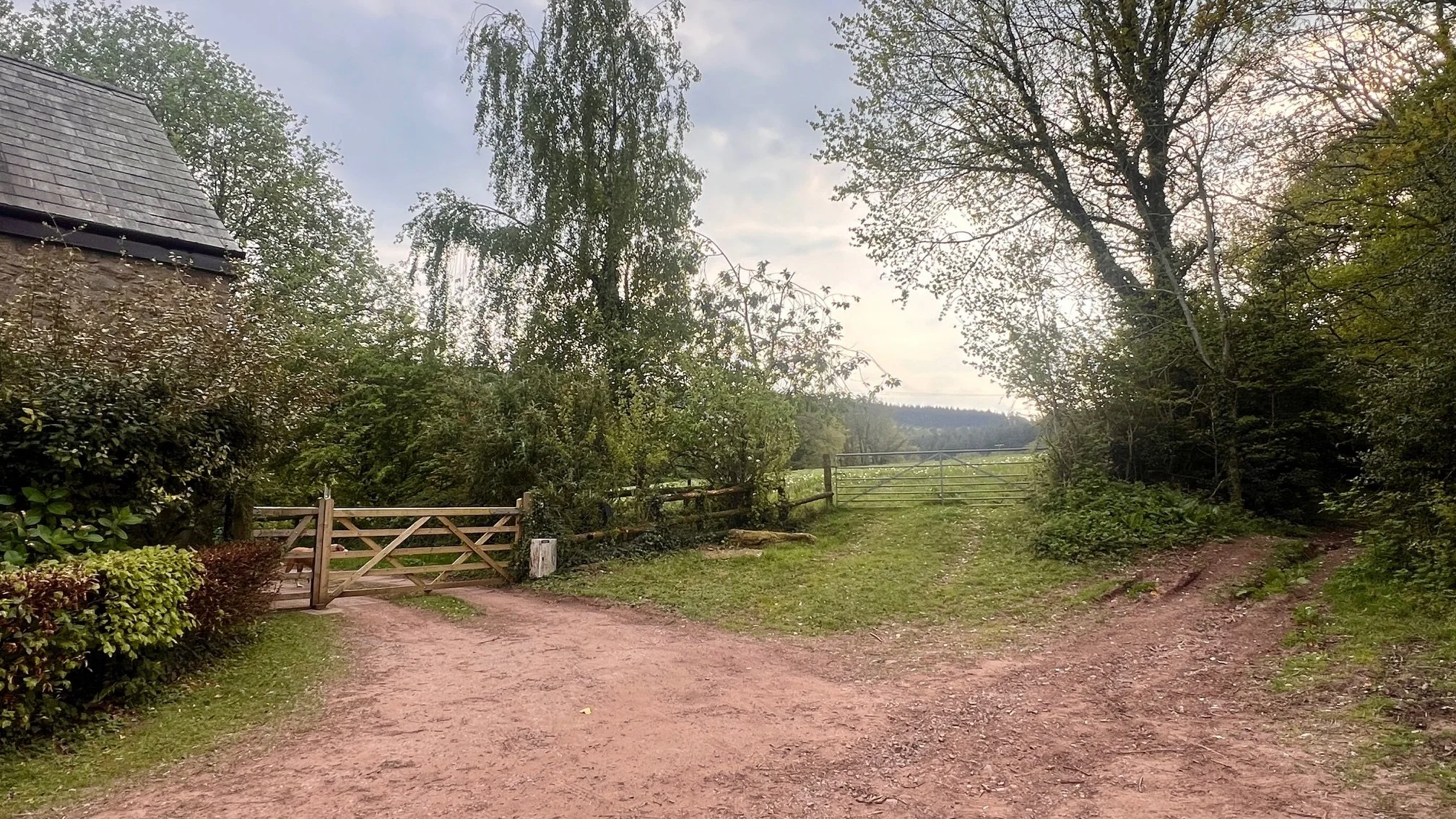
The Greenwood gateway, where a sheltered lane, open pasture and wooded bank meet. Its importance lies less in the gate than in the routes converging around it.
Using a Blink Camera to Monitor Wildlife
I installed a small Blink Wi-Fi security camera low along the fence line and connected it to a simple solar panel. This was not a conventional trail camera. It was designed for home security, but its motion detection, infrared night recording and wireless connection made it useful as a remote wildlife camera at a site within Wi-Fi range. When the camera detected movement, it sent a short video clip back to the house. I could see what was visiting from the sofa, or check the recordings the following morning, without repeatedly walking down to the gateway and adding more disturbance.
I’ve used them multiple times, in multiple locations, and have found them a useful tool where you have the luxury of a WiFi network.
There are limitations. A motion-activated clip is only a fragment of what happened. An animal can pass outside the detection area, enter the frame after the recording has started or remain after the clip ends. The camera also uses infrared illumination at night. That is far less intrusive than arriving with a bright torch, but it would be wrong to claim that the camera was invisible to every animal or had no possible effect on behaviour.
Using a remote camera does not remove me completely. I still had to install it, check the area and place food. Each visit added scent and disturbance, even if it was considerably less than sitting beside the gate for hours.
So the footage was evidence, but it was never a complete record of everything taking place around the junction.
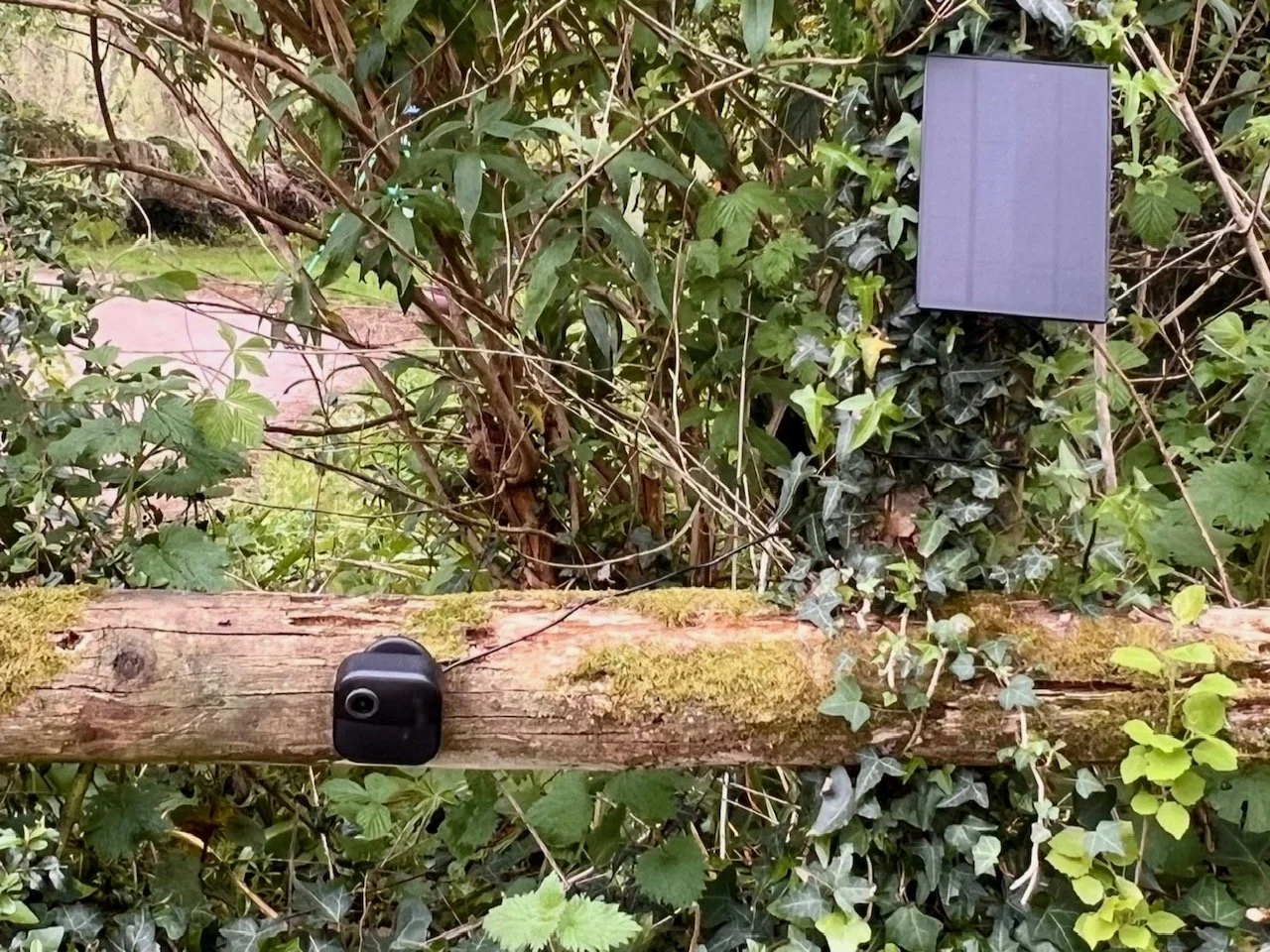
The Blink camera in its original position. The angle covered the gateway well, but the clip had no independent tether if the camera was knocked free.
The First Badgers Recorded at the Gate
The first regular badger recorded was a female. She generally appeared during the early hours and moved with a steady, deliberate rhythm. When she stopped to feed, she sometimes stayed within the camera’s view for ten or fifteen minutes before slipping away again.
A larger male began visiting on subsequent nights, often rather earlier in the evening. He sometimes returned more than once, and on several occasions both animals fed within the same small patch of ground.
There was no obvious aggression between them during those shared visits. The female occasionally appeared to adjust her position around the larger male, but that is as far as I can take the observation. A handful of short clips cannot establish a lasting dominance relationship between two badgers. What the recordings do show is that they tolerated one another at close range while feeding.
Badgers were not the only animals using the junction.
Fallow deer travelled along the lane, sometimes alone and sometimes in small groups. On several recordings, a feeding badger became alert or withdrew when deer approached closely. The clips do not prove that badgers routinely avoid fallow deer, but they show that the arrival of a much larger animal could interrupt use of this particular patch.
Foxes were more cautious. They tended to remain closer to the cover of the lane when a badger was present. On one occasion, the male badger actively drove an approaching fox away.
This was the point at which the project became more interesting. I had started by watching badgers, but the camera was revealing a small area of shared nocturnal space. Badgers, deer and foxes were all using the same junction, yet they did not use it in the same way.
The Blink system allowed me to observe behaviour from the comfort of my sofa, regardless of which species visited the gateway.
Had I Found a Badger Route, or Created a Feeding Site?
There was an obvious complication. Each evening, I placed a couple of handfuls of shelled peanuts on the grass outside the gate. The intention was modest: give animals already passing through a reason to remain within the camera’s view for long enough to record their behaviour. But modest feeding is still feeding. It changes the situation.
The peanuts almost certainly increased the amount of time some badgers spent in front of the camera. They may also have affected how frequently they returned, or encouraged them to approach that exact patch rather than continue along another part of the lane.
The tracks, hairs and thermal observations showed that badgers were using the wider area before the monitoring began. What the camera could not tell me, while food was consistently present, was how much of the recorded pattern belonged to the junction and how much I had created myself.
There were at least three plausible explanations:
1. The gateway was already part of an established route and the peanuts merely prolonged visits that would have happened anyway.
2. Badgers naturally passed the junction but returned more frequently after discovering a reliable food source.
3. Feeding changed both the frequency and duration of visits enough to create a pattern that would otherwise have been much less obvious.
I could not choose between those explanations from the footage I had. That was the reason for planning an experiment rather than simply continuing to collect attractive clips.
The Experiment I Intended to Run
My original plan was to feed at a low level through May, remove the food during June and July, and then resume feeding in August. Each visit would be logged by time, duration, species, individual identity where possible, behaviour and direction of travel. I also recorded obvious disturbances and environmental conditions.
The question sounded simple enough: “Were the badgers using this place because of its position in the landscape, or because I was putting food there?”
The more I considered the method, however, the less clean that comparison became.
May with food, June and July without it, and August with it again would not isolate the effect of feeding. Night length, temperature, rainfall, vegetation, farming activity and natural food availability would all change across the same period. The badgers’ own ranging and social behaviour might change too. If visits declined in July, I could not safely conclude that removing the peanuts had caused it.
That weakness could have been reduced by alternating shorter periods with and without food within the same part of the season. Before I could redesign the study properly, something rather more decisive happened to the camera.
When Cattle Ended the Study
Some cattle escaped from the adjoining pasture and entered the lane. One of them knocked the Blink camera from its mounting clip. Once it had fallen to the ground it was trampled, and it never worked again.
That brought the planned comparison to an abrupt end.
The surviving footage was not worthless. It documented at least two badgers repeatedly visiting the junction, showed foxes and fallow deer using the same space and captured several interactions between them. It confirmed that this was a productive place to monitor. What it did not provide was a complete period with food followed by a comparable period without it. There was no honest way to use the remaining clips to answer the original question.
This is where wildlife monitoring can become deceptive. Once you have hours of footage and several memorable encounters, it is tempting to build a confident explanation around them. But an engaging story and a tested conclusion are not the same thing.
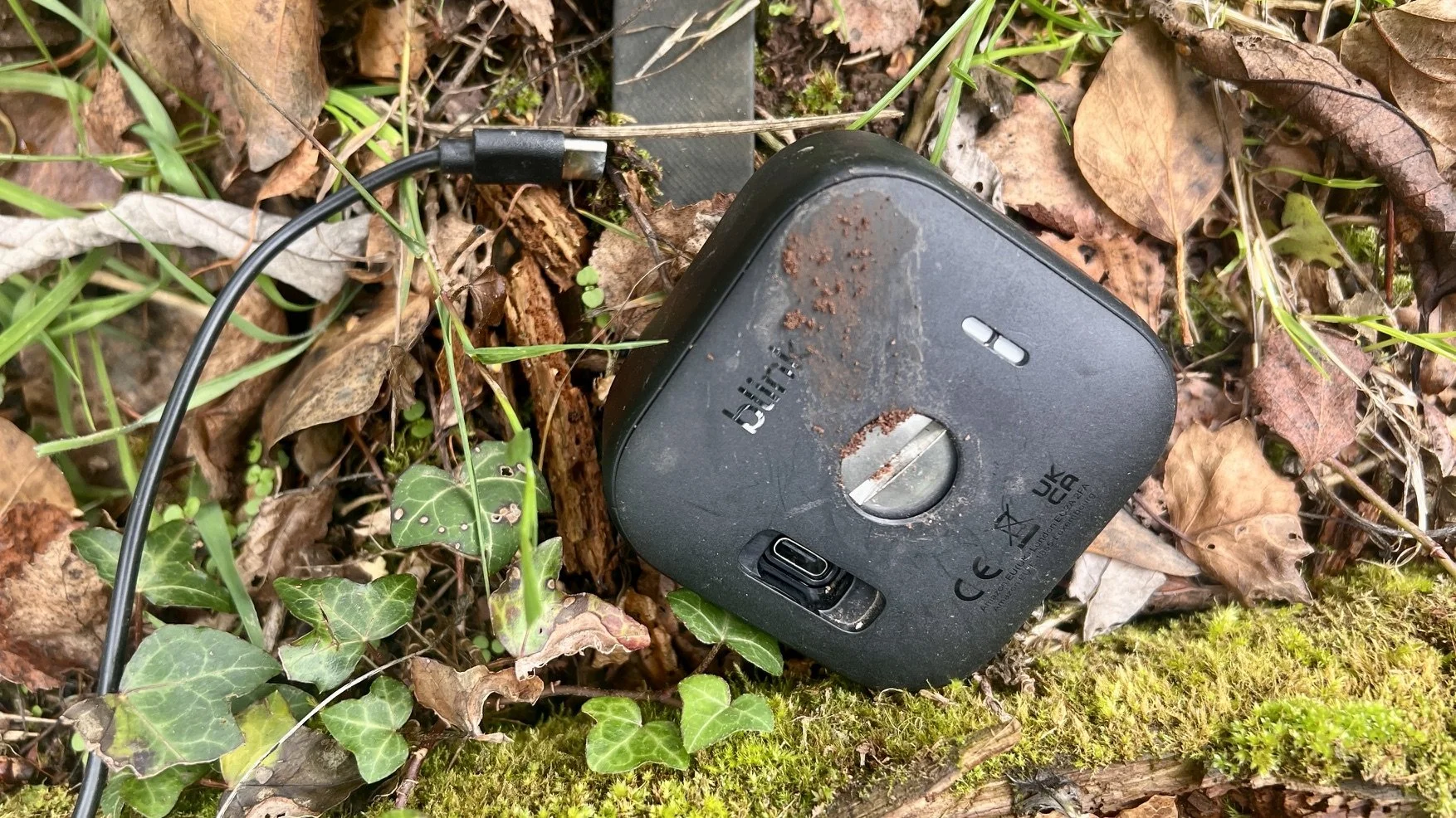
The camera and clip photographed after recovery. Cattle entering the lane knocked it from its mounting, after which it was trampled and stopped working.
What I could reasonably conclude
At least two recognisable badgers repeatedly visited the monitored area.
Badgers approached and left through the wider junction rather than simply appearing at an isolated feeding point.
Foxes and fallow deer also used the same confined area.
Some close encounters with other species changed the badgers’ immediate behaviour.
The peanuts held badgers in front of the camera during at least some visits
What remained unknown
How often badgers would visit the gateway without supplementary food.
Whether feeding increased the number of visits or mainly lengthened them.
How consistently the route was used across different seasons.
Whether weather or light reliably affected the timing of visits.
Whether the apparent differences between the male and female reflected a wider social relationship.
The broken record does not allow those gaps to be filled by inference. They remain unanswered questions.
What the Failure Taught Me About Remote Wildlife Cameras
There was nothing sophisticated about the failure. The battery had not run down, the wireless connection had not dropped and the electronics had not developed an unexplained fault. The camera was simply mounted in a place where an animal much larger than a badger could knock it to the ground.
I had thought carefully about the view, detection area and likely direction of travel. I had not thought hard enough about what else might enter the lane. That produced several lessons I will carry into future remote-camera projects.
Assess everything that can use the site
A gateway beside pasture is exposed to different risks from a secluded woodland path. Livestock, farm vehicles, gate maintenance, people and dogs all matter, even when none is expected during a particular week. The target species is only one part of the site assessment.
Give the camera a second attachment
The clip was both the working mount and the camera’s only means of retention. Once it failed, the camera fell directly into harm’s way. A separate tether or locking cable might not prevent an impact, but it can stop a dislodged camera reaching the ground.
Protect the camera without ruining the view
The most convenient angle is not necessarily the best long-term position. A slight change of height, a recessed mounting point, a solid post or a protective housing may reduce the risk while preserving the important part of the frame.
Count functioning camera time, not calendar time
A camera left outside for 30 days has not necessarily collected 30 days of evidence. Batteries fail, lenses become obscured, cameras move and memory cards corrupt. Only periods during which the camera was operating and correctly aligned should count as valid monitoring effort.
Assume something will eventually go wrong
Remote cameras are left unattended because that is their purpose. It is therefore worth planning for predictable failures before walking away: vegetation moving in the detection zone, water ingress, battery exhaustion, false triggers, card problems, theft, livestock and physical displacement.
The camera is a tool for collecting evidence. It is not the evidence by itself, and it is certainly not the whole study.
Why I Am Waiting Until Spring 2027
I considered restarting the monitoring this autumn. The equipment problem can be fixed, after all. But an autumn-to-winter study would introduce a new set of seasonal changes and would not repair the missing spring and summer comparison.
Badgers remain active during winter, but their emergence, ranging and feeding can vary with weather and natural food availability. If activity changed while I was also adding or removing supplementary food, I would face the same problem as before: two possible explanations changing at once. I will therefore treat spring 2027 as the beginning of a new study rather than an extension of this interrupted one.
The replacement camera will sit outside the likely livestock contact zone on a stronger mount, with an independent safety tether. I will begin with an unfed baseline, then alternate fixed periods with and without a measured amount of food within a narrower seasonal window. It will still be a small field investigation, not a controlled scientific trial, but it should remove the most obvious weakness from the original plan.
I will also distinguish between an animal passing the junction and one stopping to feed. That difference may prove more revealing than the raw number of recordings. If similar numbers of badgers pass in both conditions but remain longer when peanuts are present, the food is affecting visit duration rather than creating the route. If the number of passes changes as well, the interpretation becomes more complicated.
Direction of travel, visit length, identifiable individuals, weather, disturbance and confirmed camera-operating time will all be recorded again.
What the Greenwood Gate Has Revealed So Far
The original question remains unanswered. I cannot yet say how much of the activity at the gate would have happened without supplementary feeding.
What I do know is that an apparently ordinary gateway sits within a wider pattern of animal movement. Tracks, hairs, thermal observations and remote video all point in the same direction. Badgers use the area repeatedly. Foxes and fallow deer share it, although not always comfortably, and each species responds differently to cover, open ground, food and the arrival of another animal.
The project also exposed the limits of watching wildlife through a remote camera. It extends observation well beyond the hours I can spend outside, but it does not remove uncertainty. The recordings are fragments. Feeding changes behaviour. Equipment can move, miss events or fail altogether. Every conclusion depends on understanding not only what the camera recorded, but what it might have missed and what I changed by putting it there.
I would have preferred a neat result. Instead, the camera ended up underneath a cow! That failure is still part of the fieldwork. Pretending otherwise would make the story cleaner, but the evidence weaker. For now, the conclusion is deliberately limited:
“The evidence identified a wildlife junction worth studying. It did not yet explain it.”
The monitoring will begin again in spring :-)
Explore More…….
Animal Trails & Wildlife Pathways: How to Read Them
Eyes in the Woods: Mastering the Use of Trail Cameras for Wildlife Watching and Photography
……….Back to the Photography & Gear Hub
Frequently Asked Questions
Can a Blink security camera be used to watch wildlife?
Yes, where the camera has a reliable Wi-Fi connection and suitable weather protection. A motion-activated Blink camera can send short wildlife clips directly to your phone, making it useful around gardens, gateways and buildings. It is not a conventional trail camera, however, and its dependence on Wi-Fi, triggered clips and cloud or local storage makes it unsuitable for some remote sites.
Do badgers use the same routes every night?
Badgers commonly reuse established paths, but they do not necessarily follow exactly the same route every night. Weather, disturbance, seasonal food and the behaviour of individual animals can all affect their movements. Repeated tracks and camera records are much stronger evidence of regular route use than a single sighting.
Does putting food in front of a wildlife camera invalidate the footage?
No, but it changes what the footage can demonstrate. Recordings made around food can still show identity, interactions and behaviour at the feeding point. They cannot automatically be treated as evidence of how long an animal would stay, or how often it would visit, without that food. The feeding needs to be disclosed and considered when interpreting the results.
Can an interrupted wildlife-camera study still be useful?
Yes, provided its limits are reported honestly. Surviving footage may confirm presence, identify individuals or reveal particular behaviours even when equipment failure prevents the planned comparison. It should not be used to answer a question that requires the missing monitoring period.
How should a remote wildlife camera be protected around livestock?
Position it outside the likely contact zone, use a robust primary mount and add a separate safety tether. A protective housing may limit damage, but good positioning is the first defence. Where livestock or farm access is possible, those risks should be considered before the camera is left unattended.